Showing posts sorted by relevance for query selvedges. Sort by date Show all posts

Tuesday, June 7, 2022

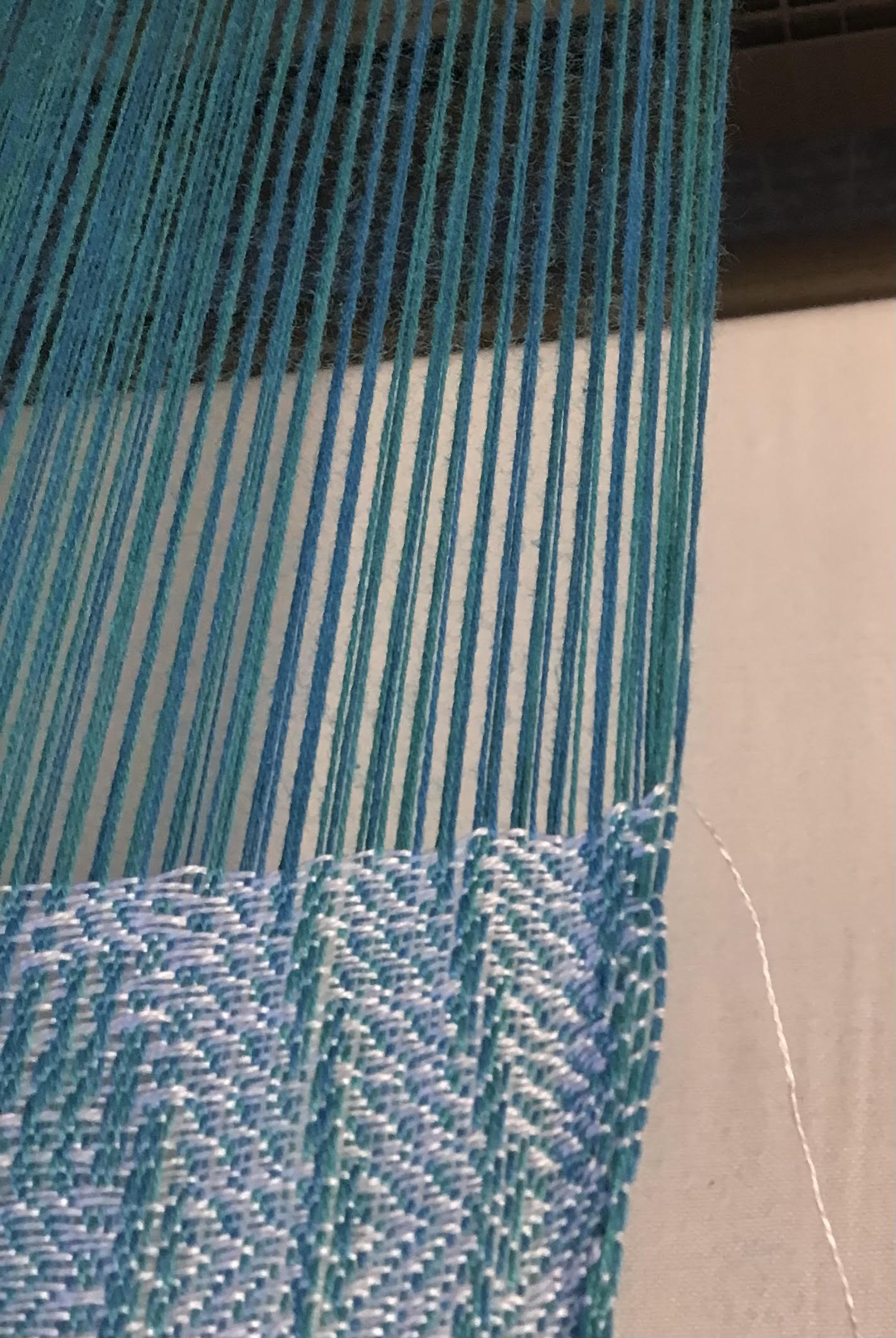
Selvedges

 The bugaboo of so many weavers - their selvedges.


2:2 twill


16 shaft 1:3-3:1 twill


16 shaft fancy twill

New weavers will often times get tangled up in the fact that their selvedges are not 'perfect'.  They hear that there *must* be a plain weave interlacement at the selvedge or it's 'wrong'.  Or that there cannot be any draw in.  Or you have to pluck your selvedges (and then wonder why the selvedges break).  Or you can't possibly get good selvedges if you don't have a floating selvedge.  Or use a temple.  Etc.

Sometimes people will ask on a group how to get 'perfect' selvedges.

Sometimes I'd like to just point them to the thousands of words I have already written on the subject.  Because just like with everything about weaving, the reason why selvedges are 'bad' depends.

There are multiple reasons for selvedges to be 'bad'.  And new weavers who don't understand this want a magic potion solution.  There isn't one.

Getting 'good' selvedges doesn't depend on one answer because there are multiple causes.

Sometimes it's the yarn.  An elastic yarn will behave very differently from an inelastic one.  What process does the person use?  How consistent are they in applying it?  Do they understand the role of tension in warp preparation?  Or in the weaving of their cloth?

So if they don't give an example of how their selvedges are 'wrong' there isn't much I can say other than play 20 questions with them.  Or point them to my previous writing.  Or my bookOr my on line classes.

So, to new weavers who are having issues with 'bad' selvedges?  Pay attention to what you are doing.  Then, one by one, try different solutions.  Perhaps the warp was beamed with too little tension.  Or you are weaving with too little tension on the warp.  Or too much.  Or too much draw in.  Or not enough.

Or, or, or...the list does go on.

Sometimes the solution to 'bad' selvedges is in dressing the loom in the first place.  So it doesn't matter what you do while you are weaving.  You have to FIX THE PROBLEM THAT IS CAUSING THE ISSUE in order to get different results.  Applying 'bandaid' solutions won't always work because the problem happened before you started throwing the shuttle.  Sometimes it is the throwing of the shuttle.  And on and on.

If you don't want to pay someone for their expertise there are plenty of weavers who have written extensively about this issue - because it keeps being a problem.  I've linked some of my blog posts on selvedges in the first sentence of this post.  You can read what I've written here for free.

But each person must do the work of figuring out what is happening, then changing what they are doing to solve the problem.

A lot like life, honestly.

(Other 'experts' you might like to pay attention to:  Jane Stafford, Janet Dawson, Jette van der Meiden - spelling may not be correct, sorry), Peggy Ostercamp.  Each of us has unique experiences and may have different solutions to try.  Because we weave different things and have different perspectives.  Above all keep trying.)


Saturday, November 20, 2010

Results


a fan of scarves showing my selvedges....click on the image for an enlargement


People quite often exclaim over the straightness of my selvedges. They want to know my secret, or assume that I must have some trick up my sleeve for getting ruler straight selvedges (most of the time, depending {there's that word again} on weave structure and yarn).

The secret to getting straight selvedges is no secret at all. Or at least, I've not kept how I do what I do a secret. I've been active on the internet since 1994 (anyone remember bulletin boards and usenet groups?) telling people what I do and how I do it. (Check the labels here or my You Tube channel for video clips.)

The 'secret' to getting good selvedges is learning the physical skills that need to be utilized and using 'good' tools/processes.

What those tools are will depend on the individual - their physical size, their personal hand/eye co-ordination, their equipment.

But to gain proficiency at something like weaving or any other skilled craft, the practioner must understand the essential theory behind what they are doing, be analytical about how they are doing it, and practice, practice, practice with a self-awareness of what they are doing, gauging the success of their results and tweaking their processes, sometimes changing their tools for ones that will work better for them.

Instead they rely on what I call 'magical thinking' - if I use this trick or this tool I will magically get good selveges without my having to do anything else.

Getting good selvedges requires a succession of steps, any one of which if not done well, will lead to poor selvedges.

First you must beam the warp well and under tension. The longer and wider your warps, the more crucial this step becomes. If your warp is 'cigar-shaped' on the back beam, you will have problems with your selvedges. (Unless you build that shape properly so that the outside threads don't slide off causing them to be shorter than the middle ends.)

A short narrow warp simply doesn't have the length and breadth to show poor beaming techniques because it's all too soon done. So a weaver who has consistently woven short (less than 5 yards) and/or narrow (less than 15 inches wide) warps who decides to put on a longer/wider warp will suddenly run into problems that s/he has never experienced before and cannot figure out what went wrong. They've been weaving for years and never had the problem before, after all!

A weaver should know how to hold and throw the shuttle efficiently. I know, I know, many people aren't interested in being efficient. What these people don't realize is that holding and throwing the shuttle efficiently simply means that you are doing this process in a way that will lead to good selvedges and a good consistent beat. In other words, they will get a better quality cloth.

Some people don't even know that there is an efficient way of holding and throwing the shuttle. I so often see shuttles being thrown (or should I say shoved) 'backwards' or even upside down. When I mention this to the weaver I generally get a blank look and a response of "I didn't know there was a 'right' way to hold the shuttle."

Again, if the weaver is only weaving on a narrow warp, how s/he holds the shuttle doesn't matter as much as when they try to weave a wider warp.

I watched a sheep to shawl demo one time where the weaver held the shuttle 'overhand' which meant she could not get the shuttle from one selvedge to the other as it could only travel 3/4's of the way across the web which meant that she was reaching into the shed to retrieve it. The net result of this? The handspun alpaca warp was stretching at the selvedge and I could see that the selvedge was starting to pull apart from the repeated stretching and abrasion due to fishing the shuttle out of each shed.

Over and over again I read/hear people being advised to leave sufficient slack on the weft. This is absolutely true - as far as it goes.

But over and over again I see weavers leave a nice lovely angle on their weft pick and then as they beat they pull the hand holding their shuttle towards their body which effectively shortens the weft pick and results in excessive draw in. And they get frustrated because they don't realize what they are doing and continue to do the same thing. Or they make longer and longer 'bubbles' in their weft which results in loops forming at the selvedge which in turn results in loose selveges ends and then..........poor selvedges.

Since I have begun having private students come to learn how to weave I have been delighted that they all appear to be 'natural' weavers achieving good selvedges on their very first sampler. It occured to me during a recent bout of insomnia that perhaps in addition to being naturally adept they are also benefitting from my tutoring. They are learning from the get-go how I hold and throw the shuttle and they are very quickly achieving selvedges that are generally consistent and pretty straight right away.

Ultimately if a weaver is happy with their results there is no need for them to change what they are doing. If they are not happy with their results, perhaps a good analytical look at how other weavers achieve their results will get them closer to the results they desire.

For a complete look at what I do and how I do it, CD Weaver III pretty much sums up everything I do except for how I now sley the reed. Since I've posted extensively on that technique (learned from Syne Mitchell who learned it from Peggy Ostercamp) I don't feel the need to upgrade the cd for that technique.

My advice? Get Peggy's new book and look at how she does what she does. Or buy CD Weaver III and try out a few of the things I do and see how they sit with you.

Christmas is coming - ask Santa for either of these resources and be open to trying something different if you aren't happy with your results.

(CD Weaver III is $60 on my website - if you order before Dec. 6 I'll include the sample packet set for free - this combination is $75.00 plus shipping on my Art Fire store.)

Saturday, February 18, 2012

Selvedges Are Over Rated?

So this is what my right hand selvedge looks like on this fabric.  You can clearly see the pale green weft being carried up the selvedge and weft tails hanging out.

Does this bother me?  As I said in my previous post, the selvedges are going to be cut away in the end, so no, they don't bother me in the slightest.

For many years I wove yardage for a fashion designer who cut the fabric to sew her garments.  Did she care about the selvedges?  No.  What she cared about was that I wove the cloth as quickly as possible so that the cloth would cost as little as possible.  Since the time a weaver puts into the weaving is the largest part of the investment in hand woven cloth, every little time saving process I could institute was more money in her pocket at the end of the day.

I think that hand weavers get obsessed about selvedges because by and large most weavers do not cut up their fabric so their selvedges are there for all and sundry to see, not just themselves.  Selvedges are therefore an integral part of their cloth and so they want them to look 'perfect'.

As I've posted before, getting good selvedges is not a one-tip-fixes-all kind of thing.  There are several factors that play into getting good selvedges.

1.  Beam the warp under consistent tension using good packing materials.  Make sure the warp is cylindrical, not cigar shaped.  If the tension is too loose and packing material is not used, upper layers can cut down into lower layers causing all kinds of havoc during weaving resulting in poor weaving tension, not just at the selvedges, but within the body of the cloth.

2.  Try to be consistent about using the correct amount of tension for the yarn being used.  Too loose and selvedges will draw in, usually inconsistently.  Too tight and selvedge ends may break.

3.  Do not weave too close too the beater/reed.  As the fell approaches the reed the angle the warp threads open at becomes more acute putting stress on the threads and usually results in either broken threads or loops at the selvedge.

4.  Wind your bobbins well.  So many weavers have never heard of winding a bobbin by building up a 'hill' at one flange, then running the weft over to the other flange and building up a hill there, and only then filling in the valley between.   If this is not done the bobbin will jam in the shuttle cavity causing pulls at the selvedge and even broken selvedge threads from the repeated stress of the jams.

5.  Leave a good angle and ensure that the weft is not 'locked' into the opposite selvedge - make sure the weft is loose in the shed when beating to ensure the weft can take up and not cause excessive draw in.

6.  Be consistent advancing and tensioning the warp.  (See #2 above)

7.  Be consistent in beating.

Review my video clips on You Tube for bobbin winding and shuttle throwing/handling.
Laura's You Tube Channel
Currently reading Ian Rankin's latest - realized I'm running out of time before I leave so I'm going to read the two books I'm most interested in.  The others can be taken out of the library when I'm home again.

Sunday, July 13, 2025

Selvedges

Selvedges  (click on word for all 21 posts written under that label)   


Someone asked about my selvedges in the previous post - it appeared that the selvedge thread was not 'attached' to the cloth well (I paraphrase).

It's true.

I don't always have a selvedge that has a 'firmly attached' selvedge thread.  In the above photo, I do - it's a 2:2 twill, and no, it doesn't have a plain weave selvedge, but a two thread 'float' - because it's a twill and the weave structure has 2 thread floats in it.

I could have left a comment without much of an explanation, but...I'm me, and not much given to short answers.

I have had a lot to say about selvedges over the years.  If I've done it properly, the title of this post is a link to the 21 posts I've written for this blog all by itself (up until this one).  Usually I tend to just address one aspect of a complex topic per blog post, then label them with the subject as in 'selvedges'

I've also discussed selvedges in The Intentional Weaver, and again in Stories from the Matrix, both available from blurb.com

Selvedges are also discussed in my online classes.  And I've certainly said lots on online groups over the years, and had plenty of people tell me I should not talk about what I do because I am doing it 'wrong'.

Plain weave selvedges.  No.  I don't do that.  If a plain weave selvedge is used on a weave structure with fewer interlacements, the selvedges will take up at a different rate.  This can (and in many cases will) cause tension issues at the selvedge.  The selvedge has to be compatible with the weave structure being used.  Or accommodations need to be arranged.

Floating selvedge to create a plain weave thread at the outer edge.  For a number of reasons, no, I don't use them.  *IF* I were to encounter a situation that seemed like it required one, I do know how to do them, and would.  But I've been weaving for 50 years and so far...no.

The point where I change the length of the selvedge thread varies, usually on the fineness of the thread.  The maximum 'float' length I will use is generally in the 5-7 range, have rarely but sometimes have done 9.  It depends on what I'm making, too.  For a tea towel, my 'standards' are less stringent than for, say, a table runner.

Do I have ruler straight selvedges?  Sometimes.


Decided to 'prove' it one day by laying a ruler alongside the selvedge.  The shine off the metal ruler makes it look a bit like the selvedge isn't straight but it is a trick of the light.  

When I'm weaving the large fancy twills, the selvedge may shift, depending on which direction the twill line is running.  


Where the twill line points back into the cloth /\ the cloth can retreat; when the twill points away from the centre of the cloth \/, it can to tend to expand outwards.  It's subtle.

Another thing that happens is that when weaving a 'fancy twill' where the twill structure is not 2:2 but other variations, the cloth with more weft showing than warp will tend to have a selvedge that curls up and in; when more warp than weft is showing, it will tend to curl down and in.

Hard to see this effect in the photo, but it happens.

If you want more detail, check out the other 21 articles I've posted here.  You don't have to agree with me.  You must do what you feel is 'best'.  Having as many different tools/techniques in your toolbox as you can will allow you to pick and choose what is the best way to approach an issue if you aren't happy.  

Tuesday, January 26, 2010

Selvedges


Selvedges.
Such a fuss about selvedges at times.
What I've found over the years is that there is no one thing that will guarantee good selvedges.
First of all, the warp must be evenly wound onto the beam with good tension. If it isn't, selvedges are likely to be terrible. The warp must be well packed too. A cigar shaped warp will mean poor selvedges. I use bamboo blinds between layers of the warp on the small loom. On the big loom with the sectional beam, each section is wound under tight tension so that threads cannot cut down into lower layers.
A good rule of thumb is that the warp should have equal to or slightly greater tension as it is being beamed as will be applied during weaving. It can be a little less, but any slack left in the warp as it is beamed may show up in the woven cloth in the form of uneven fell line, uneven beating, excessive draw in or poor selvedges.
The weaver must then throw and catch the shuttle well, leaving a good angle on the weft and not trapping the weft into the opposite selvedge with too little slack on it to allow it to seat properly into the cloth.
Watch my videos (click on video clip label below) for hints and tips on how to hold, throw and catch the shuttle.
Adding a plain weave selvedge to a weave structure with much fewer interlacements will make a smily fell line - unequal build up of the cloth at the selvedge. This will result in bad selvedges.
A floating selvedge is not necessary when weaving an ordinary fabric. A float length of 2 or 3 picks at a set of 24 epi/ppi is not going to result in a poor selvedge.
Picking at the selvedge will just elongate the yarns, resulting in worse and worse results. Don't touch them (unless the weft gets jammed, as with the pesky linen, and then don't pluck the warp threads but open the shed releasing the trapped weft as I showed in a previous post).
Keep your hands out of the shed. Shoving your hand and arm into the shed at regular intervals will elongate the threads causing uneven tension - and poor selvedges.
Currently reading What Remains of Heaven by C. S. Harris

Monday, August 7, 2017

Self edge


Selvedges.  So many opinions.

In order to get 'perfect' selvedges you must use a floating selvedge.

In order to get 'perfect' selvedges all you need is an end feed (or delivery) shuttle.

In order to get 'perfect' selvedges you must have a plain weave interlacement, regardless of the weave structure of the body of the cloth.

Well, those things are all well and good if they actually address the issue of the 'poor' results.

There are so many ways selvedges can go wrong.

Beaming.  In my experience a warp weaves off much more nicely if it is beamed under tension - at least as much tension as will be applied during weaving.

Warp packing.  In my experience warp packing should be firm enough to prevent threads from upper layers from cutting down into lower layers.

In my experience warp packing should be several inches wider than the warp to prevent ends from sliding off the warp packing and causing issues with different length/tension from the rest of the warp.

In my experience tensioning the warp as consistently as possible makes for better selvedges and body of the cloth than being wildly inconsistent.

Shuttle handling.  In my experience I get more control over the weft pick by holding the shuttle cradled in my fingers, not gripped from above.

So in the above photo, the edge of the beige is, in fact, the selvedge.  The weft is a reasonably smooth yarn, so all in all, it makes a nice tidy consistent selvedge.  But I get pretty much the same result with a 2:2 twill selvedge.


And no, I don't worry about a 2 thread float.  I don't even particularly worry about a 3, 4, or 5 end float.


The above photo is 1:3-3:1 twill blocks.  No the selvedges aren't ruler straight, but the cloth is 2/16 cotton for the warp and weft as 32 epi, 32 ppi.  The length of float isn't a problem.  To me.  Your mileage may vary...

Currently reading Martha Grimes Vertigo 42

Monday, December 27, 2021

Liminal


lim·i·nal
/ˈlimənl/
adjective
TECHNICAL
  1. 1.
    relating to a transitional or initial stage of a process.
  2. 2.
    occupying a position at, or on both sides of, a boundary or threshold.


Weavers think a lot about selvedges.  Some of us actually obsess about them.  Are they perfect enough?  Are they straight enough?  Does every selvedge require a floating end in order to create that 'perfect straight' edge?

Other definitions are about ambiguity.  There doesn't seem to be much ambiguity about a selvedge.  It's very definite about being the end of the cloth, surely?

But if you consider that the term also relates to being at the edge of a boundary, is there anything more liminal that a selvedge?

At each edge the shuttle returns to the other side with each pass.  So the shuttle makes that transition from going one direction, then abruptly going the other in a process that takes the entirety of the warp to complete.

The more I think about ambiguity in weaving, the more I see it and coming across the term tonight as I began reading Victoria Finlay's new book Fabric, a few things began come together for me.  

Selvedges are not the only measure of the worthiness of a cloth.  It is what happens between the selvedges that is the important part of any cloth.  The selvedges just define the space of cloth/not cloth.

And yes, they must be crafted in such a way as to protect the cloth, to assist it in doing the job it is meant to do.  

What I have found is that if I pay attention to what I am doing to make the cloth as a whole, the selvedges tend to take care of themselves.  If my cloth has a 5 end float in the centre of it, without compromising the cloth's ability to do it's job, that five end float at the selvedge is not all that important.  It is not the number of ends in the float but the actual length.

In other words a five end float in a cloth that is 45 ends/picks per inch, the actual length of that float is much less than if there are 8 ends/picks per inch.  So I don't fret about how many ends are floating at the selvedge.  I don't force my selvedges to have a plain weave interlacement.  Plain weave will take up differently than other weave structures and can actually not improve the situation.  A floating selvedge is not necessary if you are weaving plain weave.  Unless you want one.

If you do, use them.  But sometimes I think weavers put way too much emphasis on things that are liminal - transitional - ambiguous.  

When I teach, I hope that I can convey to people all the different ways we can approach weaving.  How when you change one thing, everything can change.  How valuable it is to have multiple tools in your toolbox.  

And yes, pay attention to the details, but not at the expense of the whole cloth.

Give yourself the grace of being imperfect, but still worthy.  Still valuable.  Still functional.  Keep learning.  Keep trying.  Keep weaving, even when things aren't 'ideal' or 'perfect'.

Leonard Cohen said it 'best':  Forget your perfect offering.  There is a crack in everything.  That's how the light gets in.


Monday, August 5, 2013

Monday Rambles


When I published Magic in the Water, I realized I would need to attend fibre events in order to show people the book in order to sell it.  Since having just one item to sell wasn't going to pay the expenses of renting a booth space never mind travelling to get to the event, I decided to sell yarns as well.  I tried very hard to stock yarns that other vendors did not carry.  Which worked, sort of.  I wound up importing yarns that I thought were special and nice to weave with in hopes that others would be attracted to them, too.

In order to make my yarns even more different, I stocked a lot of hand dyed yarns, some dyed by others, some dyed by myself.


This yarn is one of the ones I imported and dyed myself.  It is a 2/20 silk, quite nice, dip dyed variegated.

After going through not one but two major (and not a few minor) health issues, I decided that now I was in my 60's I needed to stop doing so many things.  It was taking up far too much time, space and budget to order in cases of yarn, skein it off, dye it, attach labels, store it and then schlep it across the country in hopes people would buy.

So for the past week Doug has been turning these skeins into coned yarn.  Because in order to weave with it, it needs to be taken out of skein form into something more efficient.


This is the 3rd bucket he is starting to fill and there are enough skeins for at least two more.  That's a lot of silk scarves coming up!

And once gain the issue of selvedges has raised it's head on one of the chat groups.  If you want to know my thoughts on selvedges click on the label to the right hand side.

But here are a few shots of some of my textiles and their selvedges.  All of them are some sort of twill and none of them have been woven with a floating selvedge or an end feed/delivery shuttle.


It is not necessary to use a floating selvedge to get a 'good' selvedge.  As I've posted before selvedges are not that simple.  While some people may find that they get better results with them than without them, they are not 'necessary'.

As always, if you use them and like them, carry on.  If like me you don't, try to find out why your selvedges are not good and then fix that problem (or problems).

Sunday, July 21, 2013

Selvedge Subtlety


 cloth winding onto cloth beam in a spiral


Sticks inserted to provide support for the cloth

The painted warps are 10.5 meters long, yielding 4 scarves.  Apparently I did a sloppy job somewhere along the line getting this one into the loom.

A) the reed slipped sideways as the warp was winding onto the warp beam
B) I tied the warp off centre at the beginning
C) Both of the above

With the cloth winding onto the cloth beam in a spiral the right selvedge is hanging free over nothing but air.  This means the cloth is curving downwards because there is nothing to support it and the right selvedge is beginning to loosen.  (Could not show this in a photo.)

There are two things that can be done to fix this problem.

A)  Cut off what has already been woven and re-tie.

B)  Insert sticks to provide a solid foundation for the cloth to wind onto.

Since I am half way through scarf #3 cutting off is not an option, so I simply inserted sticks as I continued to roll onwards.

There are two other situations where inserting sticks or cutting off are required.  (Which is why I cringe when the immediate answer to the question of poor selvedges is 'use an end feed shuttle'.  An end feed shuttle will do nothing to correct poor selvedges in the above and the following instances.)

A)  The weaver has been weaving a twill weave structure and then switches to plain weave.  Since plain weave does not draw in as much as twill, the selvedges will be hanging over open air and eventually both selvedges will loosen.

B)  The weaver changes to a thicker weft.  Again the cloth will not draw in as much as previously and both selvedges will hang over open air.

When I am switching weave structures and/or thickness of weft, I try to weave the wider cloth first.  But if that isn't possible, inserting sticks will often times do the trick.

Currently reading The Bride Box by Michael Pearce


Thursday, January 7, 2010

MI/MO


The end of Plan B and the beginning of Plan C


Larger view of Plan C - weft is a varigated cotton slub


I've said it before, and I'll no doubt say it again - one of my goals in weaving is to create the maximum amount of output for the least amount of input. Or Minimum Input/Maximum Output. MI/MO for short.

In the past, when people have asked me about floating selvedges, I rather flippantly replied "Don't use them - they slow me down."

Many people seem to get quite perplexed at this comment, asserting that using floating selvedges doesn't slow them down.

Well, that's probably because most people don't weave nearly as fast as I do. :} Not that they can't, they just probably have never been shown how to weave ergnomically and efficiently.

As I travel around the continent, I find so many people who just don't know that there is an efficient/ergonomic way to hold and throw the shuttle. Many are happy to have me demo and try it the way I do, but others are quite happy with what they are doing and continue on the way they've always done it.

As for floating selvedges, they are a tool - or perhaps I should say a technique - which is appropriate in certain circumstances.


http://www.weavolution.com/node/7250?#new

Read Bonnie Datta's post #17 for an extremely informative post on how to do a floating selvedge for a weft faced rug.

So when I say I never use a floating selvedge because they slow me down, what I am really saying is that I don't weave fabric that requires one. Because I don't want to weave slowly when I can weave quickly.

Therefore, when I'm choosing a twill I never weave huge goose eye twills. The outside threads will fall out of the fabric if you do an extended reverse twill. So, I don't. If I want to do something like a goose eye, I will thread a herringbone twill and weave it the same way - skipping a shaft/treadle when I change direction so that no threads fall out of the cloth.

To use a floating selvedge on a plain weave or even a straight twill is unnecessary. But there are those who tell me that they can't weave without one. If that's the case, they will be hard pressed to build up speed if they want to because no matter what anyone says, it still takes a moment to push the floating selvedge down so that the shuttle can pass over it, interupting the weaving rhythm and therefore reducing speed. And those moments add up.

If the weaver is trying to weave 60" in width, it will slow them down even further. And forget using a floating selvedge on a jack loom with fly shuttle. The fly shuttle doesn't know the fs is there and it will simply knock it aside, ignoring it completely.

So no, I don't ever envision myself using a floating selvedge. If I can't be perfect, I will be as consistent as I can be. I've found that being consistent, holding the shuttle as I've demo'd in other posts, will bring about good selvedges much faster than messing about with a floating selvedge.

Now stepping off my soap box..........

p.s. you can click on the second picture to check out my selvedges

Sunday, May 11, 2025

Subtle


I see so many suggestions about how to create 'perfect' selvedges.  Many of them rely on this 'trick' or that 'secret tip'.

I've been weaving for 50 years, now, and I can assure you I agonized over my selvedges.  I, too, looked for the 'magic' solution, fussed over creating 'perfect' selvedges.

But here's the thing - like everything else about weaving, selvedges are complex.  Not complicated - complex.

There are two 'sets' of threads (usually) - the warp and the weft.  And the way they weave together can change.  It can vary, even within the textile.  There are unseen forces at work that can be quiet during weaving, and suddenly - and rather dramatically - change during wet finishing.

I see people insisting that a selvedge *must* have a plain weave structure.  (No, it doesn't.)

I see people frustrated because they have loops at the selvedge, which they then pluck at and tug, which doesn't actually solve most of the problem.  It, in fact, can cause more.  It depends.  Literally.

In the above photo, you can see the selvedge.  The weave structure is in the twill family.  What may be more difficult to see is that the weave structure builds a 'wave' into the edge of the cloth so it's not exactly 'ruler' straight.  

The twill line changes direction:  /\/\/\/\

As it changes direction, the weave pulls the selvedge 'into' the cloth, or pushes it outwards.

There are 'floats' at the selvedge, but after wet finishing, they resolve and - using a fine enough thread - the length of the floats do not materially affect the cloth.

This structure also causes the selvedge to roll.  In areas where the tie up is 1:3 the cloth will roll upwards, while the areas that are 3;1 will roll downwards.

These are subtle effects that most people don't even notice when they are weaving, or if they do, they want to 'fix' them.

If you are a new weaver, I urge you to watch how experienced and proficient weavers hold and throw their shuttle.  Consider the way I do - and if you don't do it the way I do, you might want to consider changing how you hold and throw the shuttle.

You might want to pay attention to your posture and position at the loom - making sure that your loom bench is tall enough, that you are sitting (perching) on the edge of the loom bench.  I strongly suggest you do NOT sit on an ordinary chair.  Sit upright - back straight, shoulders in 'neutral', not hunched or shrugged.

Hold the shuttle in the cradle of your fingers, pushing shuttle using your index finger and catching it in the cradle of your fingers, give the weft a very slight 'tug', and make sure that the leading edge of the weft is not trapped into the shed without sufficient slack in the weft to begin the curving path through the cloth.

Still having problems?  Check your warp.  Have you beamed using tension?  Have you used a firm warp packing?  Have you tied on using about 1" worth of warp (give or take), not tied tiny bouts, or massive ones?

There are so many more things I could say about selvedges, but honestly?  I've said them over and over again.  But every day I see new weavers asking questions.  I hesitate to answer in groups because everyone gets to practice their weaving the way they want.  But if you are interested, or are trying to help someone else, I have (free) video clips on You Tube

If you are interested in this sort of information in print I tried really hard to think of all of the 'it depends' aspects of weaving in The Intentional Weaver

My online classes continue at School of Sweet Georgia  And at Handwoven/Long Thread Media

And of course I've got all sorts of articles for various magazines, including for the latest magazine, WEFT.

And of course, this blog, where I try to label each one as to content.  All you need to do is scroll down and click on the label to find the posts I've tagged on a topic.

Welcome to the wonderful world of weaving.  :)

Saturday, April 1, 2023

Under Tension


warp under tension


warp not under tension

Today is April 1, but this is not an April Fools post.

There is a lot of discussion about selvedges in the handweaving community - usually how to get 'perfect' selvedges.  But what IS 'perfect', anyway?

And how do we learn to recognize when something is good enough?  Or not?

These photos are taken on the loom and it is quite clear that my selvedges are not 'perfect'.  It was only after I took these photos and cropped them that I noticed that one pick is tighter than the rest and takes a wee notch out of the edge.  The under tension photo also shows something I mention once in a while (and there is an essay on selvedges that discusses this in greater depth, all in one place), where the 1:3 and 3:1 twill areas cause the cloth to begin to curl up or down, plus the cloth is either pushed outwards or pulled inwards depending on the angle of the twill.

But these photos are to illustrate something more subtle and you may need to click on them to see them 'better'.  As far as the wee 'notch', it will likely become a lot less noticeable after wet finishing and a good hard press.  These towels are already off the loom.

Under tension, the selvedge ends are closer together and, in fact, the selvedges look slightly denser, while in the photo of the warp NOT under tension the selvedge ends tend to relax and push apart from each other.  It is also possible to see, if you look hard, the fact that the doubled warp ends begin to have a 'saw tooth' look to them.  They are not 'smooth' but show the twisting of the doubled ends around each other.  The twist isn't a lot, perhaps one twist per inch.

/
/
/

When the warp is under tension, those twists are much less obvious (well, they are to my eye) because any slack that was in them loose, is now gone due to being tensioned.

The tendency for the threads to move to an area with less resistance is obvious when the tension is released.  When I'm weaving, it's under fairly high tension (because I prefer to do it that way) and when I ease the tension off the warp I can see the web relax and 'grow' widthwise.  When I tension the warp again, the web becomes slightly narrower.  Kind of like how we suck in our gut and stand up straight for a photo, then relax again once the photo has been taken?  

Yarns with lots of texture will be easier to weave when under tension.  When there is less 'slack' in the warp, the weft will beat in more easily and get caught less frequently on the texture of the warp.  It's one reason why I prefer to put textured yarns in the weft, when I can.  But when I can't, I want to make sure I've beamed with good tension (no slack areas in the yarn) and use good warp packing.  

When we put highly textured yarns in the warp we have to remember to adjust for that texture.  One thing to remember is to have a more open density.  A good example of this is brushed mohair.  While the core of the yarn is perhaps quite thin, if it has been brushed before being woven the tendrils of the loose mohair will grab and catch on everything within reach.  A density that would be appropriate for the core yarn will make for difficult weaving as sheds will not be clear, and the finished cloth is going to be very dense.  Sampling is critical, or following the directions of an experienced brushed mohair weaver.  It will look incredibly unstable and unsuitable in the loom, but this is a case where the weaver really has to understand what is happening and make the web so that *after wet finishing* they will get the quality of cloth they want.

I wasn't sure I should post these photos.  Perhaps they are too subtle?  But for people interested in such subtleties, perhaps they are enough to get the concept across...

Tuesday, March 27, 2018

Guest Post - Mary Lessman


There are times in my life when I know I’m one of the very fortunate. This February I got to be with Laura in Prince George. In addition to spending time with two people who seem to enjoy me as much as I enjoy them I had the opportunity to learn a lot about myself and my weaving. Laura was at the end of a warp on the AVL and offered to let me weave 2 towels. I have little experience with linen and she had a couple bobbins in a humidor so I was set.

The surprise for me weaving on the AVL was how much attention I could pay to just the mechanics. The computer keeps track of the “treadling” sequence; the automatic advance keeps track of the fell line. “All” I had to do was keep track of me. It turned out to be quite a job. Here are things I learned in the order my mind became aware of them.

·    
8    * Wear Ear Protection. This is especially necessary when working with an air assist. That baby is LOUD. It is a lesson I’ve taken home. I have a Baby Mac and have been weaving with noise cancelling headphones on and really have noticed the difference when I take them off.

·        * Keep your feet flat on the floor. On the AVL one foot presses the pedal. One foot is, if you’re me, on its toes making my calf cramp. That habit took nearly 2 hours to break. My take home is to be aware where your feet are. I’ve found there is a good resting place for the foot not treadling at the moment. I can weave longer with more comfort if I am thoughtful of my feet.

·         *A pelvic tilt helps concentrate the power in your core when you pull the beater: That baby is heavy! It’s got all sorts of add-ons for a flying shuttle (If I recall correctly it can manage 4 colors at a time) and controls the cloth advance. Laura can throw the shuttle fast enough to just let the beater ricochet its way back and forth. I’m not so fast and needed to control it on the far side of the swing. It takes a whole lot of core strength to slow it down to my speed. Keep that tilt going! It has made a huge difference in my home weaving. I maintain good posture and can weave longer and feel better all around.

·       *  Relax your shoulders. Good posture lets you weave longer.

·       * The weight of the bobbin changes the throw strength. I didn’t appreciate how much difference this makes over one bobbin. I had to change my technique as the bobbin emptied in order to have it cross the entire width of the warp and end up in my hand ready to toss back. This isn’t as noticeable with my smaller loom but really made an impression on me.

·        * Watch the angle in the shed, too much leaves loops. As I was using linen the thread itself wanted to sproing like a spring in the shed when the humidor hadn’t moistened the inner yarn on the bobbin. I would have way too much slack to lay flat. Keeping track of all the above things made watching for this fall by the wayside too many times. Selvedges suffered.

·        * A humidor is your best friend with linen. The yarn softens and turns the selvedges better.

·       *  When Bobbins are dry in the center they are harder to control. Make sure they have plenty of time to humidify.

·       *  Fixing broken threads is the same with 16 shafts as with 4. You can get good at it. It only looks intimidating. When you are getting too much experience look for a reason.

·       *  A loud, breathing, puffing, clanking machine isn’t scary when you know what makes all those sounds. It’s possible to sort out what is happening where. Knowing helps make weaving deliberate to achieve the result you are hoping for. Weave with intention. It does help the results.

·      *   Relax your shoulders. It helps you with your rhythm, Loom Music as Laura calls it. Your accuracy will follow. Eventually the speed does too.

·       * Don’t use extra motions. I thought I was holding the shuttle above the beater each time but had the time to realize I was lifting it as I was supposed to but pulling it back towards me. The shuttle wasn’t waiting in the perfect place to hit the race and make the next pick. I was using energy I could use to keep weaving. Be aware where your hands are. You can weave longer and with more accuracy.

·         *Advance the warp regularly. There is a small sweet spot. You will get better results-straighter selvedges and a more evenly beat web if you advance every inch and a half or two inches (on my Baby Mac) making the entire process more rewarding.

·         *About this time I was breaking a sweat. This weaving is work! Make sure to tighten your core and make a slight rocking motion back to beat, forwards when changing the shed. When this motion comes from your core it reduces wear and tear on your upper body. You can weave longer. I mean that both that day and as a lifetime activity.

·        * There is a rhythm that will improve your selvedges and your cloth. Throw the shuttle, beat before/as the shed closes, change shed and repeat. The yarn is free to settle into the length it needs for a repeatable length of yarn in the pick. When I would throw, close the shed “locking in” the length of the yarn and then beat, the length of the yarn changed depending on how close the fell line was to the beater and the exact angle of the thread to the fell line. My selvedges straightened right out. My friend Kaaren said it doesn’t always hold true and I plan on having a chit chat with her about that. She’s a wonderful and knowledgeable weaver too.

·     *    When something changes look for the reason. This loom has quite a learning curve and so do I. “What you don’t know you don’t know” is huge with this kind of equipment. Why were the warp threads breaking? Why was the fell line changing (I forgot to reengage the gear of the advance mechanism after I fixed a broken thread. Laura had warned me.)

·      *   Distinguish between operator error and loom error. Sometimes it’s you, sometimes it’s not.
·         Relax your shoulders. Have I said how important I think this is yet? It’s easier to weave when your shoulders aren’t all balled up. Easier to sleep that night too.

·         Sometimes you have to ask for help. Laura isn’t a helicopter instructor which was good for me. I could announce every once in a while what I had just learned so she could get a giggle. When I needed help though, I needed an explanation why things were going wrong.

·       *  Last but not least, sometimes you just have to walk away Renae. Come back another day. Sleeping seems to help your body remember the lessons learned that day so things fall into place easier the next day.

All this made me realize just what a process it is learning to be an Efficient Weaver. Yes, I’ve taken her class and I have her wonderful Video  The Efficient Weaver  Thanks to both of those I had an idea what I wanted to pay attention to and where I was heading. If you have a chance, both are wonderful learning experiences and she didn’t pay me to say that.

Lest you think I did nothing but weave, I learned these things and with a couple of them my body learned them too with a two hour session one day and an hour and forty minutes the next. I was weaving with every sense open and attentive. No daydreaming happened. Each movement was felt and thought about. When I weave with intent at home these lessons have and are becoming part of my weaving practice.

What about the rest of the week? Why, I learned the basic stitches of bobbin lace. The second day it also started to become body memory. I reveled in the snow and left snow angels around the neighborhood. I spent an evening with my Prince George guild and enjoyed women whose company I love and who return the love. I watched Laura enjoy her new e-spinner, The Device, while I spun on my Russian spindle. We drank a lot of tea and laughed a lot. Everywhere I looked there was an inspiring bit of hand woven to make my heart sing. I’ll be back in three months. Who knows what I’ll learn then! I can’t wait.

Wednesday, May 18, 2022

To Float or Not to Float


Mug rug woven in rep weave with plain weave hems (unhemmed)


This is a sample of warp rep.  It was designed for a workshop topic where students would weave 'mug rugs' in weave structures and yarns suitable for table.  As a 'mug rug' or coaster, they still got a usable textile at the end (if they wanted one) but could quickly explore a variety of options.

One of the things that some people insist on as being 'essential' is floating selvedges.  By and large they are not particularly essential if you understand how to 'lock' the two different wefts at the selvedge.

So this little sample did not come with floating selvedges because I never use them.  Instead I would show the participants that they simply had to watch what was happening to the threads and then twist the two shuttles around each other to keep the pattern weft weaving right to the edge of the cloth.  As the blocks changed, sometimes you would twist the shuttles one way, then the other.  But it didn't take long to begin to see the pattern and just accommodate the sequence and keep things going.

Some people would insist you HAD to have a floating selvedge.  I told them to add one if it was important to them, but in point of fact it wasn't necessary for this (or most other two shuttle) weave(s).

Some two shuttle weaves are more consistent and the twisting remains the same throughout.  Some structures like warp rep change as the block sequence changes.   But it was pretty obvious that I needed to change the direction of the twist of the shuttles.  And then it remained the same for the duration of that block.

If someone prefers floating selvedges, then they should use them.  But they are not 'essential' to the weaving - unless the weaver wants to use them.  Nor is a plain weave selvedge 'essential'.  But that's another post, for another day (or check out what I've already written on selvedges.)

Sunday, June 2, 2024

WEFT! Right?


selvedges - no that is not a plain weave selvedge

I am pleased to say that the Kickstarter for WEFT seems to be going well and it's looking like we will see a 'new kid on the block' in terms of weaving publications this time next year.  (see yesterday's post for the link.)

It is also good to hear more about the project (I finally watched the promo video on the Kickstarter site) and really wish this magazine had been around in my early days when I was fumbling around trying to figure out how things 'worked' - and what didn't.

It also feels good to know that there are some passionate younger folk willing to take up the reins and try to bring good content to weavers who also want to know how things 'work' - or don't.

Over the past 100 or so years there have been a number of people who have similarly tried to write it all down.  From Margaret Atwater, to Mary Black, to Harriet Tidball to David Xenakis, to Madelyn van der Hoogt - and many others - there has been a consistent effort to keep the knowledge alive and getting it out to those who want to know.

But there is a complicating factor right now - the growth of 'artificial intelligence' and the enshittification of sources of information.

Given I rely on the internet for some of my resources when writing, I was concerned about AI interference in my searches, so this morning I tossed a search term onto Google, then figured out how to filter out their AI responses.  Good!  I don't need to foul my searches with verbal word salad.

However, in the search for the way to do that, I typed in an actual search term, and then took a look at some of the links that were provided (after the AI filtering).  And there was a link to an industry publication that piqued my interest.  Because it was something I had observed, and wondered at.  I'd even been about to do some 'testing' of my own textiles to see if what I had observed made an actual impact in my cloth.

Well, industry had already done that inspection, and their link confirmed my observation - that most draw in happens primarily closer to the selvedges, rather than within the body of the textile.  How much?  I'm pretty sure that depends on the width of the cloth.  I suspect that, the wider the cloth, the larger the area of draw in along the selvedges.

The effect is pronounced enough that some industrial looms now come with separate beams specifically for the selvedges, so that the take up that occurs doesn't interfere with the weaving of the body of the cloth.

Now, in industry, looms typically have roller temples, but even so, draw in happens, enough that industry has made mechanical adjustments to counter the negative effects.

Hand weavers work at a much slower speed than industry, we can make tiny adjustments on the fly.  We don't usually weave 1000 yards before we cut off and re-tie.  

Right now I'm weaving 30" in the reed, about 90" in length per shawl, and I'm only weaving 3 shawls before I stop and cut off and re-tie.  Yes, there are minor tension differences in my cloth, but not enough that I'm overly bothered about them.  I know that I will soon cut off, re-tie and resolve some of those minor tension issues.  So a lot of the issues that industry deals with are so far beyond the scale that handweavers are using that it might seem irrelevant to us.

But for me, reading that link today, confirming my own observations and conclusions felt...affirming.  

And it gives me a much needed boost to continue to explore, dig, analyze and write about what I learn.

I really hope that others are as interested as I am in digging deeper, exploring further, and will support this magazine, which I hope will cater to the best of the nerds in all of us who 'play with string'.

And for anyone who wants to read the post I found, link here