Sunday, September 30, 2018

Letting in the Light


The past week has been pretty fraught for many of my friends.  I have also been struggling.

I post this reminder that we need to help each other.  Support each other.  That in order to banish darkness, we need to have more light. 

Using our light to light someone else's candle costs us nothing.  Zero. 

Be kind.  Share the light.

Thursday, September 27, 2018

Work Flow


My dining room this morning.

Foreground - last of the green shawls being fringe twisted.
On chair - shawls ready for wet finishing.
In bucket - four shawls to be fringe twisted.
On bucket - stack of table runners needing to have their tags attached and pricing affixed.

What is just out of sight on the blue chair is a stack of knitted shawls that need to be blocked.

Waiting in the wings - my chequebook to be reconciled to my bank statement, stack of bills waiting for cheques to be written.  Then a trip to the bank to pay them.

In the studio - well, lots more, because I'm still trying to weave more for craft fairs.  But also a box of homework to be packed up and mailed.  And, oh yeah, mark to be submitted to the college - next on my list, I guess.

One of the reasons I keep track of how long it takes me to do tasks is so that I can allocate my time in order to get everything done that needs doing.

The creation of textiles is labour intensive.  It takes time.  Lots of it.  Right now I only have so much energy so I have to conserve what energy I do have in order to focus on the things that require being done on a priority basis.

Weaving (designing, preparing warps, dressing the loom, actual shuttle throwing) is just the first in a long list of steps.

Dry finishing.  In the case of shawls and scarves, fringe twisting.

Wet finishing.  Getting things through the washer/dryer (or done by hand, as appropriate).  Then further dry finishing such as hemming.  And then a 'final' press.  For the twisted fringes, a final trimming of the fringes.

Last but certainly not least, tagging with legally appropriate cleaning instructions and fibre content.  And pricing.

I work in batches because once I have my work station set up it's just a whole lot easier to get all of that bit done before I clear the decks for the next task.  So this morning I finished fringe twisting the green shawls, then cleared the table so I can deal with banking.

The end of September marks the end of the third financial quarter of the year.  I have to report any GST (goods and services tax) collected and paid out.  I also need to review my finances because I have been carrying debt (travel and show fees) and need to make sure I can pay the current crop of bills. But in order to report the GST I have to finish entering my financial records into my ledger, balance it and figure out the figures to submit.  Not my favourite job.

So I keep track of what needs doing and try to keep the work flow logical.  And timely.

Wednesday, September 26, 2018

Language Matters


I have been weaving long enough that I was part of the growth of weaving in the mid-70s, part of the shrinking of practitioners, part of the recent growth in interest again.

As such I have a library of books that span all of that time.

One of the things the level one Olds students do is write a comparative book review - comparing two books to the course curriculum.  Mary Black is frequently one of the two.  Also Debbie/Deborah Chandler/Redding.

Mary Black wrote her book in the 1940s.  It was always intended to be a textbook, and it is reflective of the time it was written.  In other words, it's dated.

By the time Redding's Learning to Weave was published I had already been weaving for quite a few years and I didn't see the need to purchase a beginners book, so I don't actually own that one.

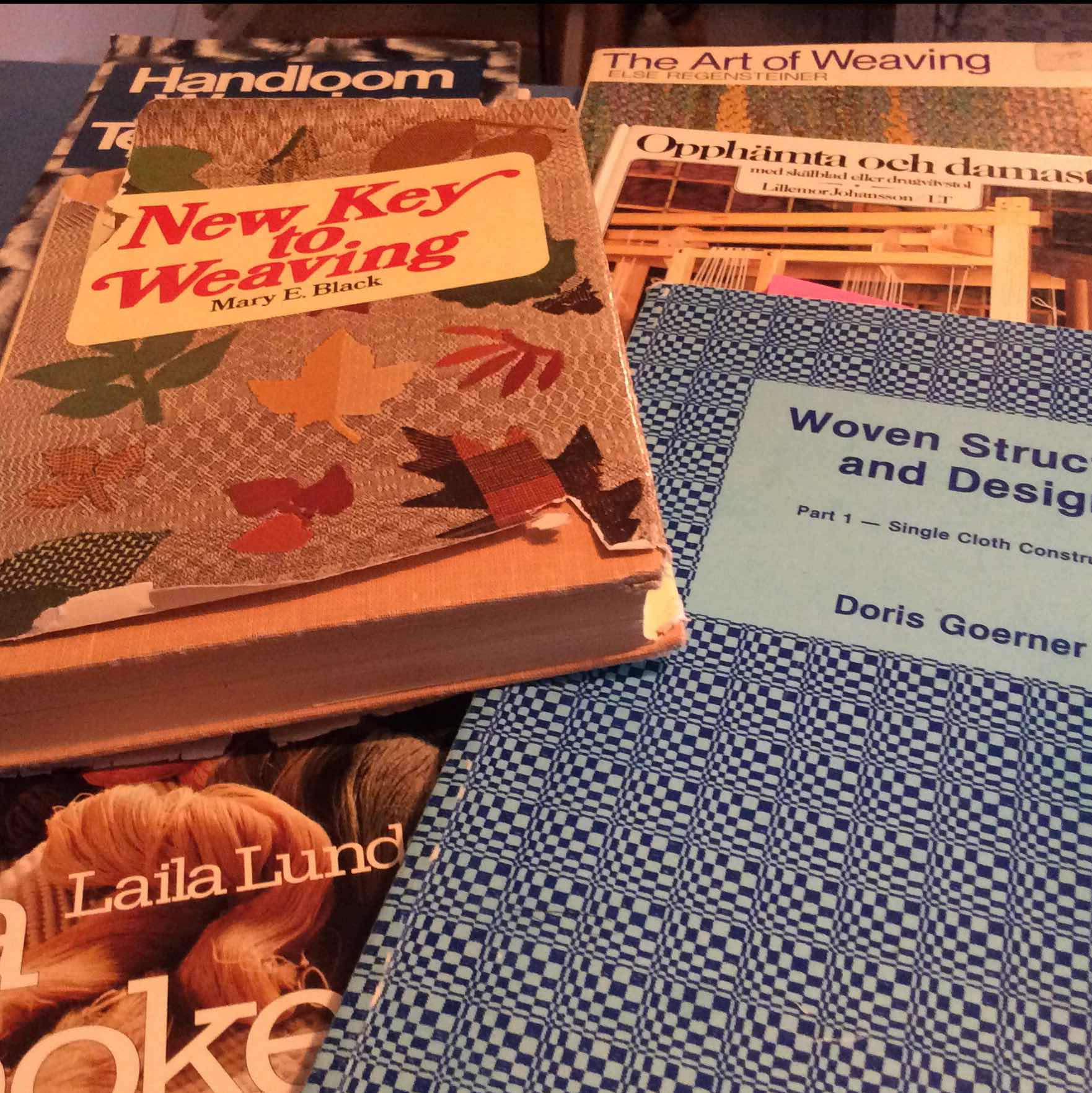
My weaving class textbooks consisted of Mary Black's book, Shirley Held's book Weaving and M. P. Davison's green book.  Regensteiner's book was also recommended as additional reading.  So those were my first books.

Over the years as I learned more, I bought books to add to my library.  As I gained in knowledge, I fine tuned my interests and bought more specialized books.  Since I had a connection to Sweden, several of my books were purchased - originally in Swedish - reflecting that interest.

I also bought English books, partly because they seemed more...technical...to me.  Since I was interested in weave structure, I wanted to know more about how threads could move through the cloth to create pattern.

The above photo is just a very small selection of books from my library.  Some I rarely use (the Regensteiner, for example) some are used infrequently, but consulted for specific information, some I just can't bear to sell.  Yet.

What these books have in common is the variety of weaving terms that get used.  There is not a standard language for things.  Or wasn't, when I began.  With the growth of the internet and the popularity of Handwoven, weaving terms have swung more and more towards American usage.

Someone commented recently that Mary Black only used the word 'sett' to refer to the colour order of a tartan.  That's because she tended to use 'set' for the number of epi/ppi, not the American 'sett'.  If you look through Black's book she always refers to epi, never to 'sett' to indicate density.

Having a broad based approach to reading books, I am familiar with the many varieties of terms - portee and pourrey cross, for example.  Heald instead of heddle (British vs American usage), batten instead of beater (ditto), woof for weft (woof now being referred to as 'archaic' usage).

Other cultures have different approaches to weaving.  Swedish weavers don't have 'names' for all the different overshot patterns that Davison lists in her book - or Black in hers.  Instead they tend to group weaves by category of structure.

I'm sure other cultures with other languages probably show similar differences.

But I don't speak those other languages, so I have to communicate in English.  On the other hand, I am Canadian enough that I well remember that the 'proper' spelling of colour is, well, with a 'u'!

Lately I have noticed that more frequently we are seeing dying being used instead of dyeing.  I'm sure it is a combination of auto correct (or auto carrot as one person I know says, or auto INcorrect as a friend and I call it) plus a lack of knowledge on the part of editors who either don't know or don't realize that dye in the past tense is actually dyed and that while dying is a perfectly good word it doesn't mean to add colour to yarn/fibre/cloth!

Having an editor who actually weaves was very important to me. I didn't want someone who really didn't understand the craft cutting the manuscript indiscriminately.  Having an editor who not only understands the language of weaving, but also has familiarity to the processes meant that we could cut right to the chase - make sure that my words were as clear as we could make them for others to read.

I am on tenterhooks right now as she finishes doing the part I could not face.  I am trying very hard to be patient while she does what needs to be done.  My schedule for Sept-Nov was such that if I were doing this by myself I couldn't have touched it anyway.  So having someone else work on it means that we are still on track for publication in early Dec.

If you hear a ginormous sigh of relief on Dec. 2?  That will be me, pushing 'send' on the ms file...

Fragile


As I was twisting the fringe on a shawl this morning I started thinking about how fragile the web is when it is cut from the loom.

The threads are no longer under tension.  The threads can easily be pulled out of alignment.  Slippery yarns like this rayon can slither and slip.  The weft yarns don't want to stay where they have been placed but start to fall out of the web entirely.

Fragile.

Once the fringe (or raw edge) has been secured in some way, things are better but the cloth still won't - can't - perform its function properly.  The threads, warp and weft, are still individual.  They have no cohesiveness.  No strength.  They are interlaced but that web has no structural integrity.  It is fragile.

Weavers have to wet finish their results just like potters have to fire their bisque, glass workers have to anneal their glass, etc., etc., etc.

Almost every craft I can think of has to 'finish' their product in some way before it is finally done, done.

Textiles have been used for centuries as metaphor for life.  In some versions Hansel and Gretel use a ball of yarn to mark their path through the forest.  Sleeping Beauty pricks her finger on a spindle.  Rumplestiltskin spins flax into gold.  The Swan Princes have to have their curse broken by their sister making a dozen shirts of nettle   And so on.

I look at the web of my life and stand here, near the end of my warp (so to speak) and pick out this thread and that, threads that I had no idea would be incorporated into my life when I set out on this journey.

I have met wonderful people, made dear friends.  Been to lovely places.  Enjoyed conversations that ranged from quantum physics to the history of language.  I have been welcomed and treated royally.  People seem to enjoy my writing - something I dreamed of as a child but never imagined would become any sort of reality for me - blue collar poor, living in a geographically remote location.  And yet.

I traveled to Sweden (by freighter, across the Atlantic in May, which was...interesting), took a bus tour of Europe, toured England, visited Sweden several more times, have been to Greece and Istanbul (only 24 hours in Istanbul, but still).  I have been to nearly every province in this country (still a few more to get to) and many of the US states.

This blog is coming up to 1.5M  (Million!!!) page views.  I've published books, created educational weaving 'kits', done not one but two DVDs.

I've attended - and organized - conferences, sold my weaving wholesale, worked for a fashion designer, done 'ghost' weaving for others.

I've had the privilege of transcribing interviews (WeaveCast, Tien Chiu and others) and been interviewed for podcasts.

As a child I grew up thinking I was fragile.  That I'd never really amount to much.  But through the challenge of creating textiles, I seem to have 'finished' myself.  Into something "not fragile".

Currently reading The Prisoner in the Castle by Susan Elia McNeal


Tuesday, September 25, 2018

Order


end of a towel showing part of the motif and the hem area...

One of the things that really appeals to me is how the threads march steadfastly in order as I weave them into the cloth.

Yes, I know about the threading error in that block.  No, I'm not going to 'fix' it.  It won't affect the function of the cloth and I have decided to accept it as my unique maker's mark.  Yes, I know I'm lazy and I should have re-threaded 2/3's of the warp to fix it.  No, I didn't feel like it.  Which just goes to prove that I am not, and never will be 'perfect'.  Yes, I know some people will judge me.  That is their prerogative.

I have spent many years of my life making sure every textile I produced was 'perfect'.  IOW, without obvious error.

However, there comes a time when another part of you says, you know what?  I don't have the time or energy for that level of 'perfect' for this warp.

When it came to this warp, I felt ill (from the adverse effects of the 'miracle' cancer drug I'm taking) and I had a brain blip.  When I finished and had four 'extra' threads left over I was pretty sure I had made a mistake, went ahead to sley, tie on and start weaving.  If the mistake had been closer to the left hand side of the warp I probably would have sighed, taken the warp out and fixed it.  But it was much closer to the right hand side and I just Could Not Face re-threading that much warp.  For a mistake that really wasn't going to adversely impact the cloth's function.

It was also smack in the middle of the spring teaching trips and I just did not have the energy to deal with it.

Instead I decided to just accept the fact I could not deal with fixing it, that this warp was going to have a flaw - just like it's maker.  With all my wrinkles, excess poundage, aching muscles and joints.

On the other hand, this warp is bringing me a lot of happiness.  In spite of the mistake.  In spite of the flaw.  Just like I hope the towels will bring their future owners happiness.

After much delay while I worked on other stuff, I think I'm at about the halfway mark.  The loom is finally behaving - mostly - within tolerable limits - and I am going to try to weave as much of this warp as possible.  Because if I can bring the towels on my next trip to hem in the evenings, that would also make me happy.

And I will continue to enjoy the order as I lay the weft threads in and beat them into place.

Saturday, September 22, 2018

Not Just Washing


Climbing onto my soap box...

These are Color Catchers.  Today I've been wet finishing a load of red scarves and shawls.  I knew beforehand that the weft on these items bled copious amounts of fugitive colour and it needed to be dealt with in the wet finishing.

If all I had done was wash this load of cloth, there would have been a significant amount of dye left in it and any friend or customer who owned one might have had a really nasty surprise when they tossed it into their laundry.

So no, wet finishing isn't 'just washing'. 

Wet finishing means that if there is fugitive dye, it is - as much as humanly possible - removed.

Wet finishing allows the yarns to shift to areas of least resistance so that weave structures like lace weave, deflected double weave, honeycomb, waffle weave and others will develop to their finished state.

Textiles that rely on shrinkage differential will not look anything like they will coming off the loom and after wet finishing.

Wet finishing may be much harsher in terms of water temperature or agitation than simple washing.

Other processes such as a good hard press (which these scarves and shawls will receive tomorrow) or brushing (to raise a nap, usually on wool) are applied during wet finishing.

Once the web has been brought to it's 'finished' state, every rule you ever learned about cleaning that textile kicks into play, especially for wool.

These shawls and scarves went through a standard wash cycle of 8 minutes with gentle agitation and spin, warm water wash, cold water rinse.  I used four rinses.  The three Color Catchers on the left went through two rinses and the wash cycle.  The medium coloured one in the middle went through three rinses.  The two on the right went through two rinse cycles.

The washing instructions that I will attach to the items will read "Wash separately in warm water, dry until damp, press if desired."  Quite a different process than the wet finishing I just applied.

For more info on wet finishing...

(to see the entire photo, click on the photo and open in another tab)

Friday, September 21, 2018

Plain


Plain weave doesn't have to be 'plain'.  And 'simple' isn't always 'simple' to achieve.

One of the things that endlessly fascinates me about constructing textiles is how the layers can be peeled away, revealing another dimension of the craft.

It is the very exploration that keeps me getting out of bed of a morning, wondering what discovery will be presented today.

Sometimes it is how colours interact.  Sometimes how different textures can be created.  Either by texture in the yarn itself, or through how the threads interlace.

When I first started weaving I was particularly interested in weave structure.  My former favourite colour was white - usually on white.  And the 'interest' was in how the threads moved, combined, shifted as they made their way through the cloth.

I never really got comfortable with weaving plain weave until I got comfortable combining colours.  In many cases, the 'best' way to combine them was one on one - plain weave.  The colour blending became pointillist with one pixel of colour next to the next, next to the next.  Distance or scale then helped the colours blend completely or with contrast even shift the perceived colour into something else entirely.

As I wove more plain weave I got better at doing it.  Plain weave is so consistent that every little inconsistency will show up.  Especially when using two different colours, warp and weft, even more when those colours are of high value contrast or across the colour wheel from each other.

I had to get really good at paying attention - to my beat, to advancing the warp frequently, to re-tensioning the warp after advancing.

Weaving plain weave is now comfortable for me - although I'd be the first to admit I'm still not perfect.

But I also know that tiny inconsistencies will usually disappear in the wet finishing.  And what better reason can there be for wet finishing - to hide the slight imperfections and make us look more 'perfect' than we are.  So no, I'm not the least bit concerned about the reed marks in the web.  I know they will, by and large, go away once the shawls are wet finished.