Showing posts with label A Good Yarn. Show all posts

Saturday, July 6, 2024

A Good Yarn


This morning PLY magazine posted the above on their Facebook page.

This is something I have been trying to explain to weavers for, quite literally, decades.  I even did a whole series of publications, *with samples* to show how yarns with different characteristics will create cloth with different characteristics.  Sadly, now out of print with no intention to republish.

Just because you know the 'count' of a yarn, doesn't mean you know everything there is to know about the yarn.


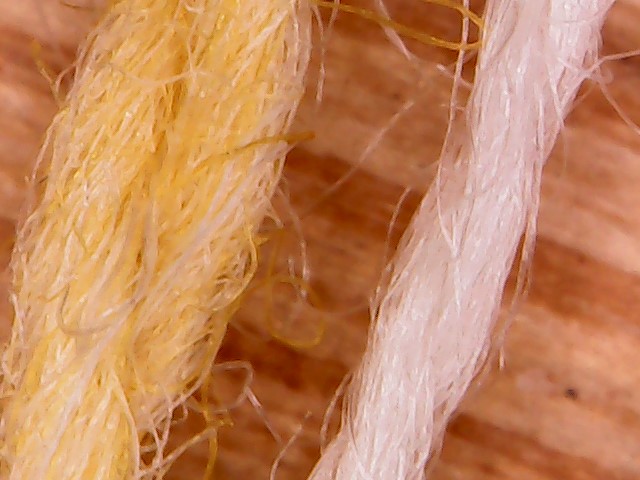
This was a photo I took for A Good Yarn: Cotton.  

As I travelled all around the US, I constantly ran into people who would grimace when I would say my favourite yarn was 2/8 cotton.  In their mind what they saw was the yarn in the bottom of the picture.

Believe me when I tell you: while these yarns may have the same count, they are NOT the same.

How a fibre is prepared for and spun can create a myriad of different qualities of yarn.

But industry does not set out to make 'bad' yarn.  We, as weavers, can (and do) make inappropriate choices.

I'm not saying every weaver needs to be a spinner.  But what they do need to do, imho, is to look closely at the materials they are working with.  They need to understand the nature of the fibres *and of how the way they are spun* can enhance or diminish certain characteristics of those fibres.

To have people whiff away the fact that there is a quality of cotton with a count of 2/8 as being identical to a count of yarn with 8/2, is to ignore the fact that these two yarns have been spun differently.

When people tell me that the 'proper' way to write the count is 8/2 I point out suppliers like Jaggerspun who spin worsted wool yarns labelled 2/18, etc.

Maurice Brassard, who used to label their cotton 2/8 now, on the *English* side of their website call their yarn 8/2, but if you look on the *French* side of their website - voila, their yarn is still labelled 2/8.

The *count* only ever tells us how many yards per pound (or metric equivalent).  It tells us nothing about how the fibre was prepared for and spun.  For that we need to look more closely at the yarn itself.

Brassard's 2/8 cotton is ring spun.  The fibres are combed, and the twists per inch in the ply is tighter than the US standard 8/2 cotton which is open end spun with the singles tightly twisted but the ply less than Brassard's.

Why is this important?

Brassard's 2/8 cotton is stronger, smoother, and slightly *thinner* than the US 8/2 cotton, which has more air trapped in it so it is weaker, slightly thicker, and feels more textured.  The 8/2 ply presents a more 'saw-toothed' appearance that can feel rough to the touch.

This is NOT to say the 8/2 is 'bad' yarn.  It is what it is and if a weaver tries to use it beyond it's nature, there might be tears shed.  

So I happily use 2/8 cotton for warp, and will use 8/2 for weft.  However, when I do that, I know that it will shed a lot more 'lint' than 2/8 cotton.  

I wrote about absorbency for Handwoven a while ago.  People may find it helpful in understanding that aspect of yarn.

I also strongly suggest people get a fibre or textile science book to learn more about the nature of their materials.  My personal favourite is A Guide to Textiles for Interior Designers.  This book can be found second hand with prices ranging from under $10 to $100.  You don't need the most recent edition, which can sometimes be discounted as the newer editions are published.

Knowing your materials will help you make better decisions.  Just saying...

Sunday, June 9, 2024

Stash Mysteries


blue - Brassard 2/8 cotton, white - US 8/2 cotton

In preparation for doing some experiments I dug through my cotton stash looking for appropriate yarns.

I was pretty sure I had yarn that was designated 8/2, even though I routinely work with the Brassard yarn which used to be designated 2/8 on their colour cards and then, sometime in the 1980s they switched the numbers to 8/2 without changing the quality of the yarn.  If you peek at the French side of their website, their yarns are still noted as being 2/8.


When I first met Americans, some of them would recoil in horror when I said I worked a lot with 2/8 cotton.  It wasn't until I met some US 8/2 cotton that I began to understand their aversion to weaving with it - as warp, at least.

Because the two yarns shown above are very obviously NOT the same 'quality'.  

I have tried - for decades - to explain the difference to people but the prevailing attitude is that the numbers infer quality, when all they refer to is the number of yards per pound.  They are not interchangeable for reasons that may be apparent once you see them up close and personal.

So, here I am - again - pointing out the obvious - 2/8 and 8/2 cotton is not the same quality.

When I was researching the concept of why these yarns are not the same, I pestered various suppliers until I finally got the answers:

The blue cotton is combed and ring spun - which would be roughly equivalent to 'worsted' in hand spinning, while the white cotton is carded and open end spun - which would be roughly equivalent to 'woolen' spinning.

Yes, yes, I know that whole worsted-woolen thing is a spectrum and there are all sorts of variations, but I'm just trying to explain how the above yarns are far from the 'same'.  And it is all to do with how they have been spun.

The blue yarn is denser, smoother, and thinner than the white yarn, which is loftier with trapped air in it, has more fibres poking out, and slightly thicker than the blue yarn.

Which of these is the bad yarn?  Neither.  Each has been spun with a purpose in mind.

The blue will be less absorbent (slightly), stronger, and withstand abrasion better than the white yarn with its trapped air to make it more absorbent, but it is weaker and will not withstand abrasion as well as the blue yarn.

If one is looking for the purpose of these yarns, one could simplify it by saying to use the blue yarn for warp and the white yarn for weft and derive the benefit from each in terms of a stronger warp, but a more absorbent cloth, if absorbency is something you are looking to achieve.

Bottom line is that the count numbers only tell you the number of yards per pound - not how many twists per inch (apparent that the white yarn has higher twists in the singles, fewer in the ply, than the blue), the grist (thickness) and why how many epi 'depends', how well it will perform in terms of absorbency or abrasion.

Want to know more?  I discuss fibre characteristics in The Intentional Weaver...


Thursday, February 8, 2024

Absorbency


several different cotton yarns

This morning I opened my email and discovered an opinion piece that reflected on absorbency and was reminded once again that I did this article for Handwoven's Yarn Lab a few years ago now.

So many weavers have noticed that different cotton yarns vary in how much they will absorb and wonder why.

The above article sets out the best information I have found to explain this phenomenon.  And when you understand the structure of the fibre itself and how cotton actually absorbs water, then have a rudimentary understanding of how absorbency can be moderated by how the fibres are prepared for and then spun, it all makes sense.

Instead people look at the yarns, note that most mercerized cottons appear to absorb less well than unmercerized cottons, and assume that the mercerization process is the deciding factor.  When it isn't.

Generally the difference between yarns commonly available in the US is that unmercerized cotton yarns are open end spun, which means lots and lots of airspace trapped into the yarn, and mercerized cotton yarns are ring spun with the fibres lined parallel with little space for the fibres to absorb water and swell.

Thinner yarns will absorb more easily than fatter yarns (generally - fibre prep and spinning method will play a factor.)

In the above photo, the yarn on the far left is seine twine.  This yarn was designed specifically for seine nets.  Therefore it needs to be extremely strong, but also?  The less water it absorbs the better.  So it is extremely tightly spun, generally cabled.  You cannot break this yarn with your hands.  (Well, I can't and I doubt very many others could, either.)

As such it is extremely inappropriate to make towels with.  It is stiff, not wanting to bend or drape, and certainly not dry dishes.  It is used by weavers primarily for tapestry or rug warps, for which it works very well.

If you (or your guild) are interested in learning more about fibre facts, my Zoom presentation A Good Yarn will reveal more about fibre and yarn characteristics.  Email me laura at laurafry dot com

I'm still taking bookings for this year and even have one for next.

Or buy  The Intentional Weaver where I outline many of these factors in writing.

Sunday, February 4, 2024

Yarn Choices


attempting to tame the dry linen by making a 'humidor' and letting the bobbins 'steep' in a humid environment for several days before attempting to weave with it.  See link to previous post given below.

Had a question this morning about yarns listed in a very old booklet with projects for weavers.  The yarns given are no longer 'common' and the question was, what could they use if they can't find the yarns listed?

One of the yarns was linen, so I rooted around looking for a substitute, but it's a bit hard to find things that have gone out of 'fashion' and are not now available, so I offered some suggestions.  

But, I also just finished weaving with linen as weft and thought it might be a good idea to review working with linen, when you live in an arid environment.

(If you want to read my original blog post, that's here.)

Sourcing yarns can be a huge challenge when trying to replicate an 'old' project and sometimes the best you can do is come close.

I just cut my cotton warp/linen weft tea towels off the loom yesterday and so far I'm pleased.  Of course they are enormously stiff in loom state - a factor of using a singles 12 linen for weft.  Brassard still sells that quality of linen yarn, and I've used it previously (obviously, since I have/had it in my stash!).  I wish I could find finer linen singles, but they are not commonly available, so I make do.

Linen is more expensive than cotton, so I tend to use it as weft only.  (No loom waste.)  Not to mention that right now the relative humidity in my house is running around 30% - on a good day.  During the cold snap last month it went down to 20%.

Linen becomes very brittle when the environment is arid and if using it for warp, expect breakages.  There is a reason linen is woven in humid environments - it just behaves so much better.  

When it is starved for humidity, it becomes very unruly, and as mentioned, brittle, tending to break when used as warp.  

But all yarns need a little humidity, even cotton.  Wool and silk will also develop static electricity when warp winding, bobbin winding, or even in the loom.  

A further challenge to sourcing linen is that so many linen yarns are now 'cottonized' which means the long staple length has been cut into about 2" lengths.  Finding actual 'line' linen is difficult and when you do find it, it will be expensive.

I did, however, stumble upon a listing in Etsy:

They may possibly still be spinning line linen and offering larger cones, not tiny spools.  I would have to do further digging to find out if their yarn is line linen and what kind of pricing they are asking.

Since I'm in Canada, I try to purchase from Canadian suppliers.  Brassard does still carry some linen yarns, but it would depend if what they carry is suitable for your project.

Yesterday I did a Zoom presentation called A Good Yarn.  The lecture is about yarn characteristics and I was happy to answer questions.  Weavers really do need to know at least a little bit about how yarns are sourced for their fibre and prepared for and spun into yarn in order to understand how they will behave - in weaving, yes, but also after wet finishing.

I did some very short run booklets on this topic back in the early days of this century (gawd I feel old when I say that, but it's true!).  If I can find the files on one of those old CDs I kept, who knows, I might even offer the text as a pdf again.

Or book me for a Zoom?

Sunday, February 19, 2023

Deep Dive


Two yarns, the beige is a known 2/20 mercerized cotton, the bottom is labelled 20/2 unmercerized cotton


Two different 2/20 mercerized cotton yarns, one is much more tightly twisted and therefore thinner than the less tightly twisted yarn


One yarn a known 2/20 mercerized cotton, the other unknown manufacturer or count

Having done a deep dive into my stash I gathered all of my known 2/20 mercerized yarns together, along with some 'mystery' yarns.

The gold in the bottom picture is shiny like mercerized cotton, and about the same thickness as the known 2/20 mercerized cotton, but I couldn't tell if it was rayon or cotton.  A burn test leaned towards cotton.   I made a small 'tassel' of each yarn and burned them simultaneously in order to compare how they burned - how quickly, their smoke (if any), and the residue when I blew the flames out.

And then when I wove with the gold, it shrank more than the known mercerized cotton, so then I was ambivalent - was it really cotton?  Or not?

When I examined both under the digital microscope, I can see that the individual fibres have the characteristic cotton twist along their length, so in spite of the higher shrinkage rate, I'm 99.9% confident that the gold is, in fact, cotton.

The two white yarns are both labelled 20/2 mercerized, but I'm fairly confident that they are both ring spun although the Astra has a much higher degree of twist and is therefore stronger, thinner and coarser both on the cone and in the cloth.  Not a deal breaker for a tea towel.

The top photo shows a yarn labelled 20/2 and further gives the information that it has 15 tpi while the other is a Brassard 2/20 mercerized cotton.  I'm pretty confident that the 20/2 is open end spun given that it is thicker (loftier) and has more loose fibres poking out of the yarn.

Once again, evidence that the count only tells the number of yards per pound (or meters per metric length) and nothing else.

Sunday, May 1, 2022

Quality


What is quality?

Most people take the word quality to mean *good* quality, not bad.  But the word 'quality' isn't inherently good or bad.

It's always a good idea to choose a yarn suitable for the purpose of the intended cloth.  Yarn all by itself isn't good or bad - it just has built in characteristics that make it a good or bad choice for what you want to make.

The yarn going into the Leclerc right now is the right hand one in the photo.  It's finer, smoother, stronger than the yarn on the left.  Does that make it a better quality?  Not really.  The difference in the fibres used, how they have been prepared for and spun will make a big difference in how they behave but also?  In the quality of cloth they will make.  Will one be good and the other bad?  No.  They will just be different.  They will each be 'better' AND 'worse' at some things than the other.

Neither of the yarns is 'cheap'.  They are not typically found in most knitting yarn shops because they are not knitting yarns.

They are *weaving* yarns.  That doesn't mean you can't knit with them, just that they have been engineered to be used in a loom.  They have less elasticity than the 'usual' knitting yarn.  They are two ply, not 3, which for many years had been the standard for knitting yarns (not so much lately).  

Each of the above yarns will create a lovely fabric if the weaver works *with* the inherent characteristics, not against them.

So the one on the left was built with the intention that it be fulled.  The one on the right, while it *can* full, was not the primary feature.  The one on the left is loftier, hairier, and weaker than the one on the right.  The one on the left can be used as warp, but the one on the right is a lot stronger.  The one on the left will make a warmer cloth, the one on the right a cooler one - because it has less trapped air to act as insulation.

Learning how to assess the qualities of the yarn and use it appropriately is the focus on my presentation A Good Yarn.  Sign up for School of Sweetgeorgia and catch the live lecture on Wednesday, May 4 or view it later because it will be recorded.


The cloth in the photo above is the left hand quality - Harrisville.  I wrote about it for Handwoven a few years ago.  It can make a nice blanket, shawl or outer garment quality of woolen cloth.  The yarn on the right is GIST's Array, a worsted yarn.  I'm going to start weaving my first sample with it today.  I'm expecting it to make a nice garment type of cloth.  It's finer, more tightly spun, will withstand abrasion better than the Harrisville.  And I think with a good hard press as part of the wet finishing process, it might even feel quite nice against the skin.  But only a sample will tell me that for sure.

Monday, April 4, 2022

What's in a Name?


The yarn on the left is Brassard 2/16 cotton, the yarn on the right is a 'mystery' yarn labelled 16/2 cotton.

There is much discussion on what those numbers mean.  Many people say that the order of the numbers is immaterial, that they are identical.

What the photo above, taken with my digital microscope, shows is that they are not exactly the same quality of yarn.  

Even though they both have approximately the same number of yards per pound (6720 yards) it is quite clear that the blue/green one is thicker than the rust and the rust is much more tightly twisted.

And yet - they ARE both cotton, they ARE both the same (nominal) yards per pound.  The difference is that the rust has been spun out of longer staple fibres, which have been combed so that they are parallel and then plied much more tightly than the blue/green, which has been spun from carded fibres, or even from a loose fibre mass equivalent to a carded preparation (called open end spun).

You can also see that the rust yarn has somewhat shorter bits sticking out loose while the blue/grey has longer bits of fibre sticking out.

What is the effect of the two different preparations in spinning and the actual spinning?

The rust is stronger than the blue/green and will behave as warp quite nicely.  The blue/green is weaker and much happier as weft.

The blue/green will be more absorbent than the rust because the blue/green is loftier and has more air or gaps in it's structure so it will be easier for the cotton to absorb the water.

The blue/green will also shed more lint than the rust.  The blue/green is coming up in my stash very soon and when I begin weaving with it again, I will make sure that I have my filter fan running to filter some of the lint out of the air.  That will keep it out of my lungs, and hopefully reduce the lint getting into the rest of the house, too.

Just because something is the same 'number' as another yarn doesn't mean it is equal in characteristics.

As we move more into using metric sizing, we need to be aware of the actual method of spinning and look at yarns more deeply.  We can't just assume that because they have the same number of yards per pound they are the same.


These yarns also have the same number of yards per pound.  Again, look at the difference in thickness.  The yarn on the left is Tencel - a regenerated cellulose (rayon) where the fibre has been broken down into a viscous solution then run through a spinneret.  The fibres can be very long and shiny.  The yarn on the right is cotton.  While both may have been spun with the same fibre prep, the density of the Tencel, the long silky fibres are creating a yarn quite different from the cotton.  Both are given the 2/8 designation (or 8/2 because some people think it doesn't matter which order they are used in) but they will behave differently.  While it is true the Tencel has the same number of yards per pound, it is slippery and thinner than the cotton with the same number of yards per pound.  Generally a thinner, slippery-er yarn needs to be more epi than the thicker one.

When I first began weaving, I was told the 8/2 designation was equivalent to a 'woolen' type of preparation while the 2/8 designation was equivalent to a 'worsted' type of preparation.  That doesn't seem to be being taught now, but interestingly, I notice that Jaggerspun, a very American company that spins worsted yarns, used 2/40 and 2/18 and so on to designate their yarn sizes.