Showing posts with label The Intentional Weaver. Show all posts

Sunday, February 22, 2026

Driver's Manual


I get it.  People are interested in weaving.  So they buy a loom and then...ask for a 'manual' for the type of loom they bought - usually second (or more) hand loom.  Sometimes they know so little they don't even know if the loom is complete.

Or they wonder which brand it is - because the 'manual' didn't come with it.

It's like buying a car then expecting the Owner's Manual to teach you how to drive.

There is a vast distance between owning a piece of kit and knowing how to use it.

What I wish is that every person interested in weaving would buy a 'how to weave' book *first* and then get a loom.  

I mean there are lots of books that will teach a person how to weave.  I know several people who learned how to weave with a copy of Mary Black or Margaret Atwater or Deborah Chandler in one hand while sitting at the loom/warping board, etc.

It can be done.  But don't expect the loom's owners manual to teach you how to weave, is all I'm saying.

(That said, if you go to the Leclerc website you *can* download the small book that Robert Leclerc wrote that will teach you how to weave, illustrated with Leclerc products.)

There are so many 'how to weave' books available that everyone should be able to find one that suits their learning style.  

Of course, in person is 'best'.  To demonstrate a process/technique is much quicker than to try to read through a lot of weaver language that you probably don't understand - yet.

So if you are really truly wanting to learn, I advise you to buy a book and read through it.  Absorb the language.  It's 'sleying' not 'slaying' (I know auto correct will tell you it's wrong, but it isn't), and while I'm on it, it's dyeing, not dying.  No one wants you to die for the craft, but will encourage you to dye for it.

I wrote my book as a way to help people weave 'better'*.  I cover things like ergonomics, fibre characteristics, how to read a draft, how different weave structures work.  I talk about the relationship of the various factors in designing a cloth interact.  It's not a 'how to weave' book as such, but how *I* weave.  And if you want to weave like me, I tell you how I do it.  But ultimately, you have to decide what works for you, given your equipment, physical attributes, what quality of cloth you want to make, using the yarns you want to make them with.

Because change one thing, and everything can change.

Keep in mind that as a new weaver you are first and foremost making a weaver.  Once you have gained enough experience to understand the dynamics of the craft, then you can work on 'perfect' textiles.  And no, there will likely never come a time when you stop making mistakes.  But if you have been paying attention you will  have also learned how to fix them.  And learned also to accept 'good' if you didn't quite manage 'perfect'.  Not that I don't *want* my textiles to be perfect!  Far from it.  But I also know when a mistake will affect the textile adversely in performing its function, and when I can be human and perfectly imperfect, at times.

If you can't manage an in person class, I have classes on line at School of Sweet Georgia and Long Thread Media (Handwoven)

*Please note - I am Canadian and I write in Canadian English.  All those spelling 'mistakes' you see are not typos.  That is true for all of my books, my articles in WEFT - because they use the form of English that the author of the article uses, and do not convert them to US English default.  


Saturday, January 3, 2026

Puzzling


Many of my childhood memories revolve around working on jigsaw puzzles.  In our home, there wasn't a lot of room to devote to the building of a puzzle, so we were pretty much confined to 500 or 1000 piece puzzles, which we built on the coffee table in the living room.  These days, I'm still 'confined' to that size, but it is familiar, and a comfortable challenge (usually).

I came to the world of weaving well prepared to deal with multiple issues within a challenge.  To examine the various pieces.  Learn to recognize shapes, colours and sizes.  Work out the logistics of joining them up to create the pretty picture (because I prefer to work on puzzles with pretty pictures). and by sheer stubborness, eventually get them built.  (Not always.  If they are too much of a challenge, I will give up and switch to something less challenging and more enjoyable.)

Weaving really isn't any different.  There are multiple layers to the way cloth gets built, multiple pieces to the puzzle.  The weaver can (and frequently needs to) choose different pathways to get to where they want to wind up.

New weavers assume that there are hard and fast 'rules'.  Sorry.  There are hard *facts* - but then you add this consideration, that one, tweak your processes...and you can wind up making a very specific cloth for your particular purpose.

As a new weaver, you will not have the knowledge to be aware of those variations.  You will not have the facts at your fingertips.  So you ask questions.  Good.  Questions are good.

However, it would be nice if more brand new weavers would take a little bit of time and read about the 'facts' of the craft before they start tweaking the information they are given.

And then complain because what they are doing isn't working.  The designer of the project must have made a mistake.  And they are mad that the thing they chose to do isn't good.  It's someone else's fault for giving them bad information.

Um - when you chose to sley your reed at a completely different density from what the instructions specified, why are you surprised the results are...wrong?  Oh, you didn't want to do the 'hard' thing, so you did the 'easy' thing and it's not working?

You haven't bothered to learn the language, and get mad because people are not helping you properly?  

Personally I get chastised for repeatedly (and rather boringly, I admit) tell people to *sample*.  When a new weaver complains that they don't have enough yarn to 'waste' on a sample, I wonder why they are willing to waste the entire project by having it not turn out?  First of all, stop buying expensive knitting yarn.  Buy some weaving yarn.  Weaving yarn frequently comes in half pound tubes, or 6 ounce cones, sometimes even pound cones.  You might pay $30 for that pound, but you will have plenty to weave a sample.  Maybe even 3 or 4, trying various approaches.

New weavers buy a kit, don't follow the guidelines for epi/ppi, and complain the kit designer 'shorted' them yarn to make the project.

Personally, I gave up making kits - kits designed to create *two* colour gamps, then had a couple people bitch that there wasn't enough yarn in the kit I made to make four napkins.  I was called a 'rip off' artist.  What part of a kit that specified *two* square colour gamps ever equated to four square napkins?

By that time most of the people who actually *wanted* colour gamp 'samples' had bought (if they were going to) and I just...stopped.

I wrote a book that I wished had been available when I was just starting out, with the same sorts of questions new weavers have.  When I did a demo for my class at Olds, one student asked where they could find a book with that information in it.  I had to admit that no one book contained that information.  So I set about to write one.

I won't claim it is the Compleate Book of Weaving - but hopefully I sowed enough seeds for new weavers to learn more and then follow their own trail of learning.

This new year has just begun - with a bang.  I expect plenty of 'whimpering' to follow.  One person and his coterie of enablers has just done the unthinkable - except that he has been telegraphing his intentions for years.  So, while I am not surprised, I am sickened.

Resisting such actions is necessary.  Being aware of the ramifications is imperative.  And continuing to help the craft stay alive is absolutely necessary.  Weaving was one of the pillars of human beings surviving in the beginning.  It may become necessary again.  

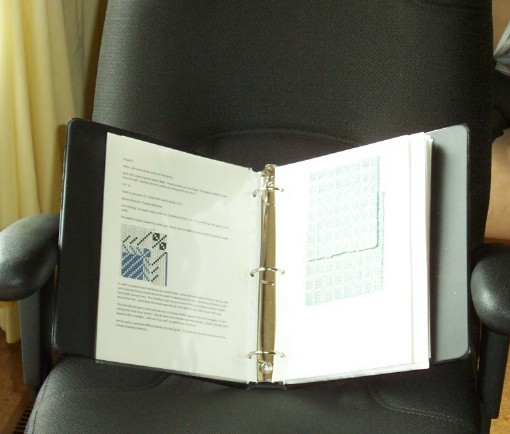
For as long as I am able, I will continue to explore, experiment, and - hopefully - document what I have been doing.  If what I do isn't destined for WEFT, I will continue to share here.  There are over 4000 posts - so far - with many of them labelled as to topic.  If you can't find what you need, you can contact me directly.  But first?  Get a book.  Get several books.  Not 'just' mine - there are many many very good books (none of them generated - I won't say 'written' - by LLM/AI) available.  Some are out of print.  Mine are not.  They are available as usual, here.  All three titles are in pdf download or print.  They are printed in the US, so not subject to tariffs.  

Weaving is not difficult.  It IS complex.  

The life so short, the craft so long to learn...

Thursday, October 9, 2025

Exploring


The above is the draft for the towels I just finished weaving.  I cut them off the loom yesterday, along with a different tie up/treadling to 'sample' the singles 6.

Just before I cut that section off the loom, I generated a different tie up and treadling, just to see what that would look like.  

As predicted, the pick count changed - quite significantly, actually - and I'm not sure I'm going to be happy with the resulting cloth, but it's interesting enough I will forge ahead and weave off the last bit of warp with the new set up and yarn.  It will likely be only two towels, and if they don't turn out, it's no biggie.  They are 'just' sampling - exploring - FAFO, as the young folk say.

But I will wet finish the last 8 towels of the above design and the sample I wove of the new set up before I begin weaving the 'sample' towels.

Ultimately I am simply gathering information - the FA - because this warp has 50% 2/8 yarn and the new warp will be all 2/16.  So it isn't giving me concrete evidence, but it will give an indication.  And if I decide to change the tie-up/treadling even further, I will have a stepping stone to stand on while I do the FO part of the equation.

My inclination is to further reduce the threading/treadling to make a smaller motif.  I'm anticipating some dimensional loss greater than the 'usual' due to the highly twisted (energized) nature of the weft yarn.  But I have large cones of the stuff and need to use it on something.  And it seems to me this is the most useful thing I can do with it - tea towels.  As long as they dry dishes, right?

Which is why I generally told my students to put a fairly long warp into the loom and then just get comfortable with throwing and catching the shuttle, being consistent in everything, and not pay too much attention to 'perfection', but focus on consistency.  What I have found is that the more you focus on perfection the less you are satisfied.  But if you focus on increasing your physical skills and being consistent?  Well, if you can't be 'perfect', be consistent...

Sunday, June 29, 2025

Writing A Book


Magic in the Water; wet finishing handwovens

As a kid, I loved words, stories.  I read voraciously and dreamt one day of writing, too.

But I soon realized that I didn't have stories to tell, as such.  It wasn't until I became a weaver that I realized that my stories were all weaving related.

Over the years I had done 'big' projects so when it came time to write my 'thesis' (or monograph as they called it) for the Guild of Canadian Weavers master weaver certificate, I knew what I wanted to do and generally how to go about doing it.

It was a work of years.  Literally.  Because I made the decision to weave samples.  Not just tiny postage stamp sized samples but samples large enough you could feel the drape/handle of the cloth and get a feel for how it would feel as an actual cloth. Five binders stuffed full of samples.

And once that was done, people started asking where they could get the 'book' and then urged me to write a 'proper' book.

That 'book' grew and grew.  I spent a lot of time (and I mean a *lot*) crunching the numbers.  How much would it cost to produce it?  How many samples?  How much would it cost to buy the yarn to produce the samples for that many copies?  The logistics were, shall we say, daunting?  (Any idea of how much space 1000 two inch ring binders take up?  A small bedroom.)

Never mind much of this happened before I ever started writing.  Having completed the thesis/monograph, I had a pretty good idea of what I wanted to include so I settled on 1000 copies and talked to a local printer who printed a fair number of local history books for local authors.

It was staggering.  Quite literally staggering.  And I was going to have to pay ALL the costs up front, on my own.  No hefty (ha!) advance to help finance it.  Because I knew that no traditional publisher would touch my 'vanity' project with all those tipped in samples.

One of the benefits of my going my own way, using local talent, financing it myself, doing ALL the promotion and marketing myself, is that this (and my subsequent) books were never 'stolen' by LLM to 'train' their AI. 

At the time I just stubbornly put one foot in front of the other, doing what I needed to do, financed the thing on my credit card and took out a hefty loan.  

The book sold fairly well, considering I asked a reasonable price, given all the samples.  I found some unexpected support within the weaving community.  And a fairly large number of people who wanted the book for 'free' because I was 'asking too much for it'.  

On the other hand, some people refer to it as a 'classic' in the craft.  Yes, it is still available, but no samples.  While dealing with chemo (and the fatigue that caused) I took close up photos of all the samples, before and after, and produced a 'digital' version of the book.  Then, when I decided to write a 2nd book, a friend oversaw the uploading of that .pdf to Blurb.com to test the site.

The site allowed the possibility of a print 'magazine' format as well as a .pdf and amazingly, there are still a few people who buy it.

And now, 22+ years later I still offer it for sale.  Just me, not a traditional publishing house.  And now we have to deal with LLM stealing our work and making money off it.  So now me is grateful that previous me was so stubbornly set on producing a book with samples, in the first place, then continuing to publish my books myself.

This year the US president decided to 'break' Canada economically so it would make it easier to 'annex' us.  I was concerned about that until I realized that the company that hosts my books is in US and the books are printed in the north east (I forget which state) so US weavers can still buy my books without paying Trump's Tariffs.  (The last book is only available digitally via my ko-fi shop but I knew very few people would be interested - however, again it is tariff free because it is a digital download.)

There are still a few copies of The Intentional Weaver at Sweet Georgia Yarns, signed ones, let me add.  Whether or not they will order more, I have no idea.  This tariff stuff is...making decisions difficult.  But you *can* still get both print and digital versions of Magic, Intentional Weaver and Stories from the Matrix at Blurb.  Canadians might want to buy the digital versions to avoid whatever shenanigans with tariffs a certain someone serves up.


Sunday, March 9, 2025

Thinking Things Through


Most people seem to assume that creativity bursts upon one in a sudden, perfect thought, no editing or changing allowed.  

We watch a program called Fake or Fortune.  In it an art dealer/expert and a journalist pair up to try and trace the provenance and/or originality of a painting.  Sometimes it gets quite convoluted, but one of the experts on the program will use technology to try to see what's under the surface.  When they use the technology, they can see below the surface paint and see the under drawings, and track the small (or sometimes large) changes the painter made as they were planning the painting.

Creatively isn't so much visual fireworks, but a fair bit of brain cramping, forehead scrunching, changing this, that, and something else, until being finally 'satisfied' enough to begin the actual creation of the item.

At no point am I ever assured of 'success' until I put the warp into the loom, weave it and then wet finish it.  Potters have a trial by fire; weavers a trial by water.

And why I am adamant that it isn't finished until it's wet finished.

In Stories from the Matrix, I tried to talk about the sorts of things that are rarely discussed.  The balancing act of taking the things that need to be done and explain why I used them in a specific way.

And other musings I tend to think about while throwing the shuttle.

I am weaving the next warp, and as of today I will hit the 1/3rd mark.  I'm still struggling with the new pain medication.  There are too many variables and it is time to let my body rest while I use the new medication and see if - as it was explained to me recently - that I do have to choose the pain I will be living with.  I have been on the new medication for 9 days and there have been some improvements, but still some pain.  It's like playing whack-a-mole - I address one thing, but 2 or 3 more pop their heads up and which I hope to keep them down.

Yesterday I finally did 'something' about some of the clutter in my office.  I was trying to write the text for the current article and realized that with so much chaos going on in the world, I needed to clear some of it out of my office.  I can *almost* see the top of the desk now.  But I need more work space, so I'm going to carry the tv trays up and give myself some flat space to work on that isn't cluttered.  

In so many ways I am 'done' with this project, in part because of the transition between meds.  My concentration is shot and my energy levels nearly non-existent.  My goal for the coming week is to keep weaving twice a day, and work on the data for the article.  

And, given the tariff and USPS situations, I am going to go ahead and mail the samples for the previous article and send them by courier.  I hear that the Seattle post office is overwhelmed and any mail that needs to be routed via Seattle are not getting delivered in a timely fashion.  And because I have no idea what will happen with a courier and the tariffs, well, a courier will at least get my parcel back to me if they can't deliver it.  I may have to consider not sending samples to the US but offer to take photos myself?

Still thinking...


Thursday, January 9, 2025

Memories


This morning Facebook showed me a 'memory' - the arrival of the actual hard copy books for the pre-orders of The Intentional Weaver,

Six years.  My how time flies!

But the memories are not just of the arrival of the completed books, but go back, at least 4 years beyond that because I actually started writing it that long ago.

A technical book doesn't always go quickly, especially when you are fitting Life in as well.  I needed the money to produce it, weave the samples, hire an editor, then pay for the printing - all before money from the actual books started coming in.

There were many times when I shut the file and walked away, wondering why on earth I was writing (another) book on weaving.  Weren't there enough already?

But my students had asked where to find the information I was giving them, and I could not point to a single volume where they could find that information.   And so, I would go back and open the file after the latest deadline crunches were over and poke away at it.

Ultimately I wrote the book I wish I had when I was learning how to weave.  Although it really isn't a 'simple' how to weave book, but hopefully, how to weave 'better'.

Did I succeed?  Dunno.  But copies still sell, albeit slowly.

Will I write another book?  I won't say 'never' this time, just 'it isn't likely'.  Instead I am focusing on writing articles.  They take less time (sort of), but also are less intense, in the way a book winds up being.

Not that I'm not bringing everything I can to the articles.  I am trying to stretch beyond what I know, see if I can wring more understanding out of the topic.  And even bringing more to my own weaving.  

Seems I'm not 'done' with learning about weaving - yet.  


Sunday, June 9, 2024

Stash Mysteries


blue - Brassard 2/8 cotton, white - US 8/2 cotton

In preparation for doing some experiments I dug through my cotton stash looking for appropriate yarns.

I was pretty sure I had yarn that was designated 8/2, even though I routinely work with the Brassard yarn which used to be designated 2/8 on their colour cards and then, sometime in the 1980s they switched the numbers to 8/2 without changing the quality of the yarn.  If you peek at the French side of their website, their yarns are still noted as being 2/8.


When I first met Americans, some of them would recoil in horror when I said I worked a lot with 2/8 cotton.  It wasn't until I met some US 8/2 cotton that I began to understand their aversion to weaving with it - as warp, at least.

Because the two yarns shown above are very obviously NOT the same 'quality'.  

I have tried - for decades - to explain the difference to people but the prevailing attitude is that the numbers infer quality, when all they refer to is the number of yards per pound.  They are not interchangeable for reasons that may be apparent once you see them up close and personal.

So, here I am - again - pointing out the obvious - 2/8 and 8/2 cotton is not the same quality.

When I was researching the concept of why these yarns are not the same, I pestered various suppliers until I finally got the answers:

The blue cotton is combed and ring spun - which would be roughly equivalent to 'worsted' in hand spinning, while the white cotton is carded and open end spun - which would be roughly equivalent to 'woolen' spinning.

Yes, yes, I know that whole worsted-woolen thing is a spectrum and there are all sorts of variations, but I'm just trying to explain how the above yarns are far from the 'same'.  And it is all to do with how they have been spun.

The blue yarn is denser, smoother, and thinner than the white yarn, which is loftier with trapped air in it, has more fibres poking out, and slightly thicker than the blue yarn.

Which of these is the bad yarn?  Neither.  Each has been spun with a purpose in mind.

The blue will be less absorbent (slightly), stronger, and withstand abrasion better than the white yarn with its trapped air to make it more absorbent, but it is weaker and will not withstand abrasion as well as the blue yarn.

If one is looking for the purpose of these yarns, one could simplify it by saying to use the blue yarn for warp and the white yarn for weft and derive the benefit from each in terms of a stronger warp, but a more absorbent cloth, if absorbency is something you are looking to achieve.

Bottom line is that the count numbers only tell you the number of yards per pound - not how many twists per inch (apparent that the white yarn has higher twists in the singles, fewer in the ply, than the blue), the grist (thickness) and why how many epi 'depends', how well it will perform in terms of absorbency or abrasion.

Want to know more?  I discuss fibre characteristics in The Intentional Weaver...


Saturday, May 25, 2024

Mystery Yarn


digital microscope look at a mystery yarn

I inherited a great deal of yarn from a weaver, some of the cones no longer had labels and I couldn't really tell what fibre they were by just looking at it.

But I have two *very* large cones of this white mystery yarn and decided it was long beyond the time I needed to use it for something.

A cursory examination led me to wonder if it was a cotton linen blend.  It was stiffer than most cotton yarns are, but had a distinctively cotton-y feel to it.

I finally dragged my digital microscope out and took a gander.  I expected to see some linen fibres in amongst the cotton, but nope.  Everything I could see had the typical flat spiral of cotton.

So, why, then, the stiffness?  Well, the singles were very tightly twisted, although the ply was not all that high.  That tightly twisted single would lend stiffness to the yarn.  With the ply being fairly loose, the yarn should be absorbent.  It is about the same thickness as my 2/8 from Brassard, and, since I have quite a lot of that yarn in my stash, I'm going to put a 2/8 cotton warp into the loom and use this yarn to weave towels.

Last week I received an email from another publication asking if I was interested in writing about a very specific topic.  Since the question they posed intrigued me, and I didn't have a definitive answer, I said yes, I would.  It means I have to weave some samples and explore possibilities, and that wet finishing needs to be part of the process.  So, right within my wheelhouse, as they say.

The next warp going into the loom will be the rayon shawls, and if the editor likes my proposal, that sample warp can be done 'next'.  And since I rarely beam a warp less than 10 yards, I can use the same 2/8 cotton warp for the samples to start using up this mystery yarn. 

Win-Win!

Since I recently sent out to the universe that I only wanted to write about the things that interest me, that makes 3 publications that have contacted me about articles - all of them asking for stuff that I know something about and that I feel passionate about sharing with other weavers.

Sometimes you really do just have to be clear about what it is you want, then be patient until time grinds away and the universe can deliver what it is you are looking for?

Anyway, once again proof that you really do need to know about and understand your yarn to make appropriate choices when using them.

The Intentional Weaver contains information on burn tests and how to identify mystery yarns that way.


Tuesday, April 9, 2024

No Silver Bullet


Most people have no idea what a cotton fibre looks like.  Or linen, silk, rayon, wool.  They don't know about the properties of the fibre, therefore fail to understand the nature of their materials.

I've been in the position of helping 'new' textile folk, some of whom are so focused on their internal 'dream' they fail to take into consideration reality.  Because when you work with actual materials that have ingrained characteristics, which can be adjusted in the fibre prep and how they are spun, simply saying you want to work with 'cotton' doesn't tell me a lot about what it is you actually *need*.

In my initial weaving class we didn't learn a whole lot about fibres, although we did have to take the spinning class as a prerequisite.  We did come to weaving with at least a rudimentary understanding of how threads are made.  

But there was still a huge 'hole' in my foundation of knowledge.  I came to weaving with a pretty common background for the 1970s - my family worked with yarn in various ways - knitting, rug hooking, embroidery, sewing.  I worked in a custom drapery house, so I got a crash course in window coverings and how the various ways window coverings would behave.

Over the years, I dug and discovered resources, primarily the Guide to Textiles for Interior Designers.  It became my go-to for technical information on fibres and yarns.  I added other textile science texts, and gradually filled in some of the holes in my knowledge.


"When you don't know *what* you don't know, you don't know *that* you don't know it."

As soon as I heard that phrase for the first time, I knew that I needed to get loud about things that *I* felt were necessary for weavers to make the cloth they wanted to make.

A lot of wannabe weavers just want to get some thread and turn it into...something.  Some of them don't really have any idea of what they want, or they have some vague notion and look around for something to manipulate into fabric.

But when you don't know *what* you don't know...

So they make a lot of things that don't turn out the way they want, and eventually they give up.  Or they get frustrated.  Some of them get angry when they ask questions and people like me say 'it depends'.

They don't like being 'interrogated' with 20 questions, they just want to make their dreams come true.  Problem is, dreams are not reality, and when working with threads, there are things like physics that need to be factored into the equation.

They also get defensive when they are asked about the results of their sampling.  I don't know how many people have angrily told me that they 'can't afford to *waste* yarn on making samples'.

There is a reason I included technical information in The Intentional Weaver.  As a craftsperson, no matter the craft, the common thing in making anything by hand is to have knowledge and understanding of your materials.

So, I tell people - don't just jump to the pretty pictures and project notes in a book - read the beginning bits.  I constantly see people asking online what author X means when they say Y.  Pretty sure most authors include an explanation of their terms in the beginning bits that they just skipped over because it was 'boring'.

If someone wants to make 'good' cloth, they need (imho) to understand the materials and equipment they are going to use.  

The Intentional Weaver is the book I wish I'd had when I first learned how to weave.  I consider all of it basic and essential.

If you have the book and you skipped over some of the chapters, maybe go back and read them now?

Monday, April 1, 2024

Spring Has Sprung


Spring seems to have arrived.  We had a small 'flock' of American robins in our back yard this morning.

The woodpecker arrived last week, claiming his territory by rattling away at the metal vents in the roof.

With climate change advancing relentlessly, it is hard to know what the future holds.  We're old, we've been around a lot longer than younger generations, and we know what the seasons used to hold.  Someone in their 20s has no real idea of what was considered 'normal' - and now is not.  To them, what is happening has been happening for all of their lives and they have nothing in their experience to compare the 'now' to what used to be 'normal'.  As in, before climate change began to accelerate.

We continue to recycle, reuse, reduce.  Our wants are simple.  We have travelled (although not nearly as much as we had hoped) and we have experienced many things in our lives.

This morning a fellow weaver/teacher posted about the 'adventures' she had in her life, saying she should write a book.  I hope she does.

If anyone wants to know more about my life as a professional weaver/teacher/author, my book is still available as a pdf via my ko-fi shop.

Things are changing, rather rapidly, and will continue to do so.  What the future holds we cannot know.  

Decisions are being made that will forever impact our lives and most of us feel like we have no input into what those decisions will look like.  Billionaires are taking over more and more and making decisions that impact those of us who are not wealthy, investing gigantic amounts of money to take over things like writing and art.  Once again people who create things are being told that a) anyone can do it, b) your creativity, skill and talent is worthless because c) a machine can do it.  So they spend billions of dollars and suck up the equivalent of a small countries energy to feed AI machines while explaining that humans who do the same, but better, don't deserve to earn money.

Yes, I know AI is a 'tool'.  But as someone posted on Facebook the other day, I don't want AI to create art so I can do the dishes.  I want AI to do the dishes so that I can create art.

Writing is a skill.  Some people are a lot better at it than others.  Sometimes writers have spent years and years honing their skill in order to be able to tell a story well, or write a knitting pattern that actually makes sense, not gobbledygook.  

In a way, I'm glad I was a weaver/writer/teacher before AI came along to try to usurp my skill.  If nothing else, perhaps, just perhaps, my books will hang around long enough for people to learn how to weave from a human, not a machine who doesn't know how to weave.  Or all the 'it depends' conditions that affect how a weaver makes choices in order to create 'good' cloth.

I did not set out to write a book for the ages.  But maybe, just maybe, my books will outlive me and be useful long after I am gone.

Time will tell.

Thursday, March 14, 2024

Painful


Minimum input, maximum output.  

Coming to weaving with a background in movement (ballet, hap ki do, aerobics, track and field, etc.) weaving became an exercise in figuring how to do it with the least possible wear and tear on my body.

Over the years I fine tuned my movements, checked with professionals (physio, massage, dance instructors, etc.) to make sure I wasn't inadvertently causing myself an injury.  And then I began including ergonomic hints and tips during workshops when I would see people doing things that would lead to injury if continued over time.

I also listened to people talking at conferences.  Like the person who was about 20 years older than me, explaining that she had been on a tight deadline and had woven for hours and hours to get her project done in time and caused so much damage to her feet that she hadn't been able to walk properly for 6 weeks (never mind weave).  Carpal tunnel surgeries were another risk factor.  

When I hosted a well known weaver during her tour around BC I explained I had an early morning physio appointment and showed her the coffee and told her to make herself at home.  She asked if I had a bad back and I said yes.  She said every weaver has a bad back.

Given I was young (at the time) and wanted to weave for many more years, I began to really study ergonomics related to weaving in a more serious manner.

But not everyone wants my input on what they are doing.  There are times when my suggestions, such as sitting on a taller bench/stool, or encouraging people to thread/sley the way I do now (thanks to Norman Kennedy's workshop, and watching Syne Mitchell sley - which she learned from Peggy Ostercamp), or suggesting that people wear some kind of footwear, especially if they weave on a loom that requires a larger foot/pound pressure than a Scandinavian style loom, some people shrug and continue to do what they have always been doing.  "I learned to do it this way" they will sometimes say. 

Well, so did I, but I learned a way that was easier on the body and took the time to learn how to do it that way.

Not only it is friendlier to the body, but it's more efficient.  And I can do more with less effort.  Seems like a win-win to me, and well worth the awkward slippery slope at the bottom of the learning curve.

Now we have the internet and sites like Facebook and I see photos of weavers sitting at their looms.  And all too frequently I cringe.

Poor posture seems to be a continuous problem.  Backs curved, sitting on the coccyx instead of the sitz bone, shoulders hiked up around their ears, holding the shuttle overhand, thumb pointing downwards - the accepted symbol for 'bad'.  One weaver didn't seem able to throw their shuttle and it was entering the shed every which way, including upside down on one toss.

I asked if she would like to see how I threw the shuttle, explained what I was doing and why.  As I walked away I heard her grumble that she didn't know there was a 'right' way to hold the shuttle.

Eventually I stopped commenting on people's photos, or offering to demonstrate - unless I was being paid to do so.  Free advice is worth what you pay for it, right?

So I document what I do in The Intentional Weaver, which I hope will be around for a while so that newer weavers can find the information.  

The weaver who commented that 'all weavers have bad backs' is now in the weaving studio in the sky, along with many others.  Norman Kennedy is still around, but not teaching weaving much, as I understand it.  However his students continue to share the information (I count myself among them, even if it was only that one workshop I took with him).  Peggy Ostercamp has her series of books with all sorts of great hints, tips and information.

And I guess I will keep banging the drum for as long as I can.

If something you are doing hurts, stop doing it.  If you can't figure out a way to do it that doesn't hurt, then only do it *until* you hurt, don't push until that hurt turns into injury.  Much better to prevent injury than heal from it.

Just saying...

Saturday, March 9, 2024

Learning Opportunities


There has been a bit of upheaval in the weaving community since Olds College decided to terminate their master weaver and spinner programs.  I hesitated to comment, but now that the dust has settled somewhat, I thought it might be time to review what is available for teaching/testing programs.

Olds College offered a college level course that provided a certain level of basic to advanced knowledge with an emphasis on learning how to communicate that knowledge.  The assumption being that, by the time a student achieved the 'master' certificate they would have a good background in the craft and would be able to teach it effectively.  Or, at least, write about it, which is just a form of teaching, after all.

Many people are feeling the loss of this teaching program deeply, and it is hoped that another college will see the value in it and - if not take the program over - at least offer something similar.

In the meantime, there are other programs that weavers may find helpful.

If someone is looking for a teaching program, there is the Ontario guild.  When I was looking for programs for myself back in the 1980s, I looked at the Ontario program *because* there was a teaching component.  Unfortunately, I simply did not have the financial resources to travel to Ontario yearly for that teaching.

I looked at the HGA COE, but it was a lot more expensive than the GCW program, and had hard deadlines that I could not meet.

I also had a group of local weavers already taking the GCW program, and they kindly allowed me to attend their 'meetings'.  I learned so much from them that I decided that was the route I would follow.

There are other guilds with similar programs to the GCW - it is my impression that the GCW program might have used the guidelines for the Boston guild as a basis for the GCW program.  One of the founders of the GCW was Mary Sandin, who had, for a time, been a member of the Boston Guild.  She, along with Mary Black (yes, *that* Mary Black) and Ethel Henderson formed the GCW and developed the program still in use today.

Over the years, I've marked levels for GCW and have encouraged people to follow that program.  Even if there is no teaching associated with it, the research I did in order to meet the testing requirements, and the samples I was required to weave to show I knew the weave structures, expanded my knowledge enormously.

It is a self-study program, so you do have to be pretty focused about doing the work and meeting the deadlines.  However, they are not 'hard and fast', but allow one to skip a year (or more) before submitting their next level.  For example, my 'master' level required a lot more years than I expected, in part because of the amount of research I did, but also the weaving of the samples required to illustrate my monograph.

Do I regret it?  Not one bit.

I loved teaching the Olds program, in no small part because I wound up teaching level one for most of the time and level one deals with wool and fulling.  Since I have been thumping the drum about wet finishing for decades (literally, now) that level was just right up my alley.  :D

The lectures I developed during Covid were directly targeted at my Olds students, especially those in the higher levels, itching to keep learning and working toward their certificate.  

Honestly, if a guild hired me to just present those 11 presentations, they would get a 'master' class in weaving.  (A friend told me that if it was true, it wasn't bragging...)

If I can't come to a guild physically, I can and will happily come remotely.

Topics and fees listed on my web site.  

Or buy The Intentional Weaver, which was written based on questions from my Olds students...


Wednesday, November 15, 2023

Hunkering Down


This photo is from a few years ago, but shows some of the accumulation that we can expect as 'normal'.

The weather forecast for the next few days is...snow.  I'm not particularly bothered by it because I don't really need to leave the house for the next few days.  After a flurry of activity (and stress) the past while, the coming week is supposed to be quiet.

I have one last box of Olds homework to mark, and I'm nearing the end of the current warp.  I will be using up one more colour on this warp and have the draft for the next ready to go.  

The next warp will be the 'last' dark blue at 36 epi and should see me able to use up the last of the mercerized cotton.  There are half a dozen or so partial tubes of navy and then some black.  Whatever the 'last' warp uses up will be the 'end' of that particular yarn.  Anything left will be too little to weave with so it will go into my bobbin lace stash.

When I'm done with that warp, there will be enough of the dark blues to do one warp at 32 epi and I have yet to decide which of the 2/16 colours will get used first.  I have some 2/16 navy, but also other colours that I 'found' when I did the deep clean of the clean storage area.

And then I will have a new warp colour to play with.  Brassard has already shipped the yarns for that.  No danger of me running out of yarn.  (HA!)

In the meantime the BOGO sale is going well on ko-fi, plus I'm hoping people are interested enough in the cotton/linen spa towels to buy - they are priced way below what they should be.

Someone complained about a can of paint costing 3/4's of their daily wage.  Well, it takes me several hours to weave a tea towel, and linen isn't cheap, so each towel warp represents several weeks of my labour, plus the materials, plus, plus, plus...  So I understand that some people can't stretch their budget to purchase something like one of my towels.  OTOH, I have bills to pay, too, and I have never ever managed to achieve even minimum wage by weaving.

So, why do I do it?  Because I must.  I worked 8-4 jobs and grew to hate them, every single one.  So I chose to do an 'antique' craft and earn way less money than I could have done, just to be able to keep my sanity.  And I always priced my things so that more people could afford them, which put me way down at the bottom of the pay pyramid.

But again - my choice.  

OTOH, someone else's pinched budget is not my problem to solve.  So I will continue to sell my textiles at a price that I feel is as fair as I can make it.  And from time to time I will offer 'special' pricing on certain items.  (i.e. the BOGO sale, the current spa towels)

The same with my books.  When I wrote Magic, it was because resources on wet finishing were sparse, and I felt I could contribute to the general knowledge in the weaving community by presenting that information in a way that was helpful.  Hence the before and after samples.  It was horrendously expensive to produce, so my labour (and that of Doug) was largely unpaid.  When I announced the price there was a hue and cry about my price gouging, especially on my shipping charge.  For a book that weighed about 5 pounds, and no book rate in Canada, I had to pay parcel rates and international shipping - because the vast majority of people wanting the book were not in Canada.  Not to mention all the tipped in samples - which were not postage stamp size.  But I held firm, and now?  People are not only getting their purchase price back when they sell it, the book (with actual samples) frequently sells for *more* than what I charged initially.  If I could have got that price when I published it, I would not have had to finance the publishing for nearly 10 years...

With The Intentional Weaver, I had to weigh the cost of the printing with what I felt people would be willing to pay for a 'textbook'.  Because that is what it is.  By self-publishing I actually get more per copy than if I'd gone the traditional publishing route.  BUT, I have to do all the marketing myself. 

Ditto Stories from the Matrix.

The *value* in my books is the information being conveyed, not in the cost of the paper and ink that holds that information.

If you want a copy of my books, they will remain available at blurb.com where you can purchase all three books (well, Magic is a 'magazine' format) or signed copies should be available at Sweet Georgia again.

But winter is definitely here, and it is time to hunker down...


Saturday, August 12, 2023

Broken Record


Yesterday I commented that two different cotton yarns listed as being the 'same' size (ie same number of yarns per pound) were NOT the same quality of yarn.  That ONLY paying attention to the 'count' does not address the qualities of the yarns, which are very different.

Someone pointed out that Tencel spun to the same count is not the same thickness, and I agree.  In fact I have the 'proof'.  Which is why you can't always 'count' on the count but need to work with the yarn itself to fully understand it.

The above photo is another digital microscope photo with 2/8 Tencel on the left, 2/8 cotton on the right.

Tencel is a denser fibre than cotton.  By rights, I submit the 'count' used should have been the linen count.  Or, better yet, one of the metric sizing counts.

To know the 'count' of a yarn is NOT to 'know' every quality of said yarn.

When Tencel first appeared on the scene the standard advice was to use the same epi as the cotton count yarn.  

However.

Tencel is regenerated cellulose, an extruded fibre, very smooth and slippery.  Since it is denser than cotton, the resulting 2/8 (or 8/2 if you prefer) yarn wound up *thinner* than cotton spun to the same count.

Given it is thinner, and slippery-er, than cotton, a lot of people were making cloth that wasn't particularly stable, wondering why they weren't getting good results.

And that, my darlings, is why we sample.  The count of the yarn is merely the introduction.  A hint.  A place to start, to begin to understand the nature of the yarn.

We have to use our eyes, our fingers, our brains, to analyze and begin to understand the yarns we work with.

And that is why there is not a hard and fast rule about what epi to use for *any* yarn - it's a spectrum.  You can take the exact same yarn, set it densely, openly, or somewhere in between, adjust the number of interlacements by changing the weave structure and/or the treadling.  In some cases, I have added a plain weave pick between the weave structure picks to increase stability and make a lighter weight cloth.

Generally the difference will be slight, more felt in the hand than seen by the eye.

It's why I have binders of samples using the *same* yarn, at different densities, fulled (when it is wool) to different degrees.

And yet, I STILL sample.

Because what we want and how we get there is a moving target.

I've been saying this online since 1994.  I feel like a broken record.  (Since vinyl is making a comeback, I feel like I can start using this phrase again.)

When ordering yarns online, don't just look at the count.  Compare the yards per pound.  Then be prepared to adjust once you have the yarns in hand and can weave samples!

The field of textiles is not just a world but a galaxy.    

Each weaver needs to study their own processes, equipment and materials to find out how to work with them to make the quality of cloth they are aiming for.

Qualities such as: absorbency, abrasion resistance, drape, insulation, etc., can all be affected by the yarn chosen, the weave structure, density.  The list goes on.

If a weaver chooses to follow another weaver's advice, be prepared to adjust things to meet their own objectives.  What works for one may not work for another!  Change the width and the epi might need to be changed.  Or change the number of interlacements - more and the cloth will be more structural sound, but it might also be stiffer.  Fewer and the cloth will have more drape but may not withstand abrasion as well.  Does that matter?  Depends!  Depends on the 'job' the cloth is to do.

Ultimately not every single weaver needs to understand the craft to the depth of the bones, but some need to in order to develop the 'recipes' others will depend upon.  If a weaver wants to provide 'recipes' then the instructions need to be written with clarity.  

So I keep preaching to the choir.  Learn.  Dig deep.  Find out *why* something is happening.  Know how to fix problems when they arrive.  Understand that sometimes 'good' is actually 'good enough'.

Do not be put off by the enormity of the task, but embrace the learning journey.  Be willing to make mistakes.  Do the best you can until you know better; when you know better, try to do better.

I included some of the variables in The Intentional Weaver, if anyone wants to take a deeper dive into yarn characteristics.  I was hoping every guild with a library would purchase the book for their members to use.  If you have a copy and find it useful, you can go to the Sweet Georgia Yarns website and leave a review on their page.  They still have 7 signed copies in stock.


Friday, August 11, 2023

Closed


are these the same yarns?

If you keep a closed mind, you can't take in new information.

There are many aspects of weaving (and no doubt other crafts) where the subtleties of the craft are such that it becomes a lifetime of learning.  Because change one thing and everything can change.

Let's say a weaver uses the same brand/range of yarns and rarely uses anything else.

They have a 'set' length and width they tend to stay within and as long as they do, the processes, tools and experience they have mean they generally have 'success'.

All is well, and they don't understand issues someone else may be having.  According to their reality bubble, everyone else just needs to do what they do and success will be assured.

That doesn't mean they necessarily understand the principles of the craft.  It means they have a skill set that serves them well, and they are happy.  As they should be.

The problem arises when they see someone having problems and try to help.  

Unfortunately the other person's circumstances may vary widely from their own and their advice is...not necessarily helpful.

Over the years I have seen this dynamic over and over again.  Especially when I try to explain *why* the correct answer will depend.

Sometimes I'm told I'm flat out wrong when I advise someone to try something or explain on a deeper than surface level, what *might* be happening.

The photo above is a prime example.

For years I have tried to explain to weavers that the US standard 8/2 (or 16/2) cotton is NOT the same *quality* as the Canadian standard 2/8 (2/16) cotton yarn.

The above photo is one of each.  Do they *look* the same?  No, they do not.

The thing is, the ONLY thing the numbers tell you is how many yards per pound each yarn will have, regardless of the order those numbers are written.

The numbers will not tell you anything at all about how the fibres have been prepared for, then spun.  The numbers will not tell you anything about the strength of the yarns.  Or, indeed, the thickness, as can be clearly seen in the photo I took, using a strand of 2/16 (on the left) and 16/2 (on the right).

What this means is that if someone is used to using a 2/8 cotton and then gets some 8/2, the experience of weaving with 8/2 as warp will be different than using 2/8 as warp.

(I use the two different number orders, not to specify anything other than that they are two different *qualities* - they both have the same number of yards per pound.)

Does the difference matter?  It can.

The 8/2 is generally spun from shorter fibres than the 2/8.  It has been open end spun, therefore more trapped air in the yarn, therefore thicker, more absorbent, weaker, with a different number of twists per single and ply, than the 2/8 Canadian standard yarn.

They are two very different yarns, having nothing in common, really, than the fact they come with the same number of yards per pound.  

There are many other cases in weaving where when the weaver does something different from their 'usual' they will run into problems.

Scaling up - or down - can mean their 'usual' skill set isn't appropriate.  They wind up with tangles and messes and huge disappointments.

So when I carefully explain *why* something is potentially going wrong, and a chorus of voices claim that *they* never have such problems, I walk away.

Because a closed mind will not absorb new information.  My hope is that, in the future, should they venture out of their comfort zone and start to discover problems, they might remember that if they change one thing, everything CAN change.   I'm not saying it will, just to be open to the possibility.  Be willing to change to meet the new challenge.  Try something different if the 'usual' suddenly isn't working.  Because it may not be 'bad' yarn, but the weaver making a 'poor' choice, given the change.  Or a poor choice of process.

When I say that weaving is a biofeedback activity/skill and people tell me their loom does everything for them, well, I'm glad for them.  Mine doesn't.  I am constantly monitoring what I am doing, adjusting, paying attention.  But that's me.  If someone is getting good results, I'm happy for them.

What I *try* to do is help those people who are NOT getting the results they desire by explaining why that might be happening and offering suggestions for how to adjust what they are doing.

It's up to the reader to decide.

If anyone is really interested in what I know/think - my books are available for sale.  I have You Tube video clips showing what I do.  I have this blog (subjects listed down the side if you are interested in a particular topic).  And I have my online classes.  I am always happy to help people who want to understand.  Who want to learn.

Happy weaving all y'all.

Wednesday, August 2, 2023

Inflation...

 ...is a thing


Yup.  Inflation is definitely a 'thing'.

Recently I had to increase the price of The Intentional Weaver to $72.00 Canadian.  I have left the prices for the pdf the same, and have not increased the prices on Magic, either format.

Just as for any other industry, the printing industry is dealing with higher material costs - and that means paper.

Along with paper, every other damn thing has gone up, too.  From ink to envelopes, staples to packing tape.  Everything costs more.

I actually lowered my anticipated 'profit' from Stories just to try and keep the book more affordable, then discovered the shipping charge I'd included for the pre-pub offer was based on last year's price so I'm making even *less* than expected on two fronts from those.   (Still a few left on my ko-fi store - signed - only place you'll get a signed "Stories".  Just saying.)

Is this a whine?  No.  Just a statement of fact.  

I do what I do because I love to do it.  Doesn't mean I don't have bills.  In fact this year and next are looking ultra spendy, so I'm actually glad my needs are few and my wants even fewer after being a 'starving artist' for all my life.

What I'm getting at is that it isn't just me feeling the effects of inflation.  Be aware that other businesses servicing your beloved hobby/passion will also be sharping their pencils and more price increases will be coming.

Yesterday School of Sweet Georgia announced that their membership fees will be increasing by Oct. 1, 2023.

You can still purchase a membership at the current price until Sept. 30, 2023.  If you've been thinking about joining but aren't sure?  You could buy a month membership now, then after a month purchase a year and lock in the current price if you find it helpful.

Still not sure?  How about 4 classes by moi?  (Fourth launches in November.)  Several more weaving classes by Felicia Lo?  Not just a weaver?  How about a fistful of classes by spinners like Diana Twiss and Kim McKenna?  (Kim, like me, is no longer doing in person classes, so her classes on SOS are especially attractive.  IMHO, of course!)

Felting.  Knitting.  Rigid Heddle weaving.  Crochet.  The list goes on.  

The classes are set up as 'chapters' so you can go directly to the section you want to view and repeat watching as many times as you like.  There are supports in the form of projects and the class 'notes' and resources.

Not to mention (but I will, because honestly, why not?) the teachers are available on the SOS forums to answer questions.

All three of my books are available here

There are a *few* signed copies of Stories here   Also Weave a V by Kerstin Fröberg

There are a *few* signed copies of The Intentional Weaver here   Type The Intentional Weaver into the search bar.

All of this is to say - prices go up.  Inflation is a 'thing'.   You've been warned.


Monday, July 31, 2023

It Isn't Finished Until...


..it's wet finished.

Or in reality, for someone who wants to sell their work, until it's sold.

One of the things that I've been doing for the past few months is remembering.

Remembering how Magic came to be - and how many years it took.  Remembering all the different shows I (we) did.  How many places I travelled to teach.

And reflecting on how the event horizons of my life have shrunk.  

In order to keep weaving (because that's what I love to do, above all else, despite the 'failures') I have chosen to stop doing a whole lot of things.

Each activity I chopped away from my calendar of events took time to grieve.  Well, I didn't 'take' it so much as it was part of the process of letting go, of accepting that it was what I needed to do in order to keep weaving.  Marie Kondo had it right - if it doesn't bring you joy, get rid of it.  When the aggravation and aftermath become too great, it had to go.  As a result, I am doing everything in my power to keep weaving.

For me weaving isn't just what I do, it's what I am, at a very core level.  

It means I look at things analytically, especially textiles, and I think about how the designer brought the various elements together to create the textile.  It's a puzzle, and one I find endlessly fascinating.

I anticipate problems by thinking through the processes and applying what I know about a situation and try to extrapolate what I know to a new problem to see if I can head off any issues before they happen.

And I carry this approach out of the studio into my life.

I'm a thinker and a planner, but I was that before I learned how to weave - it just seemed as though my attitude towards life integrated with weaving at a very deep level.  I just do it more consciously, now.

For the past few years I have been weaving tea towels.  I've sold some on my ko-fi shop, but one of the memories that got brought to the surface over the past few days was the fact that markets can become saturated.  

Have I saturated my tea towel market on ko-fi?  If so, then how do I sell them?

With Stories from the Matrix just launched, now comes the wait to see if I can sell 'enough' copies to pay for the costs of producing it.  I chose to self-publish via an online print-on-demand website.  The choice was made because I am well aware that my stories, my writings, are aimed at a tiny niche of an already niche market.  Stories may find interest beyond weavers, although that wasn't my primary focus when I wrote it.  But there is no guarantee it will be well received beyond my 'fan base'.

With all that in mind, did I stop everything else and pour all my attention into marketing Stories?  

Um, no, I did not.  While I'm not ignoring the marketing, there isn't much I can do until the reviews start appearing (I'm hoping for reviews in a couple of publications which received review copies.)

With all the memories stirred up, I've just spent the past few weeks - you guessed it - writing another, well, not sure if I can call it a 'book', yet.  Perhaps a 'pamphlet' or a 'zine'.

It's 'resting' right now.  I need time to let the files sit and, um, mature, kind of like cheese.  I need 'distance' from what I've just written, which was in some cases deeply personal and quite possibly Too Much Information.  Do I want to share those stories?  

So the files are with two alpha readers.  

And now, finally, I turn my attention to the long neglected things I've been meaning to do.  Yesterday I prepared the cloth for the aprons for the guild looms.  Today I hope to start serging the edges, a daunting task and one I may not be able to do all in one go, like I could have done even three years ago.  After standing too long at a too low table yesterday, I had too much pain.  :(   So I have to once again reduce my event horizon, learn to pace myself.

It's not the 'old', it's the decrepit...

In the meantime, if you are finding Stories (or The Intentional Weaver, because I still sell a few copies a month of that one, or for that matter Magic) and you are willing to share your comments about one or the other on my blog, contact me 
laura at laurafry dot com

Wednesday, June 14, 2023

Onwards


The smoke is back.  It was worse this morning than it is now but it is coming in from the north and managing to catch us in it's 'skirts'.  It could be worse further east and definitely worse further north which is where the current smoke plume is coming.

So far we've been lucky, here.  Most fires are distant enough that we are not under any kind of actual fire threat, but the smoke blows where the wind takes it and today?  It's here.

Yesterday I met with my editor and we finalized some formatting issues.  She will come back on Sunday with those implemented.  Then, if there are no major changes to be made, I'll make one last read through and get the files back to her.  The plan is to have the completed pdf ready by the 20th so that I can start sending out my promo copies to the list of people I want to give one to.

Since we leave on the 24th, I need to do my promo marketing before I leave.  It takes time and people have lives to live, natural 'disasters' to deal with.  Ultimately my launch date is *my* deadline, and marketing will continue long after the launch - just like I do for Magic and TIW.  (Sorry, not sorry, self-publishing means marketing, too...)

This morning I was contacted by someone I had asked to review the pdf when it's ready, hoping they would/could do a book review and get it placed with a publication.  The answer was a resounding *yes* and an indication that the publication would welcome an interview.  The interview has already been booked.

I confess that when I read the positive response my first reaction was...fear.  All the inner critic comments washed over me in a wave and I had to take a deep breath and let them go by.  I closed my eyes and felt the fear and carefully did not reach out to grab any of it - just...let it flow by.

What can I say?  This is not my first ro-day-o.  And my inner critic is a familiar (and very unwelcome) voice that I have learned to shut my ears to as soon as I recognize it.  But still - the fear was there.  

"Feel the fear and do it anyway".  

How can I manage that?  I found having a very clear goal helps.  If I can hold onto that goal, remind myself that it is important - to me, if no one else - I can grab onto that goal, that anchor point, that goal 'post', if you will - and hang on until the fear finishes rushing by.  If I keep my hands in my pockets (or firmly around my goalpost) and not grab onto any of that fear, it will go by faster than if I start examining all the negative comments that swim in that wave of fear.

I confess to a certain level of wanting to please people, then when they aren't I feel like I've somehow 'failed' them.  But I also know that not every person is the correct teacher for someone and if they are disappointed in me, their best course of action is to find a different teacher.  

Life, like weaving, like learning about weaving, is an 'it depends' kind of thing.  And sometimes the lessons the student learns don't make sense until later.  Sometimes much later.  How do I know?  Because I have had that experience from the student point of view.

And sometimes the lessons we learn are not the one(s) we were expecting, but the one(s) we needed to learn.  And yes, I speak from personal experience about that, too.

Sometimes it is only in hindsight that we suddenly have an ah-ha moment and realize *that* was what the teacher meant when they said x, y, z.

The editing dance continues.  More of a waltz than anything - step, step, side, pivot, step, step, side, pivot.  And the music plays on...


Sunday, June 11, 2023

Ego


12 more towels pressed, ready for hemming

This morning I spent about an hour pressing 12 more towels.  They came off the loom last Friday, got run through the washing machine on Thursday after burling (inspection) and mending, then finally got pressed today.

As I pressed the thought squirrels rampaged through my brain.  Not a lot of thinking required to press, so my mind...wanders...

Top of mind these days is Stories from the Matrix, so of course I thought about that, mostly.  

After running this way and that, up and down the neurons, I thought about 'ego' - what that means and that we all have one.

So I looked up the definition, just to make sure I understood the meaning of the word.  One dictionary says that 'ego' is 'a person's sense of self-esteem or importance'.  

Do I have an ego?  Of course I do.  I couldn't do what I've done for the past 40+ years without thinking that someone, somewhere would like my stuff enough to buy it.  Textiles, workshops, articles, books.

Am I 'egotistical'?   I guess that depends on what you think of me and my 'worth'.

I have been accosted by more than one person who literally said to me 'who do you think you are charging for your (insert product)?'

People can be very forthright about their opinions about other people's worth.  

Anyway, here I am, poised to launch book three.  Not a trilogy, but a 'hat trick' perhaps?  

You can't call any of my books 'best sellers', nor do I have any inclination of becoming a 'best selling' author.

Magic has become a 'classic' in the weaving world, I'm told.  The Intentional Weaver is probably too 'new' for much feeling for its 'worthiness'.  Both were very niche books for a niche market, not the mass book market.  I'm grateful to the people who have purchased both.

So, why on earth am I writing *another* book?

When I said I was doing TIW several people told me to just dump the contents of my brain box out on the page, but I knew that would never work.

In order to discuss a linear process, you have to address the information in a linear fashion.  

However, weaving as an endeavour is not linear!  And there are still too many people out there who don't understand the principles behind the craft, the layers and layers of 'it depends' considerations and how those considerations need to change as different choices are made in that linear process.  How the designer/weaver keeps circling around back to the 'beginning' as changes are made to the different qualities of the cloth - fibre choices, density, weave structure, design, wet finishing...

Plus I have stories.  Some of them do well to illustrate these principles.  Some document my growth.  Some of them speculate about the history of this craft in the face of almost no evidence barring extremely sparse physical finds that are only lately being valued.  The 'story' of textiles was, in fact, passed on by word of mouth and demonstration for millenia - do this, that happens.  Don't want that?  Do this instead, maybe that will come closer to what you want.

This whole project has come together very quickly, although as one person put it, it is all built upon 40+ years of experience.

I am in the twilight of my life and frankly I am wanting to leave something of what I know behind, in hopes of  helping others understand weaving on a deeper level.  To encourage them to dig deeper themselves, find the appropriate answers for what they want to do.  I see others (in other fields) talking about their 'legacy' and I guess I would like to think that I have one, as well.  (Yup, ego.)

But that 'legacy' is based on everything that has gone before.  And I want to acknowledge the people who have inspired, encouraged and supported me.

Some of my stories are personal growth.  I name some names, but others I do not name.  They will (if they read the essay they are referenced in) probably be able to recognize themselves.  I had to make some choices about who I named and who I did not.

If they are dead, I name them.  If they are people I know are providing good information and still active teaching, I largely name them.  Some I have asked permission to name them and they have graciously agreed.  But I didn't have the spoons to contact *everyone* who has ever inspired, encouraged or supported me and get their permission - so I did not name them.  Plus?  I didn't want the essays to be simply 'name dropping' when what I wanted to focus on was their part in my story.  Their impact on me.

The essays are...not linear.  They are about as close to taking the contents of my brain box and dumping it out on the floor.

I was tempted to title each essay 'chapter 1' like the Dancing Wu Li Masters.  Instead I gave them titles, hopefully indicative of their content, and then ordered them alphabetically by their title.  The intention is not a book that one sits down and reads cover to cover in order, but perhaps picks and chooses.  Maybe they want to learn more about me?  Several give my personal story.  Maybe they want to know about designing or being creative?  Several essays look at that.  Maybe they want to know more about fibres/yarns, or different types of equipment and which I prefer?  Some of those, too.

Why have I written these essays?  Largely because they are my stories and I wanted to tell them.  I've been told by enough people who read and leave comments on this blog or other social media that what I have to say resonates with them.  

So far two people have read all of the essays, several others have read one or a few.  Since it takes very little encouragement for me to continue, the positive response from these people has been enough to keep me going.  Despite the impostor syndrome.  (Who do you think you are, charging for your product?)

We are far enough along in the process now that my editor will come on Tuesday and we will make another sweep through the ms.  Pretty sure I want to do one more proof-read before we commit, and then final formatting will take place.

We are exploring the possibility of providing the pdf with a dyslexic font.  I know several of my students who deal with dyslexia, so if we can, why not?  I am not entirely sure that the print copy can be rendered in that font - it will be something my editor will have to find out when we get to the point of uploading the files to blurb.  And if we can't publish with the dyslexic font?  I can provide that directly via a Dropbox link.  But that will be Plan B.

Closer to launch date I will blast out the invite to the Zoom event again.  If you are on Facebook I made an event.  If you are not on Facebook, I will include the link here and on my ko-fi page.  Please feel free to share to your weaving friends.  The more the merrier.  It will be a book launch in which I will read one or two essays (tbd) and then you can ask me anything.  I won't promise to answer, but you can ask.

And if you find Stories (or my other books) valuable or even just interesting, do feel free to share that with your friends too.  I'm not a publishing house with a big advertising budget.  I will be sending copies to a few places in hopes of a review, but there is no guarantee they will be interested, so I have to plan on just me, tooting my own horn.