Showing posts with label ANWG 2019. Show all posts

Tuesday, May 21, 2019

Come and Get ‘em!


Three weeks to the conference and final detail crunching proceeds.

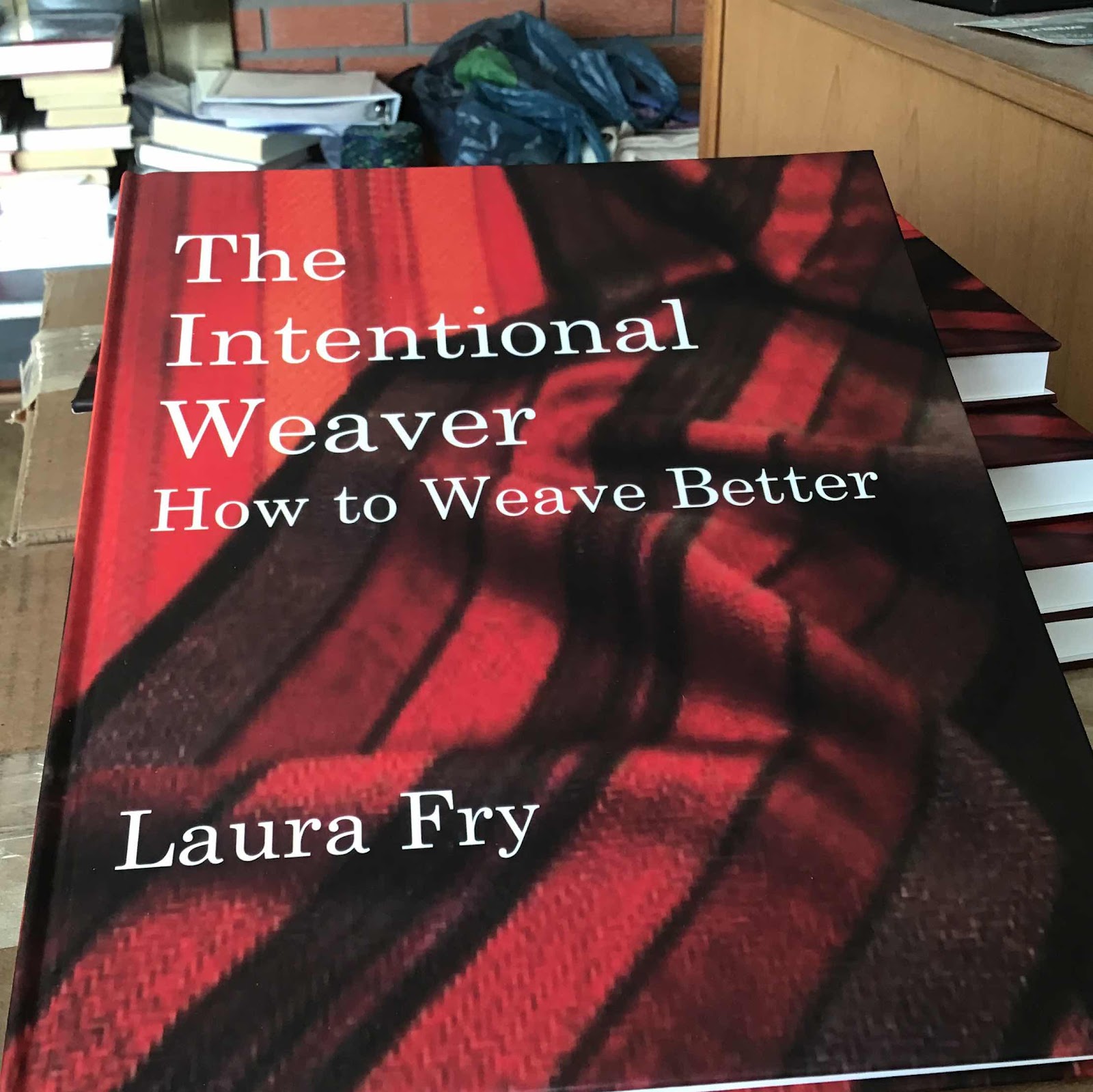
Part of the staging for the conference was pulling the boxes of books out and stacking them, ready to be packed up for the vendor booth I have at the conference.  I have 55 copies of The Intentional Weaver.  They will be available for sale during the conference.  I will also have copies of Weave a V.


Written by Kerstin Fro:berg and published in English here, it's a look at weaving a V-shaped shawl using double weave.  She includes information for both sinking and rising shed looms and general information on double weave as well as details on double width weaving, including tips on dealing with the fold.

If you can't come to the conference you can order The Intentional Weaver and Magic in the Water here

If there are copies of The Intentional Weaver left after the conference, you can order a signed copy directly from me.  People outside of Canada don't have to pay the GST but shipping is $20.

When purchasing in my booth, I have to charge applicable taxes.  For textiles, the taxes consist of 5% GST plus 7% provincial sales tax.  If you are from outside of Canada I can mail purchases to you and not charge the tax, but shipping starts at $20.  Cheaper to just pay the tax. There is no provincial sales tax on books, so just 5% on those.

Today I'm working on the exhibits, looking at what we need for display apparatus.  With the loan of display stuff from a local textile artist I think we will have enough display equipment to display everything.

I am also waiting for emails from several people about personal stuff, while my inbox balloons to nearly 8000 items.  I will be grateful when the conference is over and I can start deleting stuff.  Right now my desire is to just select all and delete but I can't do that.  Yet.


Thursday, April 18, 2019

To Everything There is a Season


We tend to forget that for every beginning there is an ending.  When we are reminded, it can be difficult to cope with the feelings that the reminder brings with it.

In weaving there are lots of beginnings and endings.

Warps end.  Thread ends. Shuttles empty and need to be filled.  Projects come to completion and we are either satisfied with our results...or we are not.

Endings can be fraught with emotion.

As we head into true spring life has served to remind me that there are also endings.  Spring rolls into summer, which rolls into autumn and then...winter.

But as life is a cycle, there is hope.  Spring comes again with the promise of new life.  A friend has goats and they are popping out babies.  Chickens are laying and hatching.  Trees are beginning to leaf out and there are little hints of green showing up in my 'flower' beds.

I have not done as much as I intended - or  hoped - over the winter.  But the current warp is significantly reduced and I'm down to about 7 or 8 more of the navy towels to weave.  That yarn was way thinner than the turquoise and therefore wove a lot more yardage!  But that cone is now empty as all the navy yarn is wound onto bobbins, currently steeping to make them more co-operative.  I'm already planning the next warp.  It was supposed to be a shawl warp, but I'm determined to get this fine linen woven up.  Besides, I think weavers will be more inclined to treat themselves to a half linen towel than a shawl - those are mostly intended for the autumn craft fairs, anyway.

Early bird registration for the conference has ended, and while we will gladly accept 'late' registrations tonight we need to make some decisions.  Better get back to crunching numbers.

Thursday, April 4, 2019

In the Fullness of Time


after wet finishing and brushing


before wet finishing (loom state)

Patience has never been one of my attributes.  I have a plan, I want things to fall into place.  NOW!

Over the years I have had to curb my impatience and just let things develop in their own time.  So I tend to cope with uncertainty with distractions.

Waiting for word on a project?  Oh let's work on that other one (or two, or three...)

Unfortunately repeated health issues and the brain fog that comes with them mean I can no longer multi-task like I used to be able to do.  The tendency has been - of late - to wait and fret for deadlines to come - and go - and not accomplish much of anything at all.  Getting old(er) has not been easy.  On the other hand?  I'm still here - so many aren't.  And since stopping the cancer drug I am feeling so much better.

So it was with a sigh of relief that I read the email yesterday, saying I was booked for level one at Olds College Fibre Week in July.  I will know soon about Tenino, WA.

The early bird registration for the conference ends April 15 and a lot of uncertainty will be addressed when we crunch the numbers of those signed up for workshops and the conference proper. 

I know that our conference instructors are also impatiently waiting for word on their numbers and I want to give them their class lists as soon as possible.  (If you are planning on registering, please do so as soon as possible so that we can give them accurate information.)

We have extended the deadlines for the exhibits, partly because we have been overwhelmed with the generosity of guilds sponsoring awards.  We have a significant number of awards to hand out!  To be eligible for an award, you must be registered for the conference, deliver the item(s) and pick it/them up.  You can still enter exhibits if you are not attending, but assign someone to deliver and return to you.

April is well begun.  Teaching takes preparation and so I'm also watching registrations for Yadkin in NC where I'm booked to do level two and then one; September is the John C. Campbell Folk School.

After that it will be full steam ahead for the craft fair season.

And poof - the year will be gone...

In the meantime, I need to practice patience while events develop in the fullness of time.


Tuesday, April 2, 2019

And On We Go...


The conference registration is ticking along (we'd love to see more people sign up - it's gonna be a time!) and it is time to lift my head up out of that particular deep well and start looking beyond mid-June and to what comes next.

Now that I'm beginning to feel better - for however long that lasts - I am looking forward to possibly teaching at Olds Fibre Week (to be confirmed - or not - depends on registration - as do all events, including the conference).  Fibre Week has been moved to July which means that if I'm there I will be celebrating my birthday with fibre friends. 

In August I'm booked to teach level two and one (in that order) at the Yadkin Arts Centre which is in North Carolina, then back to the John C. Campbell Folk School in September.

In the meantime there is marking from last years students to be done.  There is a flock of boxes en route so I will be checking the mail box daily to make sure I grab them as they arrive.  I will mark in order of arrival.

Feedback from students is that level one is challenging but the lessons learned are significant.  If anyone is thinking of doing the program, consider the fact that it is a college level certificate course and that with the increase in satellite programming you can take it on either coast now.  This year level one was presented on the Sunshine Coast north of Vancouver, level two is scheduled at Tenino, WA (near Olympia), Cape Breton is offering levels 1-3, North Carolina is offering all four levels in August and of course, at Olds, AB during Fibre Week.  Even if you only ever take level one, you will learn a lot of stuff - things that don't normally get addressed in workshops because there just isn't time.  (If you can't take the program, I suggest my book which covers some of the curriculum - it's why I love teaching level one because I've been preaching this level of knowledge for years and finally got it down on paper...)

The other advantage of a core curriculum is that students can move from campus to campus - for example the level one class here launched a couple of people over to Olds for level two.  Level one at Olds launched someone over to Cape Breton and to Yadkin.  And so on. 

Here, spring is coming along with all the rites of spring - the woodpecker hammering away on the metal cover of the street lamp, the dust advisories, the flooded streets.  Spring Break Up - the season that lasts too long...

Friday, March 29, 2019

Adventures...

...I've had a few...


obligatory pretty textile picture

As I was writing up my latest conference blog post I thought about adventures.  I remembered how many fantastic experiences I have had since I took up weaving, all the people I've met, the textiles that have inspired me.

My first conference was 1978 Convergence in Fort Collins, CO.  (I wrote about that recently so I won't repeat that story here.)

Having dipped my toes into the biggest textile event in North America, smaller regional events such as ANWG (Pacific northwest, western Canada) were far less intimidating - and far less expensive.  They were, if nothing else, within reach - either a one or two day drive.  So my first ANWG was Spokane in 1979.

After that I attended as many conferences as I could afford - ANWG as it moved around the region (Oregon, Montana, Washington, here in 1995, Victoria 1997, Alberta)  Convergence when I could scrape the pennies together.  I even managed to get to Vav in Sweden two years ago - a dream I thought I'd never manage.

Eventually I started teaching at conferences, my first in Montana in, um, 1983?  

On the way I met so many talented people.  Some became friends and the internet makes it possible to stay in touch.

As an introvert I was nervous about attending these events, but the people are just as fascinated about textiles as I am and if nothing else there is the learning in the workshops/seminars - and smaller groups make it easier to get to know people.  Then there are the exhibits.

At Victoria's ANWG in 2017 one of the entries in the fashion show was a silk shawl made by one of our instructors - Coleen Nimetz - made from silk she had spun (may even have raised the worms and reeled it, I can't remember) and then knitted.  It was a show stopper.  

(If you want to know about silk, sign up for her workshop!  She is incredibly knowledgeable.)

One of the down sides of organizing an event like a conference is that I have no time to actually take anything.  And because I helped  choose the people and their topics, I want to take every single one!

Early bird registration ends on April 15.  If you haven't made holiday plans yet, consider coming to Prince George and join us in a fibre adventure.  Y'all come!


Wednesday, March 20, 2019

Girl Friends


All of my girlfriends are textile people.  As I engaged more and more with weaving, writing about and teaching it, the more weavers/spinners/etc. I met and the more I found myself wanting to spend time with a group of people who were as passionate about what I was passionate about.

One of the ways I met most of these wonderful women was through attending conferences.  How better to expand your contacts by going to where other like minded people are going to congregate?

Eventually we started meeting up whenever we could, not just at conferences, but at other times as well.

I'm really hoping some of the people I have gotten to know in the fibre world will come to Prince George while the Prince George Fibre Arts Guilds throws a party to celebrate fibre, share their talents, delve into techniques perhaps heard about but not really studied, maybe due to not having a teacher or not knowing where to find literature.

My very first conference?  I knew three people there.  One was the person who talked me into attending Convergence 1978 in Fort Collins, CO.  One was my weaving instructor.  One was the owner of a shop I had been buying yarn from and visited a couple of times.  She introduced me to another weaver from her area.

Otherwise?  I was by myself, surrounded by literally hundreds of people.  My host had been detained by a family emergency.  My teacher warned me she had her own interests she wanted to pursue.  The shop owner?  I only knew because I'd written letters to her.  None of them were 'girl friends' to hang out with.

I'd never been on a university campus before and it was huge.  There were long distances between events, so those few people I knew to speak to?  Never saw them again for the entire event.

I'm an introvert and I was feeling very lonely and isolated.  In fact I was throwing myself a pretty serious pity party, when on a march from one event to the next I spotted a man weaving on a back strap loom, attached to a very young sapling.  There were two women close to him and one was explaining to the other that the man was from Peru.  He had come with an anthropologist who had encouraged the man to attend the conference and could give him a ride.

I didn't know if the man spoke Spanish, let alone English.  His journey to arrive at that place at that time had to have been much more difficult than mine.  I'd simply climbed on a plane, been met at the airport and driven to the conference. 

But even more importantly...I spoke English!

I chewed over my pity party for the rest of the walk to my destination, where I lined up - again.  And realized that if I really wanted to get to know people?  All I had to do was turn around and see if the people behind me were open to talking to a perfect stranger - but one who was at an event celebrating textiles, just like they were.

So I turned around and interjected a comment into their conversation and then happily chatted while the line moved forward.

I'm really hoping that even if someone doesn't know anyone else attending Confluences that they will come by themselves.  Because they will be surrounded by people just as fascinated by fibres as they are themselves.

And the campus?  Small.  Three blocks by three blocks, not huge with long walks.

Come to the party! 


Monday, March 18, 2019

Don't Do It


A few days ago I was scrolling through Facebook and a headline caught my eye.  Something about not turning your hobby into a 'side hustle'.

Since weaving was never a side hustle for me, I kept on scrolling.

I get it, though.  The cost of doing fibre arts has certainly gotten more expensive.  Especially yarn for knitting and crocheting.  Mind you, there are some really interesting yarns available for those crafts now.  Much fancier than most weaving yarns.  It is extremely difficult to knit or crochet and sell what you have made and make any kind of money for the effort.

Weaving is different.  If you are careful, purchase yarns in weaving type quantities, not knitting type quantities, focus on creating unique textiles, you can sell your work.  It's also a really good idea to become very efficient.

But again, I agree, don't try to turn a hobby into any kind of 'side hustle'.  Weave (or spin, or knit, or crochet) because you love it.  Leave it be something you do purely for enjoyment, for satisfaction.  Use it as an intellectual stretch, or a mindful meditation, not another chore to be done to deadline.

However, if your goal is to earn an income, be that supplemental or exclusive, then you are no longer doing it as a 'hobby'.  You are now in business.  And that comes with all of the responsibilities that any business comes with.

When you are weaving as a business, even a part-time business, you have to learn how to run a business.  How to market your products.  How to design your own designs - because face it - in the  21st century, what you are really selling are your designs.  Providing something that cannot be found anywhere else but from you.

I made the decision to become a weaver/designer many years ago.  I'm having a hard time 'retiring' from that work because I still enjoy the physical input of sitting at the loom and weaving.  My production far outstrips my market to sell even 'retirement' production.  In other words, I'm having a really hard time turning my work into my hobby.

I've been working on the conference, thinking about all of the instructors we have booked and how none of them really does what they do as a 'hobby'.  I really hope that people will make an effort to come to Prince George to learn from this amazing cast of characters because we have assembled an enormous pool of knowledge for people to leap into.

If you are sitting on the fence, early bird registration ends on April 15.  After that the cost to register will go up.  We will make our final adjustments to the schedule and swing into final preparations - goodie bags, fashion show commentary, exhibit props.

Go on over to the conference website and take a look through the workshop and seminar offerings, read through the instructor bios, then click on the blue Register Here button, click on the green Tickets button, open a cart, make your selections and join us for an amazing week with like minded people just as passionate about fibre as you are!

Started The Golden Thread by Kassia St. Clair this morning.  I will do a review when I'm further into it, but even the introduction is sparking lots of thoughts about cloth and the role it has in society.

Saturday, March 16, 2019

Community


My work has been on the cover of Handwoven twice.  I was hoping for a 'hat trick', but the news that F & W, the current owners of Interweave are in Chapter 11 re-structuring has left a lot of people - not just fibre folk - wondering about the future.

As weavers, spinners and knitters, there are already options for publications.  Plyaway for spinners has really come into it's own for information about spinning, and Heddlecraft, Vav, SS&D and Complex Weavers present weaving information.  There are other knitting publications than those published by Interweave.

Eventually things will sort themselves out.  Either some astute fibre supporter will purchase the Interweave 'brand', or small publications will start up to meet the demand.  Or information dissemination will happen more and more on line.

Whatever happens, fibre folk have been and will continue to be a close knit (pun intended) community,.

Having been part of that community since 1974/5 I have watched it go through cycles of interest waxing and waning.

Along the way I have met and been inspired and encouraged by many others as fascinated with fibre and cloth as I am.

One of the delights of working on the ANWG conference is getting to work with some of them.

Some of the instructors I have met in real life and consider them more than colleagues or acquaintances.  Those that I do know are without exception positive, encouraging, have a great sense of humour (they laugh at my puns - what's not to love?)  All of the instructors are well informed about their particular specialty (some have more than one!) and generous in presenting that information to eager students.

Part of getting a conference of this scope formatted/organized is getting people matched up with rooms that fit their needs.  And then some of the offerings are more popular than you expect and in both cases, the two most popular presenters have quickly and graciously agreed to take more than they were scheduled for originally.

We are working on juggling the facilities to make sure that the rooms they will be assigned to will hold more and also have the requirements they need to do their job.

Working with people who are ready, willing and enthusiastic in co-operating to make this event work well?  Priceless.  Beyond rubies.

Sunday, March 3, 2019

Assumptions


Next place mat warp ready to go into the loom


There are two sides to everything.  As someone who has taught weaving for a long time, one of the things I have had to do is understand my assumptions.  First I had to understand that when someone didn't know something, they didn't know that they didn't know that thing.

But I also had to understand that knowing as much as I do about weaving, I could not assume that anyone else also knew that thing.

My knowledge and learned processes are so ingrained that there is real danger in simply forgetting to mention something crucial.

I also have a bias because there are certain processes or approaches that I find work best for me.  Again, there is danger in assuming that my processes are 100% best for everyone.

So I have focused on principles and then let people choose how best to incorporate those principles into their practice.

Then there is trying to articulate a motion.  How to find the words to make something so automatic that I almost never think about it any more understandable to someone who may never have the option to actually see someone do that motion.

I addressed this by making short video clips of things (posted to You Tube) but the camera angle determines what the viewer sees.  And sometimes they need to see things from a different perspective.

Interweave gave me the opportunity to do DVDs but again - camera angle is critical.  We did the best we could, but they don't always carry the information everyone wants to be able to see.

Video clips and DVDs are also approaches that are less in depth.  And so I wrote a book.  I could explain in more detail, but the words are static on the page.  We included lots of photos, but again - camera angle.

As teachers know, it is critical to be able to convey information in various ways, different formats.  It is always 'best' to learn in person so that you can get feedback from the instructor.  Having an actual interaction with the instructor reminds the instructor to not make assumptions and the student that they don't always know everything.  It is, in a very real way, a conversation.

When I was first beginning I took every workshop, attended every conference I could afford.  I still take workshops, usually because I want to have that interaction with the instructor, find out how they think, how they process information.

Now that registration is open for the conference I am looking at the offerings and regretting that I'm going to be teaching myself because there are several people giving seminars I would love to sit in on.  Abby Franquemont talking about Peruvian textiles.  Sarah Wroot about historical textiles.  Maureen Faulkner about her travels and textile collection. Susan Pavel about Salish weaving and culture. And more!

When I chose weaving as a career I knew I would not, could not, learn everything there is to know about textiles.  Once again I have been proven right as I longingly peruse the tasty menu of the conference offerings.

Sunday, February 24, 2019

Never Ending Learning

So photos from, oh, 1984?  A long time ago because I'm, ahem, a brunette...and thin...

My initial interest in weaving was in making cloth for clothing.  I wove a lot with 2/60 silk.  These garments are both woven with silk from Treenway Silks.

My background is that I learned to knit age 5 or 6 (so long ago I can't really remember), embroider when I was about 10 (multiple bouts of tonsillitis meant days in bed), sew my own clothing when I was 12.  Weaving was just going one step further and weaving the cloth for me to sew with.  And yes, I sewed both of those garments.

Over the years I have delved into most areas of weaving, but not all.  There are whole swathes of the craft I never see myself digging into - for reasons.  And that is just fine and dandy - no one needs to be an expert on every single aspect of turning thread into cloth.  My focus has evolved into developing fashion accessories (scarves/shawls) and household textiles (towels and table napery).

That doesn't mean I'm not interested in other types of cloth, and which is why I'm casting longing eyes at the conference schedule.

For example, I'd love to attend Abby Franquemont's seminar on Preserving Textile Traditions in the Andes.

Maureen Faulkner's seminar Travel and Textiles:  Culture, Shopping and Making Souveniers a Part of Your Life sounds intriguing.  Partly because I know I'll never get to India or Indonesia as she has done.

Fibres on the Wild Side by Sue Perron is going to look at fibre sources from locally sourced plants. 

Sarah Wroot has studied historical textiles and will use historic fabrics to analyze how they were made.

What's the Point of Spinning off the Point by Mary Lessman?  I didn't know I needed to know this!

I'd especially like to sit in on Dr. Susan Pavel's seminar Weaving Words.  She will bring a traditional Salish Loom and share stories, bridging cultures.

Heide Kraus is a fount of knowledge about cashmere - I learned more in an hour listening to her and Mary Lessman talk than I ever knew I needed to know.

While I know a little about the sashes most commonly known as ceinture fleche', Sue Perron has studied them in detail.

I've never steeked, but Elizabeth Schatz will take the Eek out of Steek. 

Syne Mitchell will look at Etextiles - a marriage of old technology with new.

Ack!  So many wonderful choices.  So much more to learn...I'm going to need another 40 years, I think!

Saturday, February 23, 2019

Conundrum


Photos of scraps of fabric from the textile collection at the fortress of Louisbourg in Nova Scotia.  Photos by Janet Dawson (I had my head buried in the boxes!)

One of the down sides of teaching at a conference is that you can't - or don't have the time - to sign up to take anything.

One of the down sides to organizing a conference means that you get to choose the seminars and workshops - BUT - you don't have the time to sign up to take anything. 

And so...

There are a number of things I would just love to take at our conference but can't. 

When we selected the conference teachers and their topics, we first and foremost looked at the talent available in our region.  The instructors might not be well known outside of our region, but we wanted to give them a chance to share their knowledge and perhaps become better known. 

We wanted a range of instructors who could teach a variety of topics or who had specialized in parts of the craft that perhaps weren't very well known.

We also looked beyond our region for others who were well known further afield, but who also brought a broad spectrum of knowledge, or filled in gaps in our offerings.

We looked for people who were very specialized but also for those who were more general in their approach.

We wanted to cover the spectrum of fibre arts.

We didn't manage to cover every single approach to making textiles - we were limited in the number of rooms available to us to book.

But I think we did a pretty good job, all in all.

Out of the 18 workshops, 4 are spinning, with an additional one that tackles spinning specifically for weaving.  So that one kind of bridges spinning and weaving.

Six are weaving - one is on a backstrap loom, one is on rigid heddle.

One is weaving related because it is about using Fiberworks weaving software.

One is working with colour in weaving - again, primarily weaving.

One workshop is about nuno felting and one is about shibori - a resist dyeing technique.

One workshop will look at dyes from nature, one is about design principles for textiles and we have one Fair Isle knitting workshop.

There are any number of seminars I would personally like to take but since I'm also booked to teach, that won't happen.

However, I can - and will - have an opportunity to talk to as many teachers as I can track down, maybe at meals or at the social gatherings in the evening.  One of the seminars I would really love to attend is Sarah Wroot's where she dissects historic textiles to find out how they were made.  The photos above are from the textile collection at Louisbourg when Janet Dawson arranged for us to see what they have tucked away - mainly because they don't have a budget to do anything more than catalogue the textiles they found in the middens.  I just wish I didn't live so far away because I'd love to study these textiles.  What an honour - to examine them and maybe even give them some information on how they were made.  I'm trying to talk one of the students taking the Olds program in NS to maybe consider studying these textiles for their final level.  And then I could learn more about the textiles from them.  

Tuesday, February 19, 2019

Easy


If it were easy, everyone would be doing it.

John Kennedy perhaps put it best here when he talked about going to the moon.

There are times when we dream those big dreams and they become a lot bigger in terms of getting them to completion than we had hoped.  Or Life Happens and we wind up dealing with stuff that we hadn't expected.

We dare to dream, anyway.  And we work to make them happen.

Take weaving.  When we first begin, it may seem like it's a huge big dream to get something usable off the loom.

But humans have been playing with fibre and string for thousands of years.  Our ancestors needed string to carry parcels.  They needed something to keep themselves warm - what better than have an animal donate their fibre to the cause?  Because once you've figured out how to make string, you can then take that string and loop or interlace it together to make a textile.

Weaving isn't particularly 'easy' - if it was everyone would still be doing it.  Weaving is labour intensive.  It takes up huge swathes of time.  If you also harvest and spin the fibre, it takes even longer.

It isn't 'easy' insofar as you get results quickly.  But neither is it particularly difficult if you learn how the fibre behaves, how spinning it can modify the characteristics of the fibre, then how to get those yarns to work together as one.

We did it for generations upon generations.  And we still do it now.

If we take the time.  If we invest in doing it as well as we can.

There are many things in life that are not 'easy'.  But they are worth it.  When you find your happy place, when you find what makes your heart beat stronger, your curiosity to be engaged?  It is worth it. 

I find designing and creating textiles satisfying and fulfilling.  Teaching others means that the craft that I love will continue on, into the next generations.

It is why I write.  It is why I teach.  It is why I have organized conferences. 

I was 12 years old when Kennedy gave this famous speech.  I don't doubt that it was in some way inspiring to me to think about tackling the hard things.  To aspire to increase knowledge.  To do something, not because it was easy, but because it was hard.

Yes, I have failed at times.  But every failure has brought more knowledge.  And while I don't like failing, I do recognize that sometimes you need to find out how to not do something.

And so - conferences.  They are challenging.  They are inspiring.  They are 'hard' because of all the details.  But they are also so much more than the sum of their parts.

We are in the dark days of winter winding down.  It is February, shortest month of the year.  Whoever made it so knew what they were doing!  It will very soon be spring and the deadline to register for the ANWG conference here will be coming up very quickly.  Take a look at what is being offered.  Expand your horizons, or dig deeper into something you would like to know more about.  Sign up by clicking on the big blue Register Here button, Then on the Green 'tickets' button.  Some things are beginning to fill up.  I suggest you sign up sooner rather than later.

And come see us in June!


Sunday, February 17, 2019

Those Big Dreams


After writing about my brother yesterday, I started thinking about the people I admire and respect.

They all, in one way or another, dream the big dreams.

Some people I have met and am delighted to call friend; others I know by their reputation or their presence in books/magazines, feedback from others, or their on line presence.  Some I met because of our shared on line presence, which then led to meeting in real life.

I started thinking about our line up for the conference and they all, every one of them, have my admiration and respect.

Some are authors (and hopefully will participate in the author signing event - if they aren't too over scheduled/exhausted after teaching for two full days).

All are teachers, of course.  The teaching model up until recently was in person, either in workshops for guilds or at conferences.  Now we have on-line opportunities.

Some are out spoken about issues of ethics. 

All are enthusiastic about teaching, but also about learning.  Being open minded, sharing experiences with others. 

All have dedicated large chunks of their time to the exploration of possibilities in terms of fibres/yarns.

Some of them have - by and large - earned a large portion of their income by teaching and/or by making and selling their textiles.  (Not an easy task!)

Having done this myself, I know how hard it is and the degree of dedication required to show up, regardless of how you might be feeling, and do the job.  (Ask me about the time I got food poisoning the night before teaching a five day class...)

We come into this life with a whole lot of potential.  I suppose it boils down to my respect for those who have figured out what they really want in life, then worked every hour they could to make that dream come true.

You cannot write a book, develop and present an on-line class, create and sell a line (or dozen) of textiles, teach multiple workshops all over the continent, fair weather and foul, without enormous energy being put into making those things happen.  Some of our instructors have done not one of those things, but several of them.  And generally with good grace and cheer.

So I'm going to 'fangirl' a bit and list all the instructors here, again, just to remind everyone of the fabulous event our guild has put together and invite everyone to think about attending the conference in June.

It's going to be fabulous!

Keynote speaker:  Abby Franquemont (Ohio)

Workshops and Seminars: Michelle Boyd (Alberta)
Tien Chiu (California)
Janet Dawson (Nova Scotia)
Maureen Faulkner (British Columbia)
Abby Franquemont (Ohio)
Alison Irwin (British Columbia)
Bob Keates (British Columbia)
Mary Lessman (Tennessee)
Kim McKenna (British Columbia)
Syne Mitchell (Washington)
Coleen Nimetz (British Columbia
Elizabeth Schatz (British Columbia)
Robyn Spady (Washington)
Jane Stafford (British Columbia)
Laurie Steffler (British Columbia)
Bernadette Thompson (British Columbia)
Diana Twiss (British Columbia)
Sarah Wroot (British Columbia)

Seminars Only
Laura Fry (British Columbia)
Heide Kraus (British Columbia)
Yoriko Oki (British Columbia)
Dr. Susan Pavel (Washington)
Sue Perron (British Columbia)
Leola Witt McNei (British Columbia)

Sunday, February 10, 2019

Visualize


As I have taught over the years I have come to realize that not everyone can visualize what something will look like...later...after it's been woven.

If this is the case, then I strongly recommend people weave samples.  Sampling is the only way to know for sure how something will turn out, especially how colours will look after being woven together.

I've been learning about colour in weaving for a long time because I wasn't very good at choosing colours to put together to make a pleasing cloth.  I studied colour theory.  I wound little practice warp wrappings.  I dyed yarn.  But none of those things reflected - precisely - what happens when you take one colour and cross it with another.

Gamps of various colours then became my most effective way to learn how to visualize.


gamp of tertiary colours


gamp of 'neutral' colours


gamp of pastel colours


One of the big complaints about weaving a colour gamp is the expense.  You need to buy a whole cone of yarn for just a little bit of each colour.  So for several years I sold colour gamp kits.  In addition to the more usual primary/rainbow gamp, I offered tertiary, neutral and pastel kits.

This allowed people to explore a greater range than they might have been able to do otherwise.

For some people they just don't know what is going to happen when they cross purple with, say, a red/brown.  Orange with green.  Black with yellow.

If you've never done it, how would you know?

However, if you can't afford to buy all the yarn, you can study what other people have done.

For example, you can look at something you really, really like (or dislike - both have lessons) and examine it for what the weaver/designer has done.  What colours did they use?  In what proportion?  In which weave structure?

The picture at the top is the next painted warp for Tien's class.  I don't know how much she will be able to cram into her suitcase when she comes in June to teach her workshop and seminars on colour at the conference but I'm sure she will bring some.  What better way to learn about colour than to actually see - and handle - woven examples that show precisely what happens when weft crosses warp?

Saturday, February 2, 2019

The Whole Picture


One of the things we learn as weavers is to look at the whole picture - so to speak.

Bringing cloth into material form (pun intended) from individual strands of thread means you have to look at the whole thing.

Fibre characteristics, how the yarn has been spun, the colours being combined weave structure.  Et cetera.  But you also have to look at the entire process of getting that yarn into the loom.  Even smaller, less mechanical looms, all have processes that need to be learned and followed.

The physical skill of interlacing the weft with the warp cannot be ignored.  Poor processes on top of poor techniques getting the warp into the loom will mean poor results.

At times one needs to step back - waaaaaaaay back - and take a look at the whole picture.

In many ways weaving reflects life in this respect.  We can get so caught up in the minute details of life - or weaving - that we do not see the entirety of what is happening.  Like the warp that doesn't go over the back beam...everything looks fine at the front of the loom but at the back?  Oops.

We think we have done everything correctly, but we forget to factor in the things that can either go horribly wrong, or that need to have special treatment.  Not everyone, or every yarn, is the same and sometimes we have to adapt what we are doing in order to get the results we desire.

Sometimes it is a matter of poor equipment choices.  Looms are not the same, nor are shuttles.  The shuttles I prefer for my big hands won't work for someone with much smaller hands.  So all I can do is say what I prefer and why and let people figure out what will work best for them.

Because change one thing and everything can - and usually does - change - one way or another.

So it also is with getting this conference up off the page and into reality.  We are dealing with over 20 different instructors, all with different needs and requirements.  We have 255 workshop seats and 500 or so conference seats.

That's a lot of detail and a lot of different people who need to be dealt with.  As we come closer to the event, we will be fine tuning the event and arrangements.  And asking for volunteers.

In the meantime we are keeping our focus on the big picture - sort of like building a jigsaw puzzle - knowing where we want to be and fiddling with the little bits and pieces of the puzzle, making sure we get them into the right place in the picture.

Or like making a cloth - warp and weft, fibre and yarn, colours, and wet finishing. 

Keeping our eye on the entire picture...

Friday, February 1, 2019

Breaking the Rules


There is a school of artistic thought that says "There are no rules".

I prefer to know what the rules are so that I know how and where and when to bend them.  Sometimes even break them.

For me rules are all about establishing guidelines.  Rules say "if you do this, this and that, the result will be this".  Sometimes I want those results; sometimes I don't.

Rules also give me a place to start.  When I first took up weaving I was dismayed at the multitude of possibilities.  So much so that it became paralyzing.  Where to begin when there are so many options?

Just the other day I was talking with someone about creative limitations.  Creative limitations are not about curbing creativity, but about finding a path through the morass of possibilities.  In terms of textiles, that would be akin to finding the end of the ball of yarn so that you can then use that yarn effectively.

After 40+ years of weaving, I can't say that I know everything there is to know, precisely because of that huge pool of potential combinations.  So I still take workshops.  I still read other peoples books, articles, papers.  And I still learn.

Now my focus in looking for a workshop is a little more focused than when I was just beginning.  At the start, I knew I knew next to nothing, so anything I took was good.  Now I know more and my primary intent with taking a workshop is to find out how the presenter thinks.  Getting inside their head to look at their thought processes shows me different ways to direct my own thinking.

One of the downsides of organizing a conference?  I won't be taking anything.  I will be far too busy with the organizational details, making sure the instructors have everything they need, then doing the other jobs that need doing.  And then presenting seminars my own self.

Not everyone can come to ANWG here in Prince George this year, but there are other regional conferences that may be closer - Mid-West, MAFA, NEWS, etc., etc.

Having once learned the rules?  Go on and bend, twist, break them.  

Wednesday, January 30, 2019

In Praise of Learning


When I began weaving, information on wet finishing was scarce.  Most of what I know about the process I learned from books, and - most of all - trying things to find out what was what.

The best way to learn was to have someone who knew something about it explain it, but they, too, were hard to find.  In the end I 'found' two people, both of them at conferences.

So why do we have conferences?  There are many benefits to a group of like minded people gathering in one place to share information and knowledge, either formally in workshops/seminars, or informally by meeting in person.

Having an in person experience means being able to not just see the textiles but to feel them.  This is very much a tactile craft and the proof of the textile is in how it feels.

The knowledge of how to make a textile by hand nearly disappeared after the industrial revolution, kept alive in pockets here and there - Quebec, Appalachia, other small areas.  It was Margaret Atwater who became best known for her writing - newsletter and books - then others who followed along.

Now we have the internet, You Tube videos, on line classes, etc.  But none of those provides the opportunity to actually feel the textile. 

If you live in a geographically remote area, the internet can be a god-send.  But there really is nothing quite like getting together as a group, to share, to learn, to inspire each other.

Prince George has always been considered far away from everything.  I know because I was born and raised here.  If we needed something that wasn't provided locally, it was generally a 500 mile drive to Vancouver. 

When I began weaving the local college was running a class but again, resources were thin on the ground and everyone was pretty much in the same boat - we wanted to learn but there wasn't much available beyond the college library.

So I made a gigantic leap and traveled to Finland to take a two week class at the Varpaapuu Summer Weaving School in 1977.  While there I met hand weavers from Europe and the United States.  (There were supposed to be two Canadians but one had fallen ill so both had cancelled.)

There was the French woman living in Moscow.  The Swede living in South Africa.  The Japanese woman living in Sweden (I think - it's been a good many years), some Germans, and half a dozen Americans.

Us English speakers tended to hang out together mostly, and one of them invited me to attend Convergence 1978 being held in Fort Collins, CO.  So my very first conference was the biggest textile arts conference in North America.

Quite the deep end of the pool for someone who had never even been on a university campus before, never mind a conference with 1500 or so people.

It was overwhelming.  It was also a good lesson in so many ways.  I knew exactly two people, and managed to run into each of them once during the conference.  Otherwise?  This introvert had to get comfortable with talking to perfect strangers.  But they were strangers who were just as interested in textiles as I was.  And suddenly I found myself able to talk to people about a subject that was dear to our hearts.

My next conference was the following year - ANWG in Spokane, WA.    Again, it was easy to talk to people because we all loved textiles and talking about them.

There were exhibits.  There were seminars.  There was the fashion show.  There were people attending wearing their hand made textiles.  There was talk and laughter and the joy of being with others who were 'warped' in the same way you were.

It was a time to delve deep into subject matter where resources had been difficult to find.  Over the years I have taken workshops and always, always, learned something.  Sometimes the lesson wasn't what I had been expecting, but valuable, nonetheless.

Sometimes I learned that I really didn't need to explore that technique any further, but I walked away with more knowledge than I had had.

Sometimes I learned that I really wanted to know more, and generally had a list of resources where I could do further exploration.

Sometimes I just was completely and totally inspired and in awe of the person doing amazing things and I became a more informed viewer and appreciator of their work.

A conference is a short, intense, exposure to a variety of techniques and tools that could be done on one's own, but it would take a lot longer and still might not pinpoint the resources needed to fully understand the process.

It is also an opportunity for people to meet face to face and talk to each other. 

Knowing that you aren't alone can be very helpful.  There has been a great deal of growth in knitting over the past few years, and gradually there seems to be interest in spinning/weaving growing, too. 

For our conference we have tried to have a good range of textile techniques because weavers and spinners rarely do just the one - if you spin you are making the raw materials for the next stage of textile making.  So, many spinners knit and/or weave.  If you weave, you can either make a finished item, like a towel, or yardage to be sewn into something else.

We have assembled a fantastic team of instructors.  Having been in the weaving world (and peripherally in others - spinning, knitting, bobbin lace, even a wee bit of felting) I have gotten to know a lot of people involved in teaching.  Having attended many conferences (and taught at a fair number as well) I have gotten to know many of the 'name' teachers in the world.

I think we have a good range of topics, presented by some fine instructors.

So while it may seem 'expensive' to travel All This Way, people will have the opportunity to access very knowledgeable people, see exhibits of really good work, and spend some time getting to know the faces and names of people they may have seen on line.

There will also be a vendor hall...just saying...

We have worked to create a good experience for everyone.  The facilities are all within a block or two of each other and all are accessible with elevators to the upper floors.  There are plenty of restaurants within the hotels themselves, or a short walk away.  Our town has a broad range of cuisines to choose from and many are just five minutes from the convention complex.  Including craft breweries and a chocolatier!  There is a fruit winery about a 10 minute drive away, on the bank of the Nechako River.

We have a conference rate for both hotels and discount codes for both major airlines.  There is an airport shuttle that will take people from the airport to either hotel for a reasonable rate. 

For Americans?  Remember that all prices are quoted in Canadian dollars.  As of yesterday $395 Cdn was approximately $300 US.  The airlines are Canadian and are quoting Canadian dollars, as are the hotels. 

If you've never been north of the 49th parallel, you'll enjoy our long daylit summer days.  Prince George is at about the 54th parallel.

Check out the website for tourism information.  Come early, stay late if you like.  But do think about the rare experience of being able to talk to others as 'warped' and 'twisted' as you may be.  Share your textiles.  Broaden your horizons.  Learn.

Thursday, December 27, 2018

On Line Resources


I don't 'do' resolutions for the coming new year, but thought I would share some on line resources for people who want to increase their knowledge in the coming year.

As some of you know, I have been weaving samples for Tien Chiu's on line course on colour for weavers.  She has launched her first class which will begin shortly.  You might want to check out her resources and consider if her class is right for you.  She has been working on streamlining her website and will soon move the forums to a different platform which she hopes will be more user friendly.

Jane Stafford's on-line guild is another resource people may find helpful.  I've known Jane since the mid-1980s and she gives good straight forward information in a concise clear manner.

Janet Dawson's class on Craftsy is a basic class on learning the fundamentals of weaving.  Just this morning she mentioned that she now has over 8000 students - something that shows people are becoming interested in weaving again.  Recent articles say that hand weaving is having a resurgence.  Something that makes me feel confident that the craft of hand weaving will continue for a long time to come.

Heddlecraft is an on-line magazine by Robyn Spady.  She covers one topic in depth per issue and includes .wif files for those with computer software for weaving.

Interweave Press has now migrated much of their dvd inventory into 'classes' such as mine.

WeaveZine and WeaveCast were created by Syne Mitchell.  Syne continues to fund the website so that people can access the articles and podcasts.

These are just a few on line resources.  Feel free to add more in the comments.

(PS - all of those named above are also instructing at the conference here in June.  For two of them it will be the last in person teaching they will be doing.)

Sunday, December 23, 2018

Conference Bustle

ANWG 2019 Conference - Confluences


Now that the introductory offer for the book is over there is a bit of a lull before the actual books arrive so thoughts have returned to the conference.

If people are interested in attending I strongly suggest signing up for email updates if you haven't already as important announcements will be forthcoming in the new year.

We are very excited to present the ANWG conference in Prince George again.  We did in in 1995 and here we are, holding it again.

For those guilds who say they are too small to host a conference?  If you have the facilities, you can do it! 

We are fortunate in having the Plaza with convention centre, library, art gallery and two major hotels all within a short walk of each other.  We hope to utilize the plaza as well, but that will depend on the weather.

The conference will take place in mid-June so people can enjoy our long summer days.  Our weather is generally mild, but we suggest bringing layers.  There are plenty of restaurants in all price ranges within a short walk, with food services at both hotels, the White Spot across the street alongside a Tim Horton's.  But there are others nearby and well worth checking them out.  Many are listed on the website with the tourism info.

Do check out the website where there is information on the facilities and points of interest.  If you have a spouse that enjoys hiking, there are walking trails within the city itself, but lots of trails within a relatively short drive of town.  The Ancient Forest is a rare inland rain forest with trees estimated to be 1000 years old.  The lower part is wheelchair accessible but the trail isn't terribly hard.  Do stay on the walkways though to protect the forest floor.

There are lots of rivers, streams and lakes for water sports like canoeing or kayaking or fishing.

The Railway Museum has interesting artifacts (many collected or curated by my brother - just a little bragging! - I may ask to have the jacket I wove for him on display.)  Exploration Place has interesting exhibits and the art gallery will host the teacher's exhibit in the Galleria.


photo used for inspiration - my brother created the chart, I adjusted it so it could be woven

Forms for exhibits, fashions show and author signing are available on the website with a deadline of April 1 for the first two.

Registration should go live sometime in January.  By signing up for email updates, you will know as soon as it does.

We can accommodate 500.  I'm hopeful we will sell out.  Stay tuned for updates!

Tuesday, November 20, 2018

Another Show, Another Year


some of my stash that needs using up

We are home from Calgary and the last 'big' show of this year.  The guild will be having a sale in the guild room and I have a small number of 'orphans' and end-of-the-line textiles that I will put on deep discount, but that weekend is more a time to sit and knit or spin as traditionally not very many people come.  It's a quiet weekend when I can contemplate what is to come.

As mentioned previously (probably way too frequently!) I have been spending a lot of time thinking about the next few years - what they will hold, what I will be able to do.

Long car rides are also a time for some contemplation and the 13 or so hour trip yesterday provided time for us to discuss what the coming year holds.

First of all...(ta-DAH) the book.  I leave in a week for San Jose (bringing filter masks because they are still under the same kind of smoke pall we dealt with over the summer and masks are getting hard to find down there).

I have to follow up with the website about their quote on a print version for my introductory special, which will be announced on Dec. 2 when we hit 'publish'.

Then the guild sale.

I have some weaving to do for Tien for her on-line class.  Her launch date is in December so stay tuned for further updates.  She posted one yesterday while I was on the road and there should be news on her blog.

Before I left for Calgary I beamed 30 yards of 2/16 cotton on the AVL for tea towels.  This will be done in Snail's Trails and Cat's Paws block twill for tea towels.  This warp should finish off the last of the cottolin in 2/16 and I will weave a sample of the singles 12 linen and see if I can finish off whatever is left using that.  If not, there is plenty of 2/16 cotton that can be used (up).

These towels (plus many others) are intended for sale at my booth at the ANWG conference (where I will have print copies of The Intentional Weaver and probably Magic in the Water as well as Weave a V.)

In the new year I have agreed to weave more samples for Tien's on-line course.

There are 8 scarf warps waiting to go into the Fanny, plus a couple of scarf warps for Tien.

The print copies from blurb for the introductory offer should arrive sometime the end of January, so time then will be spent signing them, packaging them up and mailing them out.  As long as Canada Post has settled their strike/negotiations.  Waiting on tenterhooks for that settlement.

We brought home the first box of Olds homework and I hear through the rumour mill that several more are imminent.  If all send, that's about 40 boxes to be marked.  Again dependent upon Canada Post getting their settlement done.  Canadians could (if they choose) send by courier, but Americans, please note that I will have to pay brokerage and possibly duty if sent by courier.  You might want to wait until Canada Post is working properly again.

I'm hoping to hear any day about teaching again at Cape Breton - just level two and three.  Dianne is working on getting a level one instructor.  (Dianne is also working on developing the Master Spinner program at Gaelic College, in August, in case anyone in the east is interested.)  Plus there is Fibre Week at Olds College, next year in July.

We have more or less decided to return to Calgary one more time next year, so in between working on some research and doing the above, I will carry on with stash reduction.  This year I was able to move six boxes of yarn out of the annex and into the studio storage here.  AND I still have a little space on the shelves, so the stash is going down!!!!

And of course, the conference registration is slated to open in January.  Right now my input is minimal, but come February I will have conference duties to tackle again.

Hmm.  This semi-retirement thing.  How's that working for me???

Currently reading The Hundred Thousand Kingdoms by N. K. Jemisin