Showing posts with label linen. Show all posts

Friday, December 5, 2025

Unseen Forces


Thinking about 'unseen forces' in weaving, it's time to remind people that if you live in an arid climate, or more especially, one where the relative humidity swings seasonally, you may run afoul of the issue of low humidity in the air.

When that happens, things go 'wrong' and it may be difficult to tell why that is so.

When the relative humidity in the environment drops, weaving can become a challenge.

If you have an electric bobbin winder, you might start getting static discharge shocks while winding bobbins.  For some yarns, just winding a warp on a warping board or mill can see the generation of static discharges.

When the relative humidity drops, wooden equipment can develop issues as the wood shrinks.  The loom or whatever might develop squeaks, and screws become loose so the loom can go out of alignment or wobble.

Some yarns will behave poorly.  Linen and other cellulose yarns can suddenly stop co-operating.  Linen in particular will become stiff and unruly, and not want to feed off a rotating bobbin nicely.  

In the case of linen as weft, I wind bobbins ahead of time and store them in a 'humidor'.  And I don't fill the bobbins higher than the flanges on the bobbin because linen is dense and a very full bobbin can create excess drag that might be too much stress for selvedges.

If it gets very dry, other yarns will become less co-operative as well.  

If the relative humidity drops below 40% in the house I run a humidifier.  Everything just behaves 'better' and I have fewer issues with dry rough hands.

I still have a little linen yarn left that I need to use up, but I'm trying to work on a few other things right now.  Even though I'm not weaving with linen at the minute, the humidifier has been running for over a month, and will continue to run until spring when the relative humidity returns to higher than 40%.

Sometimes it's not you, it is an unseen force at work.  But now?  You know to take that into consideration if you experience wild swings in relative humidity where you live.

Monday, July 14, 2025

Flax vs Cotton


Fabric Science 7th edition page 23
cotton (left) and flax (right)


Textile Science 2nd edition page 51
flax


A while ago I was reading an article about a new discovery that placed humans working with fibres back even further than we thought previously.  

Textiles tend to degrade and discoveries were rare, or were dismissed as being too insignificant to be of interest, until lately.

However, one of the photos that had been used in the magazine article (which I cannot now find, of course) showed an example of what they said was linen (or flax) fibres.  But what that photo showed - to me at least - wasn't flax but cotton.  I went searching on line and found the original paper and no such illustration was included with the paper so I wondered - had the magazine randomly done a search online and found a picture labelled flax, but which was actually a photo of some cotton fibres?  And I did actually find the magazine photo posted online, labelled 'flax'.

The topic came up on a group I belong to and I began to question what I had seen, and if I was correct in my interpretation.  Late last night I rooted around on the web and looked for better photos of fibres magnified such that their shape/structure could be seen so I could better compare them.  What I found pretty much confirmed my conclusions, but there is such a thing as confirmation bias, so today I sifted through several of my textile science books.  Not all the illustrations were helpful in trying to show the actual structure of the fibres.  Some just had really good word descriptions, others had simple sketches.  But I did find interesting images in several of the books and chose these two to share in the post today.

The first one has a decent comparison of cotton and flax, including a cross section.  The second has a bit more detail about flax.

Cotton fibre comes from the boll (or seed head) of the cotton plant.  While growing it forms a hollow tube, closed at the tip.  When it is harvested, the tube 'deflates' and the fibre becomes a ribbon, with twists back and forth along the length.

Flax is a 'bast' fibre and comes from the stalk.  It is segmented along the length, and while it has a very small 'hollow' at the centre, there isn't much room for the 'tube' to flatten in the way the cotton fibre will.  

And this is why I don't ever just accept whatever the first site I find says.  I will go digging, deeper and deeper, if I can find more websites, to see if the various resources agree, and if they have different conclusions, do they say why?  

While I search I ignore the now overbearing AI 'recommendations' because there is no 'intelligence' involved.  There is no intellect that can rationalize and/or interpret the subject.  AI is *not* your friend in such a search (or most searches, imho).  In the end, I went back to my trusted library (I have at least six textile science books in my library!) to try and tease out the best information I could find.

My 'usual' first book that I grab didn't have quite as much detail as I was looking for, so I pulled the rest off the shelf and checked all of them before I chose which ones I would use.

So, am I right?  Dunno.  But what I saw in the photo labelled 'linen' were cotton characteristics.  My concern is that someone who doesn't have the resources I have will accept that photo in the magazine as being accurate.  And as far as i can tell - it isn't.

I'm not saying the archeologist didn't know what they were doing - *they* didn't use the photo in their paper - it was the publication that included the photo.  It was, more than likely, just a mistake.  But it's a mistake that will be carried on with people who don't know repeating it.  Or looking at cotton fibres in the future and assuming that they are looking at linen instead of cotton.  

How important is this?  Perhaps not at all.  But it is a good example of not believing what you see online without double checking.  Because mistakes happen...

Saturday, March 22, 2025

Textures


It's been quite a few years since I've woven this design and I had (sort of) forgotten the tendency of the cloth to develop quite a lot of 'texture' during wet finishing.

I know people tend to say that 'tracking' only happens in plain weave, but the phenomenon of tracking will happen to other weave structures - it just looks different to what happens in plain weave.

I wet finished this load of towels the other day and finished pressing them yesterday.  When I had taken them out of the dryer, I was immediately reminded about the twill blocks tendency to 'fold up' - when I'm working with small sized 'blocks' of twills that change from warp emphasis to weft emphasis.  Especially when using two completely different yarns, warp and weft.  

This morning I did the finishing press on another twill block design, also a small size of twill blocks, and it also tried to develop some texture, similar - sort of - to waffle weave.

Not all, and not woven in all fibres.  But if you do something similar and you wind up with a very 'crumpled' cloth while still damp from wet finishing, don't panic.  Keep the cloth damp until you can give them a good *hard* press.  The above photo is before hemming and will receive a 'finishing' press once they are.  But even so, if you look close you should be able to see the difference between the blocks.  Plus you might just be able to see the 'faux' plain weave design woven into the cloth.

Tuesday, December 3, 2024

Staying Flexible


I cut the last warp off over the weekend and starting prepping the next one.  I have about 1/4 of the warp threaded, and hope to finish that today and to commence weaving tomorrow.

As I worked with the Swedish Snowflake design some things bothered me about the draft.  Since I had to 'shorten' the threading draft in order to accommodate the lower epi, I decided to edit out the areas of satin weave threading/tie up.  In the end I'm more pleased with this slimmed down threading draft and I will be working with this draft as I sort out the treadling sequences I will be 'testing'.

I used to have a neighbour who was Swedish, then moved to Canada to marry her Canadian sweetheart.  She had a tough time adapting to a different culture - at times - and one day I showed her a design I was playing with - Swedish Snowflake.  She nearly jumped out of her chair saying that the design was the version of snowflake twill that represented her 'province'.  

It was then I learned that there is a whole 'collection' of snowflake twills and I explored designing with them for a while

At any rate, she asked me if I could make her some tablecloths.  Her table was from Sweden, wider than most tables made at the time here, and she had 3 leaves she could use to make the table longer.  She asked from time to time if I would make her a 'set' of tablecloths for her table and I refused because at the time I only had a manual dobby and I couldn't face pegging a double width version.  My 60" wide weaving width AVL could not make a table cloth as wide as she needed without doing it double width.

As the years went by, AVL offered a computer assisted dobby.  I waited a year for them to (hopefully) work the bugs out, then bought one.  I was also taking a bit of a  hiatus from production weaving, so I told my friend that if she bought the yarns, I would make her tablecloths.  The thing was, she would have to wind off some yarn onto spools because I would need 72 yarn packages and I didn't want to purchase 72 tubes of 2/16 cotton.

She agreed, I ordered the yarn and brought her my small electric bobbin/spool winder so she could wind the yarn onto the spools.  

Beaming the warp was a bit...interesting...given my spool rack only held 60 spools and I had to jury-rig for the additional 12 spools, but eventually I got the warp beamed, threaded, and the treadlings designed.

She wanted the table cloths to have a 'border' all around the edge, not to just have the pattern 'fall off' the end, so I had two treadlings - one for the border, and one for the main body of the table cloth.  I had taken copious measurements of the table with each leaf installed to show the 4 sizes she wanted.  And then I had added about 10 yards in case of 'oopsies'.

This warp was probably the most 'technical' I've done, insofar as I needed to make them 'perfect'.  Her Swedish sensibilities would not tolerate the dimensions being 'off'!

It was also the slowest weaving I've ever done.  Instead of 9 yards a day, I could manage 9".  Every single shed had to be checked that it was 'clear' before throwing the shuttle.  I did NOT want the two layers 'stitched' together!

It was a challenge!  And one I won't repeat.

However, I managed to weave the four tablecloths, and handed them over 'loom state' (in part because in Sweden, when you bought linen cloth it was never wet finished for you to prove that you were buying 'new' and she had lots of experience with wet finishing and cleaning linen textiles.)

After that I still had about 10 yards of warp left and I had some somewhat thicker linen weft so I wove myself and a friend each a tablecloth with the blue linen.  Our blue tablecloths were not 'perfect' but I wasn't about to mess around changing the epi to make them more 'perfect'.

Am I glad I did the tablecloths?  Yes.

Would I do this again? Hell, no!


Sometimes you just need to go more slowly to get the results you desire.  The double weave fold is in this photo.  Can you see it?


Tuesday, October 29, 2024

Thinking Things Through


Linen from Lithuania, Tex 56 or Nm 17.9

I received a gift from someone in the form of linen produced in Lithuania.  I chose the fine singles because my end product was intended to be tea towels, and I thought this yarn would make a lovely weft.

Since I really liked the end product, I bought 5 more kilos in dyed white.  (I know I'm supposed to be stash busting, hush!)

I proposed a project for the new magazine and while it hasn't been approved yet, I figured it would be a good idea to do some experimentation to go with the idea I had to weave.

The singles linen is finer than 2/16 cotton, but that was what I wanted to use as the epi.  However, the idea I had for the article was to weave with two singles in a double bobbin shuttle, but 36 epi - my current warp density - wasn't going to 'work'.

Yesterday I got to the end of towel #6 and instead of weaving one more towel, I wove a couple of samples with the 2/16 and two strands of the singles linen.

My initial thinking is accurate, it looks like.  It's the wrong threading/treadling and the wrong epi, but I was looking to add more data to my decision making, and it's looking like the 32 epi that I expected would be needed, is.  Just based on the difference in the density, the weft is beating in too loosely to square, so it looks like 32 is going to be a better match.

Normally I wouldn't fuss too much about a weave that doesn't beat 'square', but there are times where it becomes important.  On this project it's optimal, if I can get there.

I won't go into that here now because if the project is accepted for the magazine I'm not supposed to talk about it before it is published.

But I thought it was fair game to talk about the steps leading up to my actually going ahead with this idea.  And, who knows, if they don't feel it is appropriate for them, I can go into the details here when I get them done.  Because now that I've done this much work on it, and exploring the factors that are being considered during the design process, I might as well share, if no where else.  


Saturday, June 8, 2024

Beige - Boring, or Subtle?


2/16 cotton warp, Lithuanian linen size N56 (if I remember correctly)

When seen from any kind of distance, this cloth simply looks...beige.

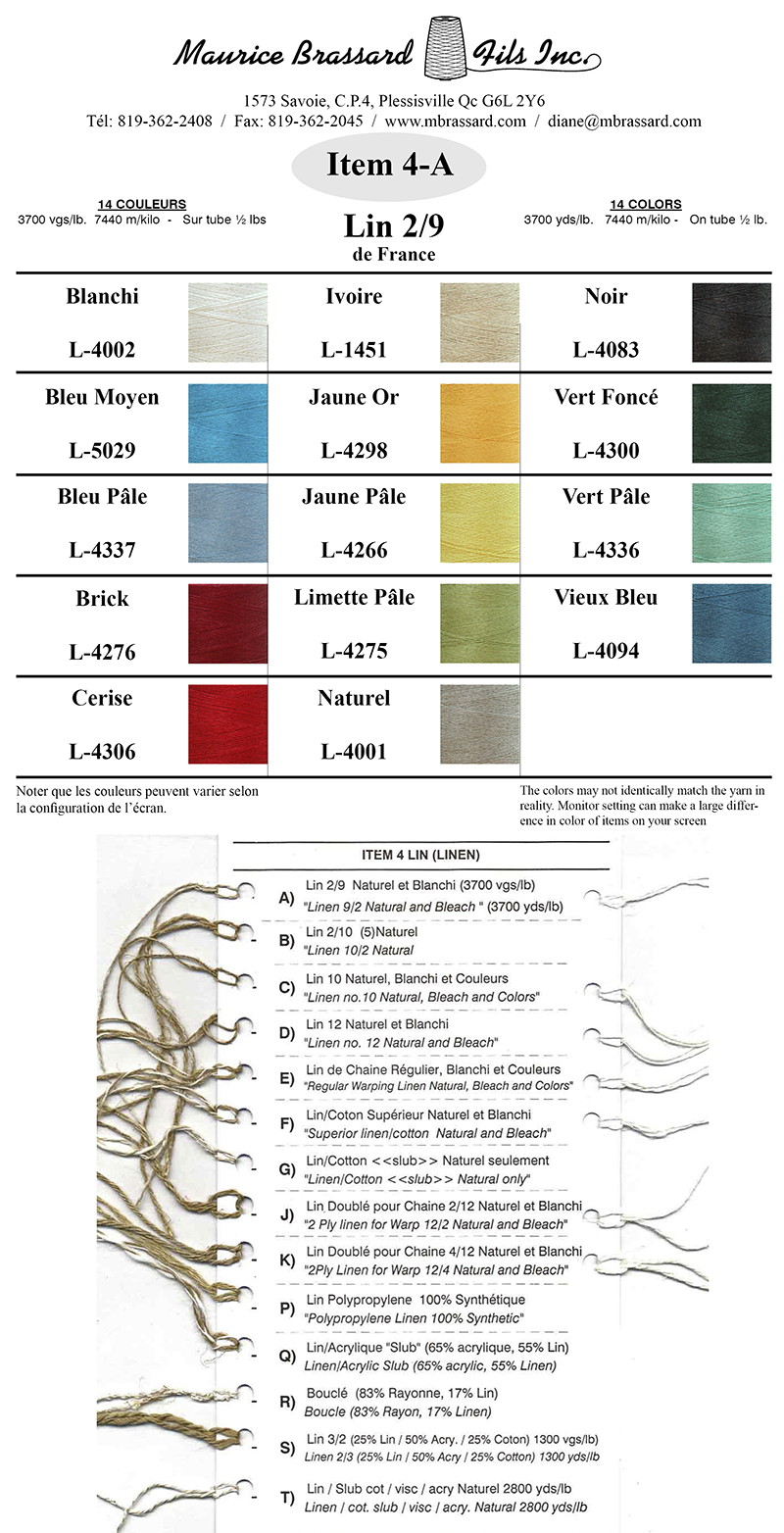
The warp is Brassard's 2/16 cotton in two closely related hues and values of beige, and the weft is the singles linen from Lithuania I received as a thank you from a student I helped.

It took me a little time to get to it.  I had to order more cotton in as I had pretty much woven down my 2/16 cotton stash and didn't have anything near enough to create a warp, never mind a colour I thought would be good for the natural coloured linen.

Coming to the end of the warp, I decided I could tell it was going to finish up nicely, so I then took a look at the seller's website and decided to get some bleached linen.  

Why, when I'm *supposed* to be downsizing my stash did I decide to buy yet more yarn - for which I then had to order more cotton to use as warp?

Because I found this warp very satisfying.  In spite of the 2 threading errors and the 3 sleying errors, once the warp was weaving it was trouble free.  The linen, steeped in humidors for at least 3+ days behaved beautifully, and even in loom state it felt like there was great potential for it to be a really nice tea towel.

And, since I recently, consciously, decided to only weave things I wanted to weave, buying more yarn that was going to bring me this much satisfaction seemed like the right thing to do.

The shawl warp should come off the loom tomorrow and then the warp for sampling (and more stash reduction) will go into the loom.  I still haven't decided exactly how much I need to weave for samples, but I'll put on my 'usual' 60 turns (about 24 yards) and crunch numbers later.

The yarn from Brassard should arrive on the 11th, so that will be here ready to go into the loom as soon as I get the samples/towels woven.  I will design another 'fancy' twill, make sure I have some plain weave in the tie-up so that I can keep the epi at 36 and not push it to 40.  The weight and feel of this combination feels quite lovely - and I know that as they are used they will improve.

So, it seems that sometimes you *can* get satisfaction!  (Take that Rolling Stones...)

Tuesday, May 14, 2024

Oops.


Yesterday I cut the first 7 towels off the loom.

I gotta tell ya, weaving with this linen from Lithuania has been lovely.  

When it arrived it was a bit thinner than I had expected (still not great at converting metric to imperial - my bad), but thinner can always - in a pinch - be made thicker, right?

But instead I mulled it over and decided I didn't want a thicker towel - thinner towels are just more absorbent, more flexible, just more...tea-towel-like...than a thicker cloth.

So I bought 36 tubes of 2/16 cotton, beamed the warp, designed a weaving draft based on one from Ars Textrina #14, tweaked it to make it 'fit' what I wanted better, added borders, added hems, etc., and then in the tie up added some plain weave to help stabilize the somewhat thinner linen.

When I was getting close to being able to weave I wound off as many bobbins as I had available and stored them in humidors (see previous blog posts on how I prepare linen for weft - topic 'humidor') to 'steep' for at least 3 days (or longer - longer is better when it comes to linen).

The warp went onto the beam quite smoothly, although I did have some hiccoughs while threading and sleying.  Nothing terminal and soon fixed.  (Just really annoying!)

Since then I've managed to get to the loom pretty much every day for at least one session and the loom is co-operating, too, so this whole experience has been very enjoyable.

So much so, I went back to the etsy site where the yarn is being sold to see if they had half-bleached.

They had what they called 'dyed white' under two different listings.  The description appeared identical, but the price was different.  One listing was being offered at a much lower price.  I mulled it over and thought that perhaps the lower priced yarn was from an older batch and they were just trying to move it out.  As I thought and looked at their other offerings and then went back and forth between the two listings for the white yarn, I noticed that a number of people had the cheaper yarn in their shopping carts.

A really good psychological tool for marketing, because it spurred me to put some in my cart, too.  And thought some more.  And decided that if I was going to buy more yarn it made a lot more economical sense to buy more than a kilo, given shipping and whatnot.

So I ordered.

Five kilos.  

Yes, yes, I know I'm *supposed* to be weaving down my yarn stash.  But I'm not buying this on spec, I have a plan for it.  (Seriously!)

Once the current warp is off the loom I will put a shawl warp on and get some of that excess of rayon yarn woven down and while I'm doing that I will think about which colour(s) to order in from Brassard of the 2/16 cotton.

Because I'm not done with weaving yet, and I'd rather weave with yarn I like than with yarn I don't.

And since it takes a long time to do the fringe twisting, I kinda need to get those shawls done now so that they are ready for the craft fairs in the fall.

My story, sticking to it.

(If you want to buy some tea towels, there are plenty in my ko-fi shop.)


Sunday, May 12, 2024

Struggle


It feels like my life has been a constant struggle since...I can't even remember when.  My entire life?

So I'm used to things not being comfortable.  Or going smoothly.  Or having to stop and re-jig what I want to do because it just isn't working out the way I wanted it to.

To be honest, this warp started out just like that.

I made not 1, not 2, but *3* threading errors.  Simple ones, fairly easily fixed with the addition of tied in repair heddles.  Just...annoying.

I suspected I had a sleying error but could not find it, only to discover - in the process of fixing the threading errors - that somehow I'd overlooked a bundle of 5 ends and never sleyed them.  Right smack dab in the middle of the warp.

Again, fairly easily fixed, just time consuming.  And irritating.  

But I started weaving again, then noticed that in the process of fixing the threading errors, I'd introduced a sleying error.

GAH!  Again, fairly easily fixed when I got to the cut line.  So, one towel has a very minor 'error' in it which may actually disappear in the wet finishing.  Or not.

But once all that was dealt with and I actually began weaving, I was surprised - and ever so grateful - to have things start to go smoothly.

(I hesitated to actually write about this in case I invoke the 'curse' that comes with the hubris of thinking I'm doing something 'right'...)

Anyway, I just finished towel #5 on this 24 (or so) yard warp which should yield around 19 or 20 towels.

The fine linen is behaving beautifully, having been steeped in a humidor for over 3 days.  My selvedges aren't perfect, but they are 'good enough'.  

And I'm enjoying my time at the loom, not needing to fight with the yarn or the loom - just sit and toss the shuttle and beat the weft into place.

I am enjoying it so much that I am seriously considering buying more of this fine linen to make more tea towels.  And trying really hard to *not* do that because I am *supposed* to be weaving down my stash, not adding to it!

However, it looks very much like this warp will use up the kilo of linen and then I may consider finally putting a shawl warp into the loom.  I prefer to fringe twist finer threads, especially for something like a shawl, and that takes time.  It actually takes longer than hand hemming.  I'm out of shawls, and I still have way too much yarn in a variety of fine rayons that I need to weave down.

But the jury is out on which direction I will go.  At the rate of one towel per day (on average) it will take me another two weeks to finish this warp.  

I have time to cogitate.

Tuesday, February 20, 2024

Enablers


Happy Tuesday to me.  :)

I am blessed with enablers who send me yarn (and books).  On this snowy Tuesday morning, a kilo of fine singles linen arrived from Lithuania.

It's a bit finer than I had envisioned, which means I will have to re-tool my plans for it, but never mind, anticipation is all part of the fun of weaving.  Thinking about what to do, how I may need to make adjustments to achieve the desired results is all part of the fun!

The company sells this yarn either singles, or 2, 3, or 4 ply.  If the singles is anything to go by, it should weave up very nicely, and then wet finishing with a good hard press ought to produce a really nice quality of cloth for things like tea towels.

I'll be pairing this as weft on a 2/16 cotton warp.  I needed more of that yarn to finish off the rest of my 2/16 cotton weft yarns anyway, so it will all come together quite nicely, I think.  Giving the singles the eyeball test, it appears to be a wee bit finer than sewing thread and is labelled Tex 56.  They convert that to 8854 yards/pound.  It has slight texture, and a lovely subtle sheen.  I think I'm going to like the results! 

They also offer it dyed, but I chose the natural colour which is has a bit of a golden glow to it.

So I won't get to this yarn right away.  I have the current warp of blue/peacock to finish weaving, then two more of that colour to finish up, which will give me time to cogitate on how to use this lovely yarn and then order what I need from Brassard.

Thank you to this particular enabler who has given me the gift of anticipation and being able to work with a new-to-me yarn.  

Sunday, February 4, 2024

Yarn Choices


attempting to tame the dry linen by making a 'humidor' and letting the bobbins 'steep' in a humid environment for several days before attempting to weave with it.  See link to previous post given below.

Had a question this morning about yarns listed in a very old booklet with projects for weavers.  The yarns given are no longer 'common' and the question was, what could they use if they can't find the yarns listed?

One of the yarns was linen, so I rooted around looking for a substitute, but it's a bit hard to find things that have gone out of 'fashion' and are not now available, so I offered some suggestions.  

But, I also just finished weaving with linen as weft and thought it might be a good idea to review working with linen, when you live in an arid environment.

(If you want to read my original blog post, that's here.)

Sourcing yarns can be a huge challenge when trying to replicate an 'old' project and sometimes the best you can do is come close.

I just cut my cotton warp/linen weft tea towels off the loom yesterday and so far I'm pleased.  Of course they are enormously stiff in loom state - a factor of using a singles 12 linen for weft.  Brassard still sells that quality of linen yarn, and I've used it previously (obviously, since I have/had it in my stash!).  I wish I could find finer linen singles, but they are not commonly available, so I make do.

Linen is more expensive than cotton, so I tend to use it as weft only.  (No loom waste.)  Not to mention that right now the relative humidity in my house is running around 30% - on a good day.  During the cold snap last month it went down to 20%.

Linen becomes very brittle when the environment is arid and if using it for warp, expect breakages.  There is a reason linen is woven in humid environments - it just behaves so much better.  

When it is starved for humidity, it becomes very unruly, and as mentioned, brittle, tending to break when used as warp.  

But all yarns need a little humidity, even cotton.  Wool and silk will also develop static electricity when warp winding, bobbin winding, or even in the loom.  

A further challenge to sourcing linen is that so many linen yarns are now 'cottonized' which means the long staple length has been cut into about 2" lengths.  Finding actual 'line' linen is difficult and when you do find it, it will be expensive.

I did, however, stumble upon a listing in Etsy:

They may possibly still be spinning line linen and offering larger cones, not tiny spools.  I would have to do further digging to find out if their yarn is line linen and what kind of pricing they are asking.

Since I'm in Canada, I try to purchase from Canadian suppliers.  Brassard does still carry some linen yarns, but it would depend if what they carry is suitable for your project.

Yesterday I did a Zoom presentation called A Good Yarn.  The lecture is about yarn characteristics and I was happy to answer questions.  Weavers really do need to know at least a little bit about how yarns are sourced for their fibre and prepared for and spun into yarn in order to understand how they will behave - in weaving, yes, but also after wet finishing.

I did some very short run booklets on this topic back in the early days of this century (gawd I feel old when I say that, but it's true!).  If I can find the files on one of those old CDs I kept, who knows, I might even offer the text as a pdf again.

Or book me for a Zoom?

Friday, July 30, 2021

Thinking, Thinking


I return to this graphic (our plans vs reality) a lot as a reminder that I need to have the plan but also need to be flexible enough to make my way through whatever obstacles I encounter along the way.

So I continue to pick away at what I'm working on while allowing my back burner to simmer, cooking, hopefully bringing any issues I need to anticipate to the surface so I can make plans for them and not be thrown off my path when they try to knock me off my carefully constructed plan.

A friend and I have discussed 'executive functioning skills' a few times and I really wonder if that is what weaving is all about.  Figuring out what you want - in life, in weaving (knitting, whatever) and then making a plan but preparing for distractions and even (god forfend) the occasional disaster.  I need to read up on 'executive functioning skills' and find out more about them.

The warp currently on the loom is a prime example.

The weaving draft was simple enough and I'd worked with it several times already so it was familiar.  But when I got to the 'end' of my ends, I had two left over.  That had never happened with the previous warps, so I *knew* I'd made a mistake somewhere.  

Instead of going back and checking thread by thread, I continued and started to sley the warp.  And very quickly discovered the problem.  Very near the beginning I had somehow managed to leave two heddles empty.  Oh they were there - just...no end in them.

The fix was easy enough.  I grabbed two spools off the spool rack and simply threaded them in where they were supposed to be, then continued sleying.

But it means I am dealing with a couple of spools hanging off the warping valet (bar mounted to ceiling at the back of the loom).  The bar is high enough that I can easily let down enough length to weave a towel, so my routine now includes, weave a towel, adjust the hanging spools, take a break, weave a towel, let down the spools.

It also means I have two 'extra' threads at the left selvedge.  I could have tossed them off the back beam, but then I would have had to deal with those loose ends and frankly no one will ever notice.  

Today I will finish the last of the tow linen - and it looks like I will have just exactly enough to weave two more towels.   Whatever is left over will get stripped and tossed.  

The rest of the warp will get woven off with a hemp yarn that I suddenly remembered yesterday while I was weaving, thinking about the yarn I had intended to use - cottolin.  But I wasn't liking that option much and was casting my mind around for something else.  I could have used 2/8 cotton, that would have been fine.  But this warp is a good one to use up some of that hemp, so that's what I'll use.

Yesterday as part of my 'end of the day' I wound off one cone of the hemp onto bobbins and got it into a humidor.  When I finish emptying the bobbins with the tow linen, I'll wind more of the hemp and get it steeping too.  Hemp is so similar to linen that I tend to treat it exactly the same and getting the moisture content  higher in the fibre will make it more co-operative and it will weave off easily.  Since I don't like 'fighting' with my equipment or yarns, it's easy enough to do.


Plastic tub with a small amount of water in it, another smaller tub floating on the water, bobbins are wound and stacked inside the small tub and the lid covers it.  The yarn can ten absorb moisture out of the higher humidity air inside the humidor.  High density yarn such as linen and hemp have the bobbins wound just about level with the bobbin flanges.  Any fuller than that the bobbin begins to weigh enough that the selvedges can become stressed and either pull in too much or even break.  Depends on the yarn, but it's just easier to fill them less full than chance breaking selvedges...

Sunday, March 1, 2020

Unexpected


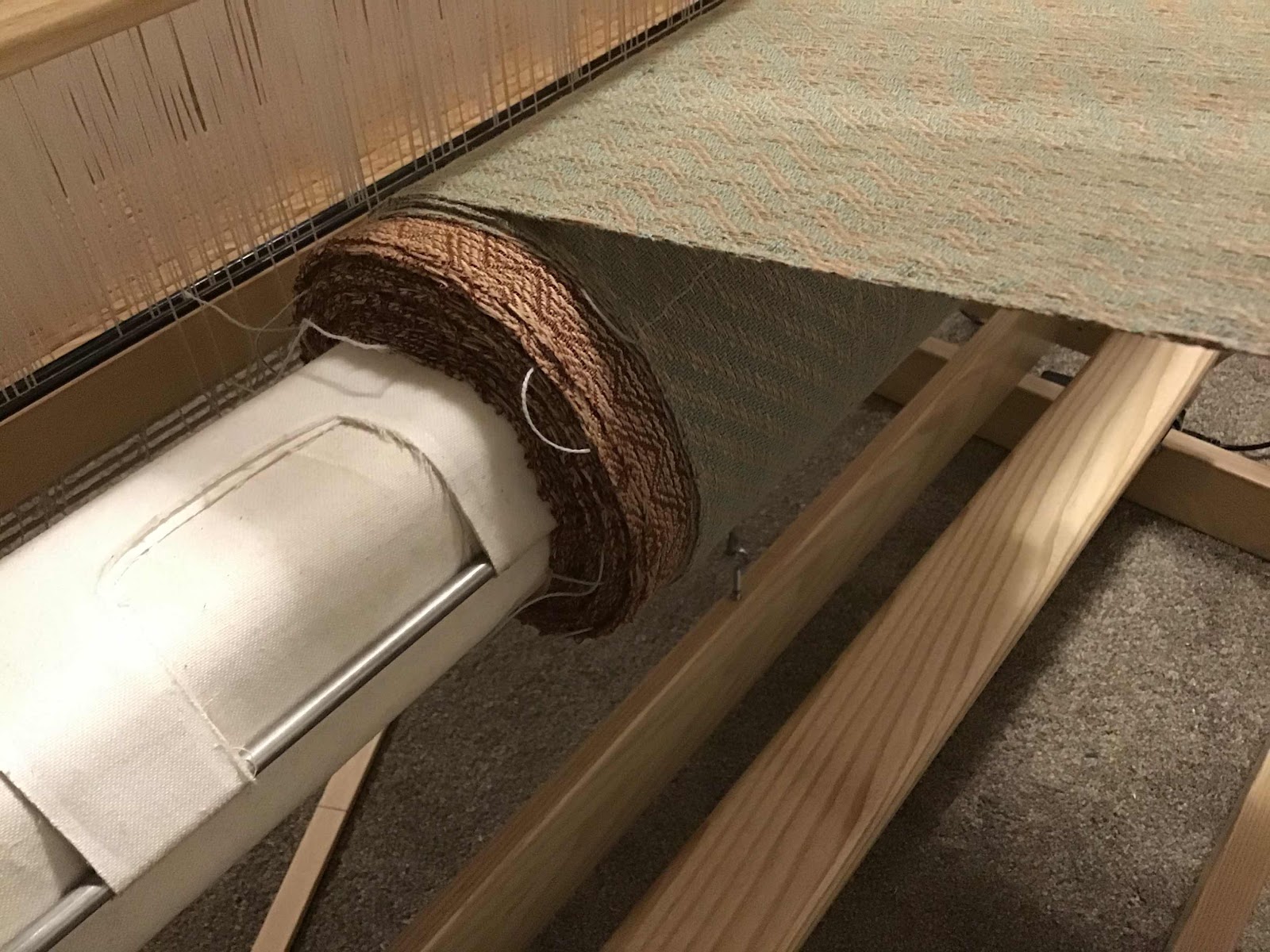
Cloth beam showing green linen and beige cotton weft

Recently someone said that linen did not behave the way they expected.

If you have only woven with wool and cotton, weaving with linen will be...different.

Linen has essentially zero elasticity.  It is denser than cotton and stiffer.  As such it does behave differently.

The above photo is an example of something that might be unexpected.  Since linen is stiffer than cotton, it will draw in less than cotton.  Hence the wider width on the beam.  This is why, if you are going to use linen as weft for a time, then cotton (as I did here) it is a really good idea to use the linen first, then switch to the cotton.  If you use the cotton first, the linen will be wider and the selvedges will then be unsupported - unless you add sticks to provide support. 

During wet finishing it will not have as high a dimensional loss as cotton.  If linen and cotton are used in stripes in the warp, you can get lengthwise 'seersucker' effects.  The cotton will shrink more than the linen and puckers can appear in the linen stripes.  This effect can be mitigated somewhat by how wide/narrow the stripes are so sampling is required if this is an effect you want.

During weaving it will feel different when you set the tension and beat.  A linen warp must be beamed as perfectly as possible so that there are no discrepancies in length in the warp ends and therefore no overly loose or tight threads.

Generally I find a linen warp behaves much better in a loom where the shed is formed by both rising and sinking the threads, iow, counter balanced or countre marche.  A smaller jack loom with short distance from front to back will potentially need some adjustment to the shed geometry.  I did actually manage to weave a fine linen fabric on a Woolhouse Margaret (about the same length front to back as a Baby Wolf) by changing the height of the back beam, raising it about one inch.  Prior to that adjustment the shed floor was so loose it was impossible to get a shed or beat properly.  After the adjustment I was able to weave it very carefully.

The high density of the linen yarn means that bobbins should not be over full.  I tend to fill just to the height of the flanges on standard plastic bobbins or the weight of the shuttle and fully loaded bobbins is too great and can cause issues with the selvedges.

Selvedges may not be great on linen anyway due to the stiff nature of the yarn as it won't want to curl round the selvedge and there may be little loops.

Linen is a huge fan of moisture.  Some people recommend misting the warp and storing bobbins with a wet cloth.

My approach is to run a humidifier to raise the relative humidity in the room (because I don't much like getting static discharge from arid conditions) and then use a jerry rigged humidor to store the bobbins in.  The bobbins sit in a container inside a humid environment and can safely be left there for weeks without harm because they are not wet.

I was so pleased with myself, using up the 'last' of my fine linen.  And then a couple of weeks ago a friend (10 years older than me, attempting to seriously downsize her studio) presented me with a bag of yarn.  Some fine silk.  Some fine linen.  Yay?

Saturday, January 25, 2020

Interlacements/Angle


Someone asked about interlacements and how one would go about changing that ratio.

I managed to get one towel woven yesterday with the finer green linen.  The camera has washed out the colours a bit, it actually looks more interesting than this, but the point of the photo is the twill angle.

If the linen had been a single 16s, 32 epi would have been good for it in the following tie-up:  (with the first number being lifted, the next number the number of shafts left down, etc.)

1:3:1:3:2:2:3:1 or some variation of that.  The lift would have been unequal, putting more warp on the surface of one side of the cloth, more weft on the other.  Only by one shaft, but surprisingly, it does make a difference.

However, the green is much finer, probably closer to a single 20s and the sample I wove was packing in more than 32 ppi.

I changed the tie up to something like:

1:3:2:2:3:1:1:1:1:1

This creates an equal shed with 8 shafts lifted for each pick.

In the end I rearranged the tie up one more time to change where in the treadling sequence the plain weave appeared but what I've given above is where I started.

It took a few inches to gain a feel for how much to 'beat' the weft in (not much, more of a 'place')  but by the end of the towel I had a pretty good angle.  The photo above was taken with the tension off the warp, but the cotton is going to shrink more than the linen, so there is a good chance the cloth after wet finishing is going to change the ratio and be slightly lower than 45 degrees.

They won't hit 'perfect' but they will work just fine as the tea towels they are intended to be.

If only four shafts are available, it is possible to change the density of the cloth and the interlacements by weaving plain weave alternately with twill using the same weft yarn.  It will change the appearance of the cloth so a sample would have to be woven to make sure it would be suitable.

So it might be something like this:  (indicating which shafts are being lifted)

1, 2
1, 3
2, 3
2, 4
3, 4
1, 3
1, 4
2, 4


The twill angle will be steeper, except if the weft is much finer than the warp it will beat in more closely and might then become more 'balanced'.

Again, only a sample will show for sure.

Friday, January 24, 2020

Green


While I have been on a stash reduction target for far too long (people keep dying and I keep getting their yarn to add to mine) there are always interesting lessons to be learned from digging deep into the stash.

Now the two yarns in the photo were acquisitions by moi, but one (the darker) was a sentimental purchase and the other was a deal too good to pass up.

Not always the most sensible way to purchase yarn!

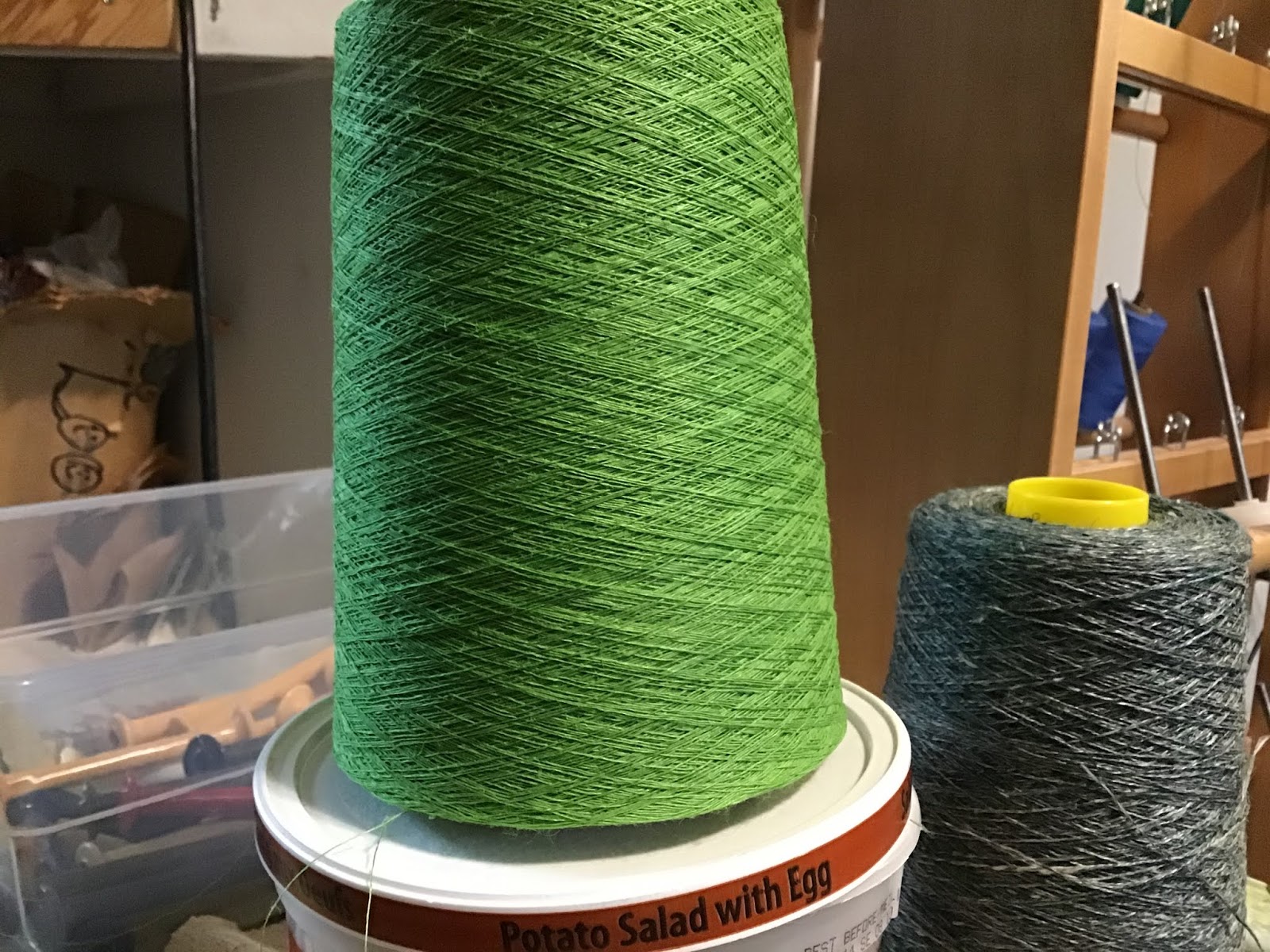
Turns out my memory was a bit faulty about the thickness of each of the yarns.  Both are linen, one I bought in Sweden (to be mailed later) because the price was - well, they were getting rid of their yarn inventory!  The price was too tempting to not purchase, so I did.  To the tune of 5 kilos worth.  In the end I didn't get what I wanted but chose from what they had left when it came time to ship and I assumed that all the yarn would be single 16s.  Nope, this one and the dark navy were more like single 20s.  In other words a lot finer than what I had been using.  However, once it arrived, it was mine and I have been using it up.  I'd have to check the chart to find out how many yards per pound single 20s has, but take my word for it...it's lots.

The other yarn was from a LYS and the photo is a bit dark and greyer than the colour actually is.  I'm thinking that if I run out of the spring green, I will try to use up some of the much thicker darker greyed green on the same warp.  Although it may be too grey to fit nicely.

I wasn't sure this bright spring green was going to marry well on the greyed blue/medium blue and fairly deep turquoise green warp, but it looks fine. 

The cloth is not turning out the way I wanted it to, however, because instead of a slightly warp emphasis on one side and a slight weft emphasis on the other, I had to add more interlacements to the tie up so that it would weave 'square'.  However, I think it's turning out ok and the plain weave I added to the tie up is helping to blend the colours together in a way that I think is going to be just fine.

If it looks this 'ok' on the loom, by the time it is wet finished it should be even better.

The epi is 32, with 4 per dent in an 8 dent reed.  That means the reed marks are quite obvious and with linen weft may not come out in the wet finishing.  But I don't really mind.  The reed marks will be consistent and (let's all say it together) if you can't be perfect, be consistent....

Thursday, January 23, 2020

New Draft


One of the advantages of having a computer assisted dobby loom is that you can design and file away complete treadling drafts for a project.

This is my latest warp.  I call it 'lily pads' for reasons which will become apparent once I get started weaving.  I hope!

But I thought it might be interesting to see something of how I approach setting up the loom to weave.

The threading is one repeat of the draft in the above image.  I know it's small I was trying to get the whole - or as much of - the complete treadling as I could.  However the 'important' bit is there.

At the very top of the treadling draft is the hem area.  Notice I have several repeats of straight progression, then a gap.  Then several more repeats of the the straight progression, but in the other direction.

What you are seeing is the hem from the 'last' towel and the beginning of the next towel, with an empty lag to tell me when to weave in a cut line (which I do in a different colour).  It also marks when I stop weaving and take a break.

The threading was repeated for the width of the warp (approx 24") with a couple of straight progressions to bracket the motif and act as a small border.  The motif is balanced, in other words where the motif is on the back 8 shafts, it ends at the other selvedge with the same part of the threading.  So each side will look the same.

So the treadling goes as well.  Beginning with the motif treadled on the 'back' and ending with the same motif, plus the hem area.

In some cases I don't do anything different for the hem, just keep weaving yardage, then measure and cut the cloth up to make the towels.  But having a woven in cut line makes the cutting apart of the process so much easier that I now set up the towels so that job is easily done on my work table, where I serge the raw edge, cut the towel off the cloth roll, then serge the other end, set that aside, then serge, cut, serge, etc.

I miss having the AVL where I could just carry the cloth roll, still on the beam, to the table and have the cloth just roll off the beam in a nice tidy way, but new loom, new processes.  And I don't do 40 or more long warps any more.  I do believe that 20 will now be my max.

Now down to tie on and weave the header, see how it all looks.

Wednesday, December 25, 2019

Regular programming


Finished the copper-y brown weft and started on the green cotton.  The cottolin I'd intended to use turned out to be 2/8, not 2/16, and therefore too thick.  However I have a fairly deep and broad stash of 2/16 cotton, and so the rest of this warp will be woven off in cotton.

Based on previous warps, I was pretty sure that the green would marry nicely with the variety of beiges and slightly peach yarns in the warp, so much so that I just started right in.  Gotta tell ya, the first 1/4 of an inch?  Big doubts.  Still doubts at 1/2", but by the time I got to 1"?  The pattern was beginning to resolve and I could see it was going to be just fine. 

Sometimes you've just got to have a little faith.

The cotton was just slightly thicker than the linen, but more flexible, so I thought it would beat in about the same - slightly more ppi than epi.  But no, instead of the less than 45 degree twill angle of the linen, the cotton is almost perfect.  Which meant that the towel was a wee bit long, given I'd only changed the tie up, not the actual treadling.

So after the first towel, I removed about an inch from each end, and the first towel will be cut shorter to match the rest.  Too long is easily fixed.


I lost count of how many of the brown towels I wove.  It really wasn't important - I was only just trying to finish off the brown linen and how many towels wasn't any kind of consideration.  But I think there might be 12. 

When changing from one type of fibre to another, it's always a good idea to begin with the fibre that will draw in the least.  When I changed to the cotton, which is a lot more flexible than the linen, which means it will draw in more, it was clear that it was a very good idea to weave all the linen first.

The change in draw in is about 3/4" on each selvedge.

If I'd done the yarns the other way around, I would have to add sticks to the cloth roll to keep the two different yarns behaving nicely.  If you find yourself in a position where a change in weft means less draw in, just remember to add sticks to support the entire width of the cloth as it reaches the cloth beam and you should be fine.  If you don't the part that extends beyond the cloth below it will 'collapse' and selvedges will become very dodgy.

You can just see the different colour I've woven in to be a cut line to make cutting the towels apart easier.  I program an empty lag to let me know when to add the cut line.  When I step on the treadle and there is an empty lag, it's pretty obvious there is something happening!

I suspect I have a threading error in the last few inches of the warp, but even the camera isn't showing me a problem, so I am going to turn a blind eye and stop fussing about it.  The gaps you see in the cloth are due to reed marks, not threading issues.  (I've checked.  Multiple times.)  So all I can conclude is that my math was off.  Yes, there are five thread floats.  I wove twill blocks and reversed the direction of the twill.  So those aren't mistakes either.

With only a few yards left of this warp, I cannot fuss about it any more.

"Forget your perfect offering.  There is a crack in everything.  That's how the lights gets in."  Leonard Cohen.

I'm going to channel my Leonard Cohen and let whatever light in that can get in.  They are tea towels.  If there is an error, they will still dry dishes just fine.

Saturday, November 30, 2019

One More Day


There was a pretty good turn out this morning for the sale.  All the tea towels I had on half-price sold.  I have three more I will bring in the morning.  There are two painted warp scarves left on half price, and one last shawl.

There is, however, a goodly selection of scarves, both smooth rayon and rayon chenille, plus a small selection of place mats.  One person placed an order for delivery after Christmas because she wanted six and there were only two of the colour she wanted. 

There is a good selection of items still available from a variety of guild members.  We have a good selection of various textile crafts - felting, knitting, spinning and weaving. 

I am really happy that tomorrow will wrap up my craft fair season, and that next year I will be one of the group, not doing the shows on my own.

Doug generously offered to carry everything up to the guild room Friday, and set up the shelves.  All I had to do this morning was set out my inventory on my shelves.  He says that if I pack up what is left in the boxes, he'll tear down the shelves and pack everything out on Monday.

I have made some progress on the fringe twisting.  Tonight I nearly finished the second 'shawl' (the first one is too short for a shawl, so will be offered as a table runner).  Monday and Tuesday I'll focus on the twisting again and get that out of my way so I can dress the Megado with the next text warp.  This time for tea towels.

Again, I'm scaling up - only 24" in the reed, but 50 turns (20 yards) on the beam.  I messed about with twill blocks, didn't like anything I came up with and settled on another 'fancy' twill.  If I don't like the first treadling, I can play with changing the tie up and the treadling.  It's tea towels.  They will work just fine. 

The cone of coppery brown is quite large.  I think it was at least a kilo and I only wove a couple of towels on another warp so there's plenty of yarn left.  Maybe more than one warp will use up.  But 20 yards should make a decent dent in it. 

Time for bed.  Have to be at the guild room by 10 am.  For the last day.

Tuesday, November 26, 2019

Planning


Now that I'm well over the half way mark on test warp #3(?), my thoughts are turning to the next warp.

In the stash reducing effort, I had planned some more tea towel warps in order to use up the fine single linen yarns that I accidentally (ahem) acquired.  I used a little of this coppery brown on a previous warp and was quite pleased with how it turned out. 

While I have a lot of yarn, it is in limited colourways because as a production weaver, I would tend to beam long warps sectionally.  So I needed enough yarn packages to wind each 1" section.  In the case of the 2/16 cotton for tea towels, that generally meant 32 epi when using the linen for weft.  (I may change the density to 36 once I run out of linen and start weaving up the rest of the cotton with cotton weft.  TBD.)

Beige/browns are not my personal favourite colours, but I have all this yarn left so I'm going to use it next and see how much of it I can use up.  I'm not sure I can use up all of the brown on 20 yards, but I'm still feeling my way with the Megado, and I'm not sure I want to go longer than 20 yards yet.  The current warp is around 15 yards (I forget) and 20 seems like a nice comfortable next step.  Just to make sure I'm getting the beaming down so that I get good tension.  Also, I'm not sure how much cloth I can put onto the cloth beam before I need to cut off and re-tie.  As the cloth builds up, setting the tension can become more challenging.  I'm used to being able to just keep on weaving, letting the cloth build up on the storage roller on the AVL, but the Megado has a more traditional set up and the cloth beam might - or might not - be happy letting 20 yards worth of woven cloth build up.  Again - TBD.  All part of getting to know the loom!

As we transition away from production weaving, re-organizing the studio, getting rid of production equipment, I am keeping a close eye on the calendar.  This weekend is my final 'sale' of the year - and my business.  I will be sorting through AVL loom parts and figuring out what might be of interest to AVL loom owners as replacement parts - I did invest in new gears in an effort to get the loom to behave, so someone might want to purchase those.  They are brand new and I paid a lot of money for them, so it would be nice to get some money back on them.

Plus I will be getting photos of some of my inventory and posting them here.  As someone pointed out my prices are in Canadian dollars (although I would never refuse US$!  I mean, in case someone wanted to 'tip'!!!)

Today I have a massage booked and she always tells me to rest afterwards.  So I'm going to go to the loom this morning, see if I can finish shawl #3 and make a start on #4.  The goal is to get them fringe twisted so that Doug can press them this weekend or Monday.  And then we'll be talking to some people who have expressed an interest in obtaining the press.

Little by little.


Tuesday, January 1, 2019

Unsupported


One of the reasons I like the AVL is that I can do things like this and not have to do anything remedial because the tension on the warp is not held at the cloth beam but up at the front on the 'breast' beam (aka the sandpaper beam).

On an ordinary loom, this overhang would have to be dealt with in some way.

In this instance it has happened because I finally used up (yay!) the cottolin and switched to 100% linen.

Linen is much denser and more rigid than cotton or cottolin (which is half to 60% cotton) and therefore it does not draw in nearly as much as the other yarn.  That means the web is wider and the selvedges tend to hang over the edge of the cloth roll.

On an ordinary loom I would either cut off and re-tie so that the linen weft was only building up on linen weft layers or I would insert several sticks (warp packing sticks, whatever) to support the linen layers.

Since the mechanics of the AVL are different, though, none of that is necessary and the web just rolls on up and nothing nasty happens to my warp tension.

When the loom is working properly it's a dream.  When it isn't it becomes a nightmare and careful diagnosis of what the problem is needs to be done.  With more mechanical 'aid' comes more opportunity for things to go horribly awry as a friend says.  Fortunately right now the loom is behaving, and I'm making good progress on this warp.  So good, in fact, that I might even be able to cut it off tomorrow, or Thursday at the latest. 

I haven't decided if I will switch to the scarf warps on the Fanny or immediately dress the AVL again.  I'm sort of leaning towards the latter while the loom is behaving!

Wednesday, December 26, 2018

Moving Right Along


Now that Christmas (and the introductory offer) is over, it is time to gear down for the long haul.

My immediate schedule now switches to conference planning.  We are very near to announcing the registration opening.  If people haven't yet signed up for conference email notices, I urge you to do so asap as things are getting very near to being ready to go public. 

While I plan on having some copies of The Intentional Weaver for sale at the conference, not everyone will be attending it and sales will continue through blurb going forward.  (If you scroll down to the bottom of the page, Magic in the Water is also there.)

What I would ask is that anyone who feels this book is worthwhile?  Could you please go to the page and click on the 'share' buttons?  Marketing a self-published book is challenging because you find yourself constantly tooting your own horn.  Which I am not too shy to do, but it helps people to know if the book is truly worth the purchase price and if they might find it helpful if others say so and not just my ego saying it is.

We are getting some snow today and I have chosen to not go out but to have some quiet days this week in order to plunge back into what needs doing next.

I reached the half way point in the current (30 yard) warp, I've used up three tubes of cottolin and am about to start the fourth and last in my stash.  Yesterday I wound the first of the linen bobbins which are steeping in the humidor.  And I crunched the numbers for the next warp, which will be a twill block version of Canadian Snowflake but in bright cheerful colours - the warp is Peacock and Emerald Green, the weft will be navy or turquoise single linen. 

Of course I am once again weaving linen at the dryest season, so I will be putting the humidifier on in the next couple of days to try and make the linen behave better.

If the relative humidity drops below around 40% I find that all fibres start to get cranky - even cotton will develop static electricity - linen and silk are even more prone to problems.

But I need to get to the loom, so off I go...moving right along...