Showing posts with label fancy twills. Show all posts

Friday, January 30, 2026

No Rules!


A weaving draft for a twill - or in this case a 1:3 twill


The other day I saw an ad for a weaving class.  NO Rules!  Ok.  You're going to ignore millennia of history regarding the things that make weaving rational and just...wing it?

Which would be fine if people bothered to learn what those rules actually say.  Instead they are 'doing their own (ahem) research' and leaning heavily into their creativity.  Because rules limit one's creativity.  Or something something gazpacho.

If going 'no rules' makes their hearts sing, then ok.  But don't assume that I am crippling *my* creativity because I know the nuts and bolts of how threads work together, understand the mechanics of the craft, understand how colours blend or contrast in a woven textile.

Or assume that any 'answer' you get from AI or LLM (Chat GPT) are going to give any kind of meaningful information.

So I'm going to discuss - briefly - what some of those 'rules' mean, specifically when I talk about a 2:2 twill.  Pop quiz...does the draft above depict a 2:2 twill?  No.  No, it does not.  How do you know?  Because I've labelled it a 1:3 twill.  See?  I know one of the rules and can distinguish the difference.

The ratio refers to how many warp threads are up at any point, and how many are down.  So that 1:3 twill has one warp thread up and 3 are down.  The weft crosses them in a 1:3 ratio.

If that was a 2:2 twill, there would be two warps up and 2 down and the resulting twill would be considered 'balanced' - if the epi/ppi is equal.

You could also weave this as a 3:1 twill, in which case 3 warps would be up and one down.  In that case, the warp is more visible.

If the warp and weft are different colours. a 1:3 twill would place the majority of the weft colour on top; a 2;2 twill would show the warp and weft colours equally; 3:1 would show the warp colours more than the weft.  Again, these aspects depend on the warp and weft being more or less equal.  The three cloths are then labelled 1:3 = weft emphasis, 2:2 = 'balanced' (for certain kind of 'balance) and 3:1 would be warp emphasis.  Weft faced means the weft entirely covers the warp; warp faced means the warp entirely covers the weft.  (There may be some instances where coverage is not complete, but you get the gist, I hope.)

There isn't any particular necessity to *know* that unless you want to design something that looks a particular way.  Or if you want to manipulate the threads to create a particular effect.  All of which are possible.  But it makes it a lot easier to do that if you just understand some of the 'rules' of the craft.

Or if you are following a 'recipe' and there is an error in it.  Or maybe you just don't know the 'rules' and interpreting the instructions is difficult to understand.

Just saying... 

Friday, May 16, 2025

Before and After


a variation on Swedish Snowflake

Wet finishing will 'change' your textiles.  Sometimes a lot; sometimes not so much.

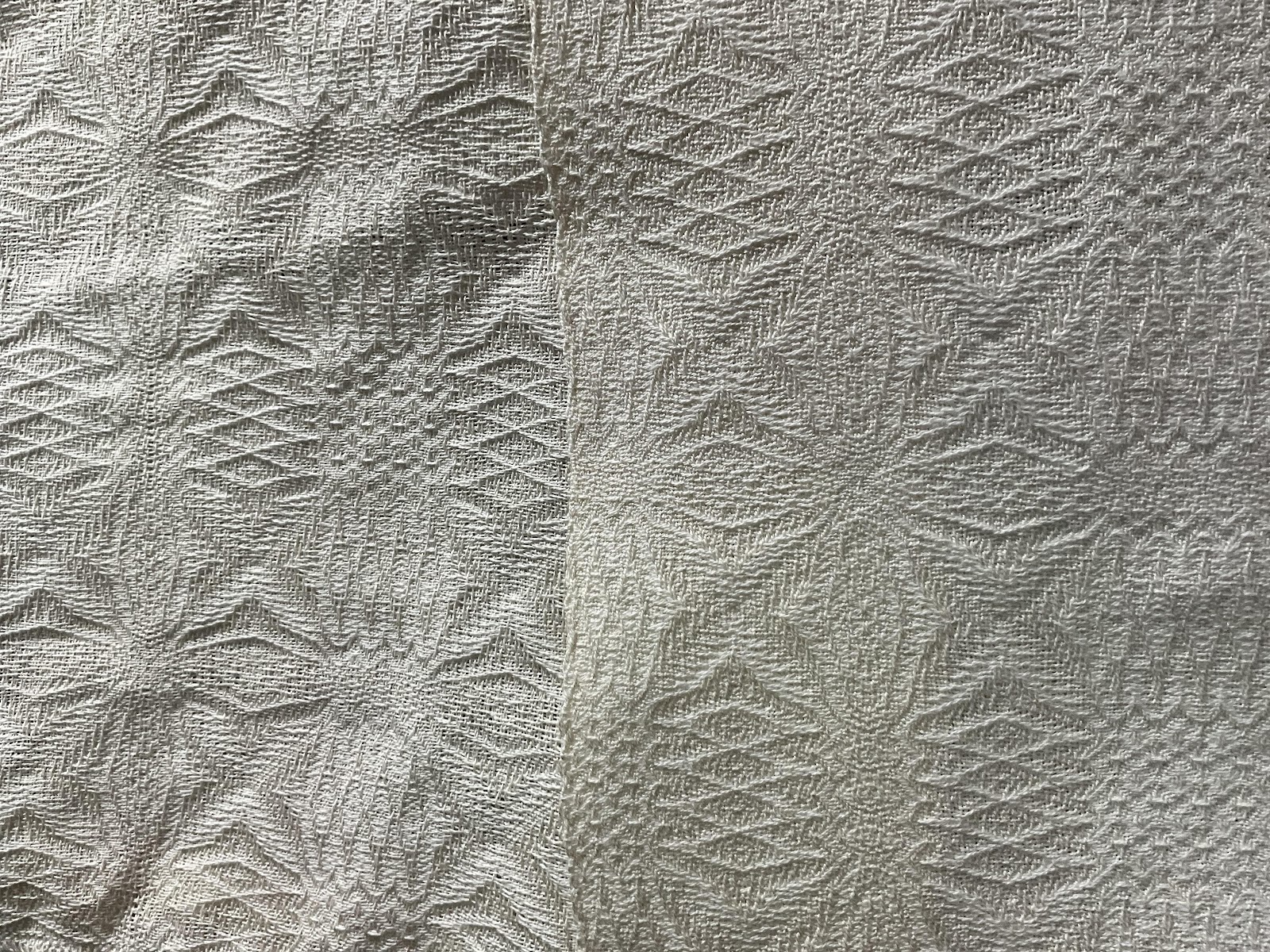
Since I wet finished the last warp while there was still some of the warp left to weave, I have an  example of the same textile in loom state and after wet finishing.

The weave structure is over 8 shafts with a 1:3:3:1 tie up, and woven as drawn in (threaded).  The thing I noticed in the loom (because I'm using the things I'm weaving now, mostly, as examples for articles) I was paying more attention to how the weave was developing in the loom, and then how it changed after wet finishing.

With the tie up as it is, given the threading, some of the sheds have more warp than weft and vice versa in some parts than in others, and as the shafts move through in their 'dance' I noticed that some areas looked less beaten in than others.  It made it look like my beating was uneven, when it was the structure of the weave that was building up differently due to the resistance (more or less) as the treadles moved the threads through to create the motif.  

In the above photo, the loom state is on the left, wet finished on the right.

One of the things I noticed as I set up the samples to be photographed, is that the colour shifted.  Those two pieces of weaving were woven identically so the shift in colour is in the way the light hits the warp and weft, not a change in colours in the yarn itself.

The loom state looks more 3D as the warp emphasis and weft emphasis threads show up differently once they have been wet finished and compressed.

The selvedges have a slight waviness to them, depending on where the warp and weft change places - some areas are drawn in a bit more than others.  I do not (generally) use a floating selvedge, and while I've never done the experiment, I don't know if a floating selvedge would adjust the selvedge to make it 'ruler straight'.

The weave structure has areas of 7 ends of float, warp and weft, and the selvedges are fine (imho) so I don't fuss about them.  After wet finishing the 'floats' at the selvedge contract and come together.  You may be able to biggify the photo if you click on it, so you can see the selvedge more closely.

Talking to a friend (who is also a weaver) I told them I wasn't nearly as concerned about being 'perfect' anymore.  So there are times when I will ignore a 'mistake', especially when it is something I didn't see until I had wet finished the cloth.  Mostly these days I weave tea towels - and even a tea towel with a threading error that is nearly invisible will still dry dishes.

I'm old now.  My vision has gotten 'worse', and my physical...well...it's gotten 'worse', too.  Frankly, these days I'm just glad I *can* weave.  Even if it means I 'miss' mistakes at times.  

So, yes, there will be times I will just carry on and not worry about the 'mistakes'.  Time/energy now is limited, and there are SO many other things I want to explore, to learn, and share.  'Perfect' is always desired, but I don't always have the spoons to achieve it.

But that's the thing.  We each get to choose what we want to do, and how much effort we can afford to put into getting it done.  I feel like I've met and exceeded expectations for years.  Now I'm 'retired' (for certain values of) and if I can't be a good example now in my dotterage,  guess I will be a 'bad' example.

Keep learning.  Keep trying.  Keep weaving.


Friday, May 2, 2025

Sampling


There are actually two samples in the photo - one was woven with 20/2 unmercerized white, the other was woven with 2/20 mercerized 'natural'.

But what I want to point out today is the selvedge.

There are so many people who insist that a selvedge *must* be plain weave.  

But here's the thing - if you are weaving something *other* than plain weave in the rest of the cloth, that plain weave selvedge will take up at a different rate than the other structure and the selvedge ends will get tighter and tighter.

Not a big deal if the weaver cuts off and re-ties, but...more work, overall, than just weaving a more appropriate structure - like the same take up as the rest of the cloth.

Now, I also deal with 'fine' threads by doubling the outside 4 ends at the selvedge *BUT* keeping the density of the cloth the same.  

And no, I so rarely use a floating selvedge that I would say 'never' but there may come a time when a floating selvedge is 'best practice'.

The samples in the photo have been wet finished, including a good hard press.  The weave structure creates 'floats' along the selvedge.  Given the 'fancy' twill weave structure, there are (if I remember correctly) 5 pick floats in the selvedge.

But!  After wet finishing, including that hard press, the 'loops' tuck into the edge of the cloth and they are fine.  

The selvedge is not 'ruler' straight.   The nature of the weave structure that contrasts 1:3 and 3:1 areas to create the motif, means that the selvedge gently curves.  

Another variable is if the weft yarn is smooth or textured.  The singles linen I've been using is *very* fine (for most people) and it has gentle 'slubs' in it.  So, again, the selvedge is affected when one of those 'slubs' is at the edge of the cloth.

In my studio I do the best I can to be a) consistent and b) as efficient as I can be.  Perfect?  Well, when *that* happens, it's lovely, but truly a Gift from the Loom Goddess.

There are many reasons for sampling.  Since I'm trying to weave down my yarn stash, sometimes it's a good idea to see how exactly the yarn is going to behave - right through to the wet finishing.

This year marks 50 years of being a weaver.  Yes, I still make 'mistakes'.  Yes, I still sample.

Today one of my 'jobs' is to explore designing a twill progression and figure out how to best illustrate how I do that for anyone who is interested.  The sample above is a variation on the Swedish Snowflake motif.  I may - or may not - submit the table runner(s) I've been weaving for the past couple of weeks.  Or I have enough of the 2/20 merc. cotton for warp and the unmerc. 20/2 to weave off one more warp.  But then there will be some 2/20 merc. cotton to use as weft on an unmerc. cotton warp.  

The current warp will be coming off the loom in the next few days.  So I'm going to have to spent some time at the desktop exploring some twill progression motifs.

Always something new to explore, more to learn.  

Sunday, October 8, 2023

A New Week, A New Warp


florets  - showing hem area and repeats of the motif

Well, not, quite - it depends on when you begin counting your week (is it Sunday?  Or Monday?)

I've just finished threading the next warp - the one inspired by the Snail's Trails and Cat's Paws motif so well known from being used as overshot - but which can also be woven in twill blocks.  There is some speculation that overshot was developed in order to create more 'ornate' and/or larger designs than can be easily done with 'only' four shafts.  Certainly there is evidence that the motif was already well known in the 16-1700s, given I found it in one of the two German weaver's pattern books translated by Patricia Hilts.  Which gave me the idea to convert some of the other smaller overshot designs into twill blocks.

After the injection Friday, with lots of warnings ringing in my ears about taking it 'easy', not 'pushing' myself, I did just that.  Since I was feeling 'off' it wasn't a hard decision to make.  But over the rest of Friday and into Saturday, the pain did begin to wear off.

It wasn't altogether gone, and may never go away entirely, given the peripheral neuropathy.  OTOH, I'm taking a medication to see if it will work for that.  We are running the experiment, in the absence of actual studies being done, but based on other conditions where it IS helpful, my pain doctor was willing to let me give it a try.

One of the light duties I did while 'resting' was fiddle around with the Snail's Trails threading and see if I could understand the weave structure better and get something closer to what I wanted.  It took a while, and it's nothing spectacular, but I was able to push, pull and prod it into something that I can weave and gained a greater understanding of how the weave structure works.

This is now in the queue for the warp after the one I just threaded.  Unless I decide the design is too 'static' (which it is) and I want to mess with it further.  Which may well happen.  Weaving drafts are not writ in stone and have Fiberworks, can edit.  OTOH, it's fine.  It's 'classic' with a 'rose' counter changing evenly and it feels very, I don't know, traditional?  And there is nothing wrong with a little tradition.

It is a rather warm autumn day - far warmer than 'normal' - but given Doug is trying to get the new screen door installed, having a nice warm day is a bonus since the back door has been standing open for a while.  We are trying to get a few maintenance things done before winter sets in, and in addition to Life continuing to lob curve balls at us, it's taken a bit longer than expected to get everything done.  So this milder weather, while concerning, is quite pleasant.

It is still early enough in the day I'm hoping to get the warp sleyed and tied on, then wind bobbins, and then, who knows, set up the laptop so I can begin weaving tomorrow.  One more day of 'rest' will not go amiss, I'm sure.  But I'm eager to see how the Snail's Trails and Cat's Paws weaves up in this weave structure, so I'm looking forward to beginning tomorrow.

Monday, November 25, 2019

Fancy Twills


four shaft Wall of Troy (M. P. Davison)


Wall of Troy extended to 8 shafts


For the past few years I have played with 'fancy' twills.  Someone asked me what I meant by 'fancy' and I had to think about that term for a bit.  While I knew what I meant, I had to think about how to define it.  There are many examples of 'fancy' twills in many resources e.g. the little booklet called The Fanciest Twills, which is likely where I first heard about fancy twill.

Beginning with the four shaft Wall of Troy, it is not a straight draw but reverses in a /\/ progression and repeats.  Technically one might refer to this as an extended point progression.  In the drawdown area of the draft, there are connected diamonds and a clear straight diagonal running through the cloth.

Extending this over eight shafts enlarges the design and makes it more dramatic.  The tie up can change from a 2:2 twill to a 1:3:3:1.

When you have more shafts, the combinations can become much larger, more complex and the tie up can also become more complex.  One of my favourites is 1:3:2:2:3:1:2:2   This keeps floats to 5 (usually) and in the finer yarns I tend to use, a five end float does not adversely affect the cloth.

The key to unlocking how fancy twills worked was from S. A. Zielinski's publications.  Robert Leclerc collected Mr. Zielinski's works, edited them into topics and published them in the late 1980s early 1990s (if I remember correctly).  One of them took twills and played with them on four shafts creating very complex patterning.  His premise was that you didn't need to have more than four to make cloth with complexity.  Since I had 16, I began to play with twill progressions to make quite large repeats.  Having a loom with a dobby meant that I could then enter the tie up and treadling into the computer, and at a flick of a switch change from one tie up/treadling to another making scarves and shawls that were related but different.  Working in a series like this made my inventory more diverse and gave customers a choice over which options they liked best.

Last night I thumbed through Ars Textrina - the information translated from the Old German by Patricia Hilts - about a class of weaves called Gebrochene.  I'm looking for inspiration for my next warp and being entranced once again by 'fancy' twills.  I think I could just weave these kinds of drafts for the rest of my life and still find fascination in them!  

The test warp currently on the Megado is one of these fancy type of twills.  Each shawl is being woven with a different weft colour, but also a different tie up/treadling.  As I mix and match the threading with different treadlings, the resulting cloth is similar but different.  

At the end of my thumbing, however, I reflected on the colours I was going to use for the next warp and instead of a fancy twill, I will do something with twill blocks.  My inspiration will be the colours of the south west and my pattern will reflect something of my feeling of the desert when I visited New Mexico and Arizona.  

At least, that's the plan.  For now.

8 shaft Swedish Snowflake.  Another example of a 'fancy' twill.  Areas of straight and point progression, advancing and satin.