Showing posts with label huck lace. Show all posts

Sunday, March 8, 2026

Maps


I have always loved maps.  They help me understand where I am, and remind me that the world is much larger than my reality bubble.

But here's the thing with maps - to be useful, they must be accurate.  Plus they need a 'legend' to help you understand what you are seeing.

Unlike the map pictured above which has all kinds of errors.  How do I know?  Because I have the 'shape' of the United States as a mental picture.  

When I was travelling, I would routinely check a map to see the layout of the route my trip would take and get myself familiar what might be there waiting for me once on the ground.  Because I like to know 'where I am'.

But apparently we have reached the stage in the 'information age' where we have a shit tonne of information, but a bunch of it is just plain 'wrong'.

As I wove today I thought about maps in the back of my head and I thought about weaving drafts.  

And how many new/beginning weavers just don't understand what they are looking at.  (In spite of loads of books that will tell them exactly that, they want members of an online group to explain it.)

Or they ask ChatGPT, which is even worse because that app will flat out lie to you.

Sometimes the questions is: where are the tabby treadles?  Or they can't work out the symbols: what does it mean to do this 3X?  Or whatever. 

I thought about huck as a weaving draft.  And how many people get confused because there are 3 (at least) different ways to write the sequence and they don't understand.

So here's a short explainer:

Huck is generally (not always) written with a 5 thread by 5 thread 'unit'.  It can look different depending on the resource one looks at:


3 ways to thread huck - blank spaces indicate that I am providing 3 different threadings

I have not included the tie up because each of those threadings needs a different set of treadles tied up to create the cloth.


Here is the option as given above for the first threading sequence, reading from the right to left.


This option weaves huck in every place it has been threaded for huck.  Yes, you can insert plain weave sections if that meets your design requirements.  Look where the plain weave treadles are placed - in between the two 'pattern' treadles.  You don't need more treadles when plain weave is already in the DNA of your weave structure.

Some people find this sequence to be easier to thread.  Note the change in the tie up.  This is the middle option in the above 'draft' showing 3 different sequences:


And then the third option which changes yet again, and makes expanding the threading to more than four shafts if you want to do that and have the extra shafts:


Which of these is correct?  

They ALL are.  The threading, tie up and treadling need to give you what you want to have in your cloth.  Drafts are not writ in stone.   It is possible to switch things around.  For example, you may not have enough heddles on a shaft.  In that case you either need to add more heddles, OR if you have more (some weavers routinely load extra heddles on the front two shafts) you can shuffle the draft to take advantage of having 'extra' heddles on some of the shafts.

Plain weave is not always 1+3 vs 2+4.  And sometimes it doesn't best serve the needs of actually weaving it by being placed on either outside treadle, OR to one side of the rest.  And sometimes you really need to get the warp set up and sit at the loom and weave a bit to really understand what you are trying to do.

Or read the beginning bits in the front of the book.   The author will generally give Important Information about the symbols they have used.

Friday, December 30, 2022

FAFO (Fool Around Find Out)


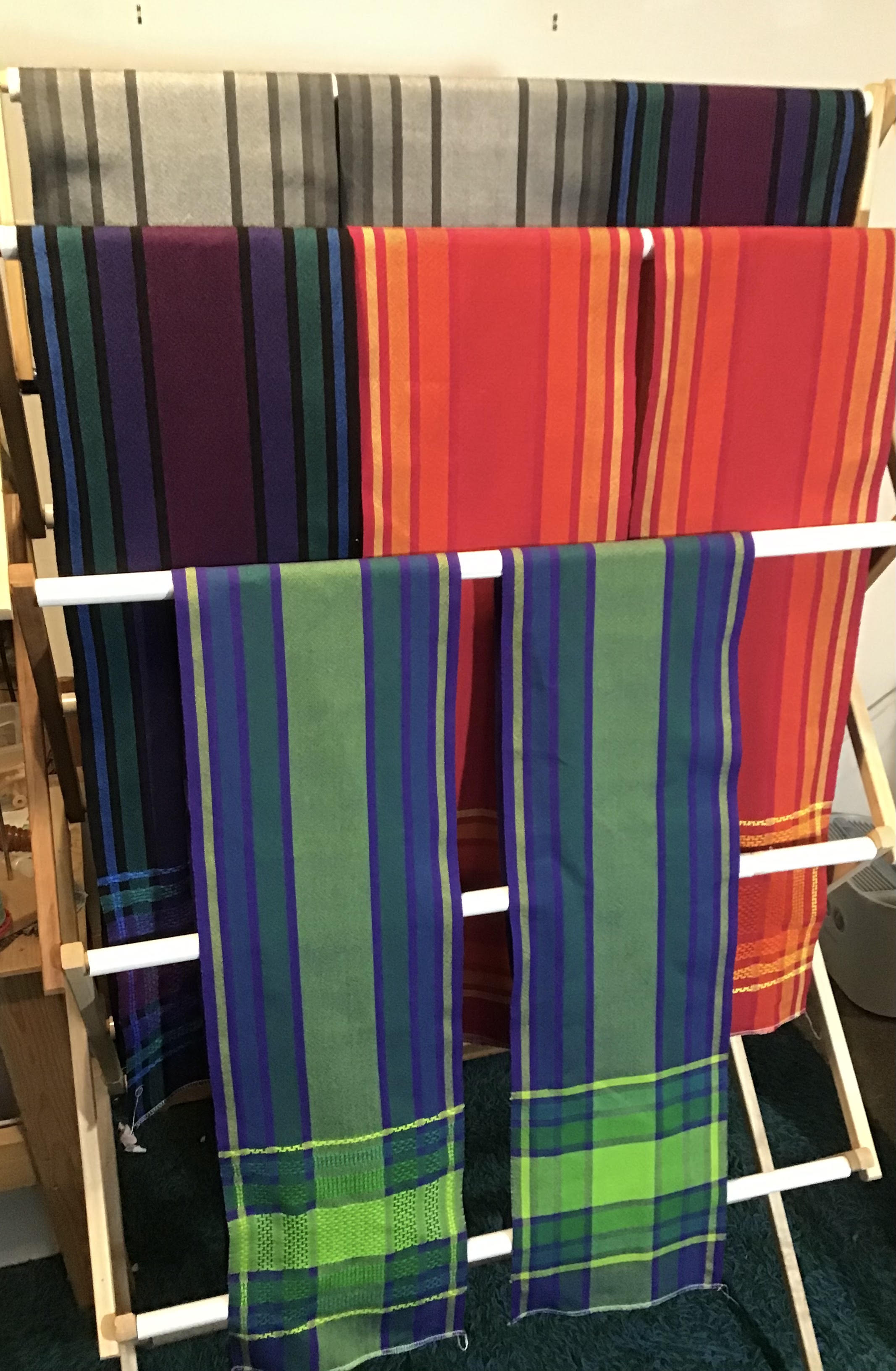
I did a little FAFO (or as some like to call it, the scientific method).

In other words, I tried things, documented how they worked - or didn't - and am now in the process of writing out my findings.  And the instructions for the class they were designed for and woven to illustrate.

Since weaving is a very high labour intensive process, I did two different 'experiments' - one was to weave an area of lace/plain weave at one end of the scarf in a colour gamp (repeating the same thread colours as were in the warp), then the second scarf was done only in plain weave, again with the colour gamp at one end..

One set (the lace weaves) will be used as the student project for the lace weave class on SOS.

The other can be used for my lecture on colour theory.

Once again I was reminded of just how difficult it is to weave a 'perfect' plain weave, even when I'm paying attention and trying.  The other is how much a high value contrast between warp and weft will show up every little inconsistency in said plain weave.  And how little an 'imperfect' plain weave will look 'wrong' if it is woven consistently.  Just saying.

A timely reminder going into the new year - to stay humble.

Not a lot to show for a couple weeks of weaving (plus several weeks of thinking, planning, number crunching, choosing the colours to use, all done well before the first warp was wound.)

But the information gained was much much bigger than one might expect given the output of the past two weeks.  (I checked my blog, the first picture I showed was of the first warp after being woven, on Dec. 13.)

Some of these scarves were woven on truly dark and dreary days and were a tonic.  

For now?  It's back to tea towels.  I beamed the warp yesterday and got it half threaded today.  My goal is to finish threading, see if I can get it sleyed as well, then generate the treadling.

As the new year approaches, I will continue as I have done all my life - begin the new year as I mean to go on.  Keep weaving.  Keep teaching.  Keep busting my stash.  Keep on, keeping on.


Tuesday, December 13, 2022

Experiments


I took these last night and the colour isn't great, but I did an 'experiment' and have been documenting the process.

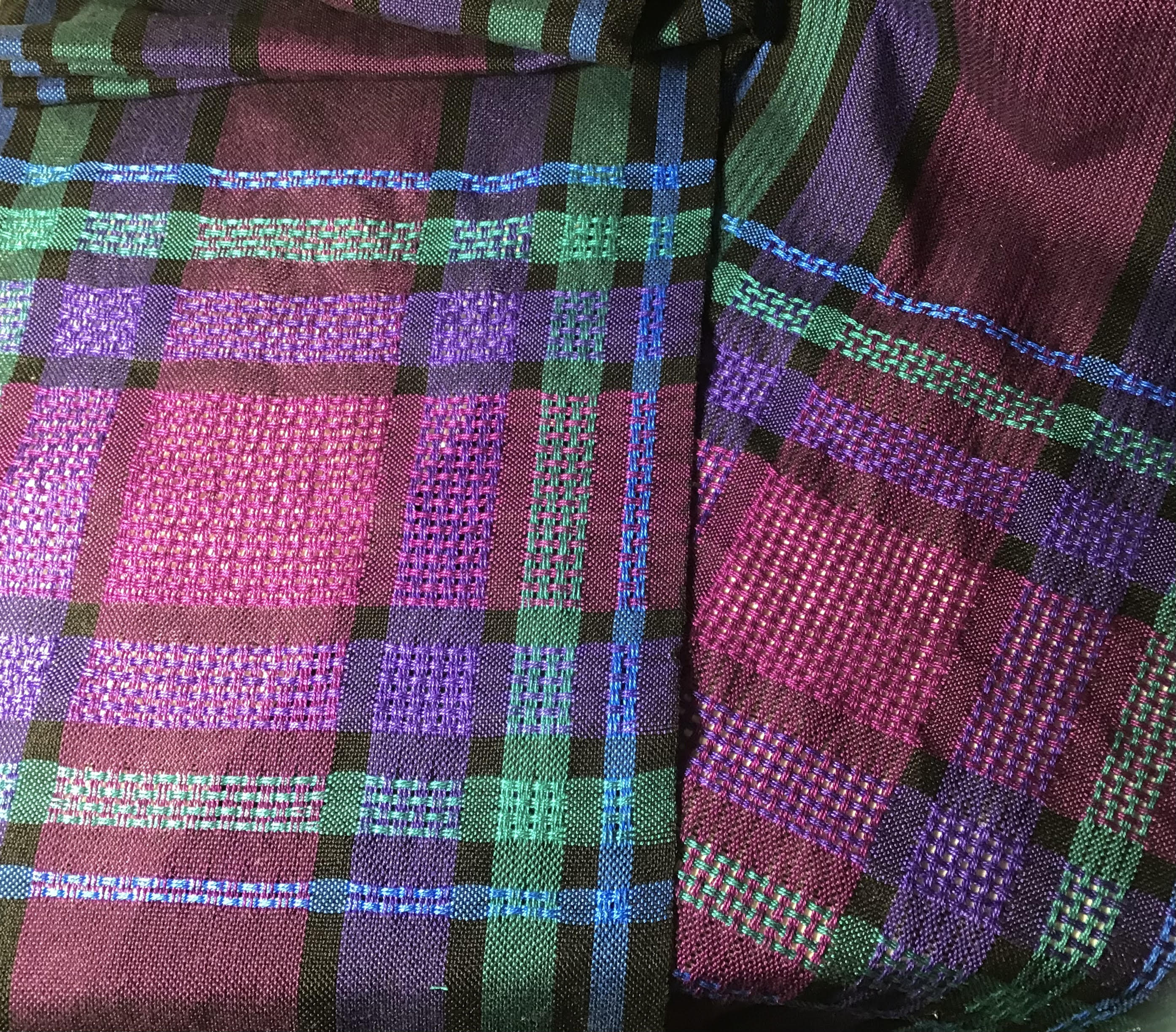
These 'samples' are scarves, one at 24 epi one at 25 epi (2/dent in a 12 dent reed on the left; 5/dent in a 5 dent reed on the right), woven in huck lace at one end of the scarf.

The warp has areas of plain weave threaded in (the black stripes) and the issue when combining two different weave structures with vastly different take up rates is that the tension goes 'wrong' very quickly.

However, a short section of huck doesn't distort the cloth too much and can make a nice effect.  So these scarves are woven huck in a symmetrical presentation, colours and lace reflecting the threading, with the balance of the scarf woven in plain weave.

By the end of the square, the fell looked like:


The black stripe is threaded to weave plain weave at all times which means the maximum number of interlacements while the huck lace areas shift and move and take up less than the areas of plain weave.  If this is done over a long length, it can actually cause tension issues in the warp, but over the 12" or so of the 'gamp', the threads soon equalized and the rest of the scarf wove off with no problems at all.

The 24 epi version with 2/dent in a 12 dent reed wove off very nicely with few issues while the 25 with 5 per dent needed a bit more coaxing.  The reed marks in the 5 dent sample are much more obvious but should lessen during wet finishing.  OTOH, they are consistent so I won't be too bothered if they don't disappear entirely.

Both required careful attention to the difference in beat required for the huck lace areas, but the enduring plain weave stripes helped keep the beat even in the lace areas.

There was a slight difference in the width, of course, but very little difference in how 'lacey' the cloth is, even before wet finishing.  I put a piece of white paper underneath the cloth so that the transparency can more easily be seen.

The yarn is 2/10 mercerized cotton and at this point it is very stiff, but after wet finishing it should develop a nicer hand and more drape.

I didn't feel like messing with twisted fringes, so these scarves will be hemmed.