Showing posts with label Magic in the Water. Show all posts

Sunday, December 28, 2025

Soap Boxes


bins of warps, not chained but just dropped into a bin

Bet you would be surprised at just how many 'soap boxes' I will leap onto at the drop of a comment. 

Or, maybe not, if you are a long time reader of this blog...

My top 2 are - of course - ergonomics and wet finishing.  However, I have others.  

Today someone asked about filtering the air of their studio.  It is something I have talked about for literally years, when my doctor suggested my shallow cough was the beginning of 'brown lung'.  Think 'black lung' - not coal dust but cotton fibres clogging up my lungs.

When I first brought the subject up, it was long before the internet, and most people I was talking to were 'hobby' weavers and I watched their eyes roll back in their heads when I suggested filtered fans and that carpet was a good preventive measure because it 'trapped' the cotton dust at floor level rather than a hardwood floor when every walk through the studio stirred the cotton linters up to float around in the air - and enter your lungs.

Eventually I stopped talking about it.  I realized most people didn't weave at the rate I did, or make even a tenth of what I did on any given day and probably it wasn't an issue for them.

I talked about ergonomics for a lot longer because it was obvious more people were running into problems with repetitive motion injuries, or sitting poorly, and having physical problems - especially as they aged.

For the past year and a half (since the brain bleed) I have asked myself repeatedly why I am still here, and since I am, what am I supposed to do?

I'm pretty quick to use myself as an example - sometimes a bad one, just because sometimes I *am* an example of 'bad' - and have spent much of this blog (when I realized I was not going to die in 2008) and being a warning about what 'bad' practices can lead to seemed like a good deed that needed doing.

At the time being able to reach out to lots of folk via the internet was still very new, and since I like to write, I decided that this blog would do as a platform to promote my special interests - weaving, and doing it as well as a person could do based on understanding the hidden information that was almost never discussed.

To that end, I have tried to provide the best information I can, and encourage people to learn more.  Understand more.  Filter the information that is 'out there' through their own experience and their own personal abilities and goals, factoring in their particular aims and objectives.

Because if you change one thing, everything can change.

So there are guidelines, general principles, but then everyone needs to apply them to their own personal circumstances.

When I began to write Magic in the Water, I was very unsure of myself.  I had a couple of private supporters - both extremely knowledgeable and both of whom encouraged me to keep talking about wet finishing, even to the point of reading my very rough draft because I wanted to know if I was actually conveying solid information, not just speaking from my own personal 'reality bubble'.

One of them read my very rough draft, noted a description to explain part of the process and commented that he had never thought of it, but I had captured exactly what the process looked like.  And he noted no errors of fact in the rest.

With that assurance, I felt I could go ahead and publish and present the best information I had been able to discover and not lead people astray.

Yesterday I obtained another potential 'helper' in my goal to reduce my pain.  It is not a 'pain killer' as such, but says that it helps support healing of damaged nerves.  It is not a magic bullet fix, but a slow, potentially healing action.  

Once again I am stunned and amazed that any of us actually survive.  If I thought weaving was a complex endeavour, it seems living is also a level of complexity that astonishes.  The more I learn about the body and the mechanisms that attempt to keep us alive, the more astonished I become.  Hopefully - if this new supplement works - in about 2 to 3 months I will have a significant reduction in pain - if that is actually my problem.  Is it?  A number of people assure me that it is part of the problem.  And frankly, I'll take a reduction in pain, whatever that looks like

In the meantime I need to carefully cultivate my tiny sprig of hope.  It came very close to not making it through the past couple of months.  But now I have a new plan, and it has a number of branches.  So I remain stubborn and hanging onto the frayed rope that is me/my life.

And trying to clamber onto one or other of my soapboxes and keep writing about the mysteries involved in taking thread and making cloth out of it.

Once again I thank the people who have reached out and given me support.  I told a friend the other day that the brain bleed was the shit cherry on top of all the rest of my physical issues.  I have begun to re-shape my approach to weaving.  I can't begin to sell everything I can weave.   So I gratefully thank those people who have shaken the pom-poms of encouragement for me.  We are tip-toeing into a new year, and no one knows what that will look like.  I will give a nod to our Prime Minister who flatly states that it may be a very challenging year.  We will get through it by supporting each other.  

Sending 'gold dust' out to everyone who needs it.  Keep creating.  When so many are trying to destroy, we can keep creating and building.  One tea towel at a time, if necessary...

Saturday, November 29, 2025

Memories


In doing a clear out of the office, I found this notice of my father's death in 1975.

This time of year has become a bit of a memory hole.  My father's birthday was Nov. 21.  My brother's birthday was Dec. 2.  And while I rarely remember death dates, I always remember birth dates.

The office clear out is happening due to needing a new printer.  As I looked at the shelves of...things...lining the walls of the room (a very tiny room, truth be told) I realized most of what was stored there was redundant.

Old computer program manuals, antique computer stuff.  I mean who knew that CDs would blow through and become irrelevant so quickly?  (Yes, I still have a large tube of blank CDs, don't judge me.)

My father didn't read.  Not that he didn't want to, he never really learned.  But he respected education and encouraged both of us kids to get an education.  I was targeted by the school system as being 'smart' - enough to potentially go to university.  If I had I would have been the first in the family - both sides. But that never happened, in part because dad got sick and there was no money to send me to Vancouver.  Instead I got a very good paying job out of high school at the telephone company and suggested that I would like to take a 'gap' year and travel to Sweden to meet my pen friend.  I didn't think either parent would be in favour, but surprisingly they were amazingly supportive, saying that if I didn't squander my paycheque I could continue to live at home rent free and save my money for the trip.

Then followed all the planning - how to get over there, etc.  (Train across Canada, freighter from Montreal to Oslo, then figuring out the train to Örebrö. etc.  Then how to get home again - train to Stockholm, taxi to Arlanda, fly to Vancouver.)

When this little clipping from the local newspaper dropped out of one of the books I was taking off the shelf, memories whelmed up.  The year dad died.  The year I chose to become a weaver.  And all the twists and turns my life went through to get me here, to this place and time.  

All the support I received from my brother to bring my dreams into being (Magic in the Water).  And how people say that it is a 'classic' of the craft.  I'm still taken aback when I see that - except that I worked damned hard to produce it.  So I am incredibly grateful that so many people still find it helpful and useful 22 years later.

Since then, 3 more books.  Years of writing articles.  Years of schlepping around the continent teaching for guilds.  Etc.

And mostly the town I live in knows nothing of this.  When my brother died it was nearly standing room only in the church.  When my mom died, the hall was nearly full.  When I die?  Well, I have a few friends, but honestly?  It's not a big deal if it's a small gathering.  Most of my 'friends' are 'away'.

There is nothing like doing a serious de-clutter to start you thinking about things.  Maybe things I should have been thinking about before now.  But taking care of things seems like a timely activity right now.  And no one really knows how long they have on this mortal coil, so dealing with one's mess is not a bad thing.  It just stirs up so many memories!

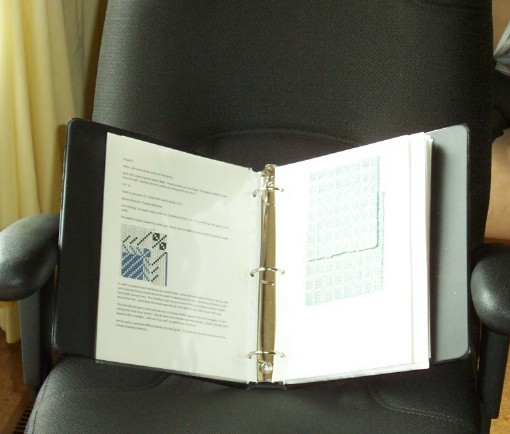
But I did decide to keep one binder that was on the shelf.  The mock up of the original Magic in the Water.  I just can't seem to make myself throw it in the recycle bin.  Not yet, anyway.


Mockup with the blank page to hold the samples (before and after wet finishing), photo of the finished item - 3 piece suit, and the draft info.  The printer wanted to make sure he understood what I wanted and did a test run in black and white to make sure.  That was the day I knew I had A Book...

Sunday, October 26, 2025

Magic in the Water


Having been in the field of weaving (doing it, teaching it, writing about it) I've gotten to know quite a few weavers.  Some have been friends.  One of them died a few months ago, after years of health problems, and the other day her daughter began listing some of her weaving books for sale.  One of them was Magic in the Water - the original publication with all the actual samples.

I struggled with the idea of producing such an expensive 'book'.  Frankly I didn't have a whole lot of money, and I also knew that not a single book publisher would want the burden of the costs involved.  I knew the cost of the book would limit the number of copies that could be sold and I thought that it would be mostly guilds with libraries who would provide the largest 'market' for it.  (Someone who had been in the textile industry commented that such a book produced by the industry for industry of similar quality would be sold upwards of $3000, not what I was asking.  So if you see one of the originals for sale for the original selling price?  Grab it!)

 Anyway.  Turned out I was wrong.  

I was bowled over by the number of people who were willing to purchase the book.  They knew the information was needed, and the handwoven and wet finished (before and after) samples of cloth would allow weavers to experience the transformation of the cloth and give them guidelines how to achieve those results for themselves.

So when the book was listed last week for the 2002 purchase price, I was reassured, once again, that I had done good.  

When I first heard someone refer to the book as a 'classic', I was astonished.  To me a 'classic' weaving book is, oh, Mary Black or Margaret Atwater.  To see that the book is still valued 20+ years after original publication makes me look back at the struggle it was produce and feel like I made the right choice.  In spite of some weavers poo-pooing that it needed to be done at - all you needed to do is wash it, for goodness sake!  For all the nay sayers who (still?) object to my using the pretentious term 'wet finishing' instead of 'washing'.  

In 2000 there were no such things as Go Fund Mes.  I pushed ahead, determined to do The Thing.  I borrowed money.  Spent what I had.  Worked 80 hour weeks to make it happen.  Recruited family and friends to help.  And by sheer stubborn determination, I made it.

To see that people will still purchase the text and photos version?  Just confirms what I knew all along - this was important.  This was needed.  

When my brother died I gave a short statement at the reception at the railway museum.  My brother had been a huge supporter of this project, and I wanted to remind people of the kind of person he was.  And, I realized much later, I was, too.

"I can think of no greater example to follow than Don's.

Be bold enough to have a dream.

Be brave enough to try to make it come true.

Live life with joy and love.

And every day, work to be a better person."


Wednesday, September 10, 2025

Light Duties


blurb web site

 One of the social media sites I belong to has a thread about weaving while sick/injured/disabled.

I have hesitated to say much because every person's journey is different.  And mine has certainly been filled with times where I was 'confined' to 'light duties'.  Now, being one of them.

I had such high hopes for the new procedure and it has not been particularly successful.   So far.  But I had been warned that I would be getting a light dose of the drug, initially, that some people find they get 'worse' before they get better, and that as I repeat the procedure things *should* improve.

But in the meantime, I've nearly caught up on all my long procrastinated light duties, and I am getting...bored.  Vexed.  Impatient.  I don't feel like I can preach coping with the inability to weave right now when I am, quite frankly, not doing all the well with it, myself.

This morning someone emailed, wondering where they could get a copy of Magic in the Water.  Talk about calling up memories.

I had to explain that the original publication was out of print, but that I had made a photos only version and was selling it on Blurb (link in the highlighted text below the image of the cover).

Why did I do that?  Well, I had someone with computer skills I did not posses who could convert the file into a PDF - but that meant I had to take every sample (before and after) and get good quality photos.  A friend came over to help me, knowing energy was extremely limited given I was in the middle of a course of chemotherapy (which contained Vincristine?).  I set up a photographic area in my living room, used a cutting board to centre the samples directly below the camera tripod which was mounted facing down.  This insured that each sample was taken the same distance away and centred in the frame.  In the end the two of us did quite well, and powered through the process fairly quickly.  

Then I had to take each photo off the camera, trim up the edges so that the cutting board didn't show (the width of the samples varied somewhat, especially after being wet finished), make sure they were clearly labelled to match the order of the samples in the book.  In those days getting a gigantic file emailed was...challenging...and I may have saved them to a CD and snail mailed that to my computer person.  Who created the PDF and sent the completed file back to me.

I then sold the PDF file, which once compressed, could be emailed.

By the time I finished doing that, I was far enough along in my chemo that I had almost zero energy left, but - because I had the help I needed, when I needed it - it got done.

And today, like some days, I got up to an inquiry if the book was still available.

You *can* still find (rare) copies of the original, with samples.  Usually found in estate sales, or older weavers downsizing.  But such opportunities are rare, and when offered for sale generally fetch very close to the original purchase price.  Some people let me know they scooped up a copy for themselves because no one else knew how highly sought after it is.

I have been told the book is considered a 'classic' in the field.  All I know is, when I wrote the thing, information on wet finishing for hand weavers was very scarce.  General advice was to just 'wash' the textile.  

But when I did my GCW master weaver monograph, I came to really begin to understand the mechanics of the process, and how variable it could be.  Once again, something that looks 'simple'...is not.

It is not, however, something to be feared.  Once a person knows the process, learns more about how to apply the variables, and get familiar how the cloth will change - at times dramatically, at others in more subtle ways - well, all I can say is...'it isn't finished until it's wet finished'.  

Unless you don't want to - for reasons!  But make that a conscious decision, not something you don't do because you are afraid of 'ruining' all the work that went into interlacing your threads.

Just saying... 

Friday, August 22, 2025

Soap Box


wet finished


loom state


Heading into my 51st year as a weaver, I have been constantly amazed - and intrigued - by the transformation of the loom state web into the finished cloth.

It has been a constant learning experience as I worked with different yarns, in different weave structures, and experimented with the 'best' practices when it comes to getting to the 'finished' state.

And then trying to convince some weavers that it is necessary.

I've done my best to explain why I see the process as being integral to making 'good' cloth, and still try my best to educate people as to why I make that claim.

I know not everyone agrees with me.  And if my experience learning as much as I can about the process, plus my examples don't convince someone it is necessary?  Well, I've done my best.

The above photos are one of the examples in Magic in the Water.  The foundation cloth is a 2 ply merino, which will full quite readily.  The accent thread is a textured rayon.  

When I was working with the local printer who helped format and print the original Magic, they were not really understanding what I was hoping to bring into being.  After months of consulting with them, sourcing appropriate papers, deciding on format/font, etc., the printer asked if I would bring a copy in so they could see it, once I had all the samples inserted.  And asked if they could have a copy for their archive.

When I finally had a 'finished' copy of the book, I brought one in and while the printer and I talked, his son, a graphic artist, was paging through the samples, closely examining them.  When he got to this one he stood upright and said "Oh!  I get it now!  This one (pointing at the loom state) it looks like this yarn is just sitting on the surface.  On this one (finished) it looks like it is part of the cloth!"

I figured if a non-weaver could see the benefit, then surely weavers would, as well.

At that point I finally was able to breathe a little.  All the work, effort, and *expense* of creating this...thing...was not in vain.

Sort of.

There are some people who refuse (I know this because they have told me to my face) to use the term 'wet finish'.  I have heard others describe the term as a 'pretentious' way to refer to 'washing'.

Has any of that deterred me?  Obviously not.  

Because I'm a 'believer'.  I will continue to climb up onto my soapbox for so long as I see people who need to know about the transformation during wet finishing.  New weavers who don't know, don't know that they don't know.  So I will keep on, keeping on.

I should finish the current section of the warp on the loom tomorrow, and then I will take those towels, plus the sample with the singles 6 weft, and run them through the washer/dryer.  I want to see how the singles 6 behaves in the water.  My examination will let me know how far off from what I'm expecting to happen really is.  And give me a clue as to how I might get closer to what I want to have before I begin planning the next warp.

Because it depends.  And without a road map, all I have is my best guess.  Which is probably a fairly good clue, but I'd like to be surer before I go to all the trouble to dress the loom and do the weaving.

Remember, it isn't finished until it's wet finished...

Magic in the Water, pdf or print 'magazine' available here...

Tuesday, August 12, 2025

Book Costs


I'm watching with close interest as Nine Ten goes through the pre-publication process for Michelle Boyd's new book, and then saw a post on FB this morning about finances, debt and trying to juggle all the things.

The memories of producing Magic in the Water came roaring back.  Picture the late 1990s.  If you were alive then, were you old enough to remember the financial crises we had just been through?  The soaring interest rates in the 1980s?  The uncertainty, the bankruptcies?  For me to then decide to launch an especially expensive book was sheer madness.  Truly.

Before I spent a dime, I costed it out - how much money would I need to even contemplate producing such a book?  What would it look like?  What would it cover?  I was determined I had to (literally could not envision it without) having before and after samples.

I heard from some people who insisted it was not necessary, but I had been dealing with a high reluctance of a certain segment of the weaving community who insisted that wet finishing was a) just washing; b) not necessary.

Given the proof of the pudding is in the eating, what else would convince some (not all) of these nay-sayers that it was necessary?  Before and after samples.

I determined that 20 different fabrics would be needed so that people could see/feel the difference wet finishing made to *all* fibres.  (Yes, even acrylic, although I didn't include acrylic in Magic.)  (Already this month I've had someone ask in all seriousness if acrylic 'needed' to be wet finished - er, yes!)

The samples needed to be large enough for not just examination by eye, but big enough to feel the difference between the before and after.  So about 3"x3".

What yarns?  Well, that's always a bit of a crap shoot because different yarns go in and out of fashion and availability.  I tried to choose yarns that were commonly available in the 1990s, and which I hoped might continue to be available for a few years.

I made lists - yarns, weave structures, various combinations, various 'weights', trying to be selective in choosing fabrics that would show themselves to their best.

With the samples would come the drafts used and the technical details - epi, details of how the wet finishing was done.

Jane Stafford heard about what I was doing and phoned to talk to me about brushed mohair - and then offered to provide the brushed mohair sample.  (Jane is an incredibly supportive person.  And yes, I offered to cover the cost of the yarn.)

I spent about 6 months doing the planning before I spent a dime of my cash on the project but eventually I had to start ordering the yarn in.  I had ordered yarn while I was in Sweden in part because it was way cheaper to order that much linen from Sweden and have it shipped to Canada.  Plus I 'found' a woolen yarn that was finer than most woolen yarns available here and which fulled beautifully.  And then I broke out my record sheets to begin doing the final designs for the rest of the yarns.

Most of the projects were 'flat', but some were clothing.  I needed to hire a seamstress, and what would I do about photography?  I hired Handwoven's photographer, Joe Coca and asked him to hire models to showcase the garments.  At a time when the Canadian dollar was about 60% of the US.  Every US dollar cost me about $1.40 Canadian (depending on exchange rate.)

I chose a local printer who regularly printed books for local authors, but this book was not like anything they had ever done before.  I brought in an example (mock up) of what I wanted and spent time with the printer and his graphic artist son, making sure I was communicating with them what I wanted.  And then making sure they would accept my credit card.  The paper alone for the project was in the thousands.  The binders?  Ditto.  The staples alone were several hundreds of dollars.

I had begun writing as soon as I had committed to doing the project, and arranged additional financing to cover the costs, then spent two years juggling my cash flow, spending down the loan, and financing my credit card charges for the book.

At one point I realized the only realistic way to deal with the sample pages was to buy plastic tubs that were clear and stackable.  I figured I needed at least 40 just to keep track of the 20 samples - sample page, before sample and after sample.

Once the pages were printed, and enough samples were cut/taped and cut/wet finished, Doug began stapling the samples to the sample pages.  Everything was carefully tracked and stored.  

My brother agreed to let me use his rec room to do assembly, even though it meant he couldn't host his usual New Year Day party downstairs but only upstairs.  Pretty sure some of his friends were a bit miffed at not having the run of the pool table, but he told them the rec room was off limits.  Anyone who poked their nose in would have seen that the assembly was underway and there was no room for any kind of party.  Nor would he have been pleased if anyone abused his hospitality.  It was an enormous gift of his space.  I would have had to rent a space which I could not have afforded because I had not included that in my budget.  

This is just an overview of what all happened.  Needless to say it was a project requiring literally years.  It took until 2011 to sell all of the copies and if my brother hadn't died, I would have likely still been financing the project.  Instead I took some of his money in 2009 once his estate was probated and paid down my debt.  By the time he died it was costing me nearly $500 for a small ad in Handwoven, which meant I had to sell at least 3 books from every ad to cover the cost of the ad.  And I almost never sold that many.  Instead I would bring a copy on my teaching trips and write orders that I would mail when I got home and sell the one copy I had brought with me.


loom state


wet finished

Do I regret doing this project?  No.  I felt it needed to be done.  I had the production loom that made it possible to weave long/wide warps, a spouse who wound up without a job so I hired him to become VP in charge of assembly, and my then studio assistant got assigned some of the warps to weave as well.  Some friends and family volunteered to help with the assembly.

So no, I didn't do it 'all by myself'.  Far from it.  And it was *expensive* to do, too.  But it was worth the effort, in my opinion, and while I would never take on a 'job' like this again, now, I would not change the fact that I did it.

It was my vision, my expertise and my project, steered through to completion, aided by my spouse,  brother and family and friends.

So when I see others trying to provide good information to the weaving community, like Michelle Boyd, you can bet I'm going to promote their efforts.  If you can't afford the book yourself, encourage your guild (if you have one) to buy for the guild library.  But honestly, the price for this book is a bargain, given the depth of information I know will be in it.

PS - Magic is still available, but only with photographs, not actual samples.  You can still find the original here and there - usually estate sales or aging weavers trying to downsize.  I've seen it referred to as a 'classic' and if you pay less than $200?  It's still a bargain.  Or you can get the 'magazine' format or PDF on line at blurb.  For far less money because there are no samples, just the photos...


Sunday, June 29, 2025

Writing A Book


Magic in the Water; wet finishing handwovens

As a kid, I loved words, stories.  I read voraciously and dreamt one day of writing, too.

But I soon realized that I didn't have stories to tell, as such.  It wasn't until I became a weaver that I realized that my stories were all weaving related.

Over the years I had done 'big' projects so when it came time to write my 'thesis' (or monograph as they called it) for the Guild of Canadian Weavers master weaver certificate, I knew what I wanted to do and generally how to go about doing it.

It was a work of years.  Literally.  Because I made the decision to weave samples.  Not just tiny postage stamp sized samples but samples large enough you could feel the drape/handle of the cloth and get a feel for how it would feel as an actual cloth. Five binders stuffed full of samples.

And once that was done, people started asking where they could get the 'book' and then urged me to write a 'proper' book.

That 'book' grew and grew.  I spent a lot of time (and I mean a *lot*) crunching the numbers.  How much would it cost to produce it?  How many samples?  How much would it cost to buy the yarn to produce the samples for that many copies?  The logistics were, shall we say, daunting?  (Any idea of how much space 1000 two inch ring binders take up?  A small bedroom.)

Never mind much of this happened before I ever started writing.  Having completed the thesis/monograph, I had a pretty good idea of what I wanted to include so I settled on 1000 copies and talked to a local printer who printed a fair number of local history books for local authors.

It was staggering.  Quite literally staggering.  And I was going to have to pay ALL the costs up front, on my own.  No hefty (ha!) advance to help finance it.  Because I knew that no traditional publisher would touch my 'vanity' project with all those tipped in samples.

One of the benefits of my going my own way, using local talent, financing it myself, doing ALL the promotion and marketing myself, is that this (and my subsequent) books were never 'stolen' by LLM to 'train' their AI. 

At the time I just stubbornly put one foot in front of the other, doing what I needed to do, financed the thing on my credit card and took out a hefty loan.  

The book sold fairly well, considering I asked a reasonable price, given all the samples.  I found some unexpected support within the weaving community.  And a fairly large number of people who wanted the book for 'free' because I was 'asking too much for it'.  

On the other hand, some people refer to it as a 'classic' in the craft.  Yes, it is still available, but no samples.  While dealing with chemo (and the fatigue that caused) I took close up photos of all the samples, before and after, and produced a 'digital' version of the book.  Then, when I decided to write a 2nd book, a friend oversaw the uploading of that .pdf to Blurb.com to test the site.

The site allowed the possibility of a print 'magazine' format as well as a .pdf and amazingly, there are still a few people who buy it.

And now, 22+ years later I still offer it for sale.  Just me, not a traditional publishing house.  And now we have to deal with LLM stealing our work and making money off it.  So now me is grateful that previous me was so stubbornly set on producing a book with samples, in the first place, then continuing to publish my books myself.

This year the US president decided to 'break' Canada economically so it would make it easier to 'annex' us.  I was concerned about that until I realized that the company that hosts my books is in US and the books are printed in the north east (I forget which state) so US weavers can still buy my books without paying Trump's Tariffs.  (The last book is only available digitally via my ko-fi shop but I knew very few people would be interested - however, again it is tariff free because it is a digital download.)

There are still a few copies of The Intentional Weaver at Sweet Georgia Yarns, signed ones, let me add.  Whether or not they will order more, I have no idea.  This tariff stuff is...making decisions difficult.  But you *can* still get both print and digital versions of Magic, Intentional Weaver and Stories from the Matrix at Blurb.  Canadians might want to buy the digital versions to avoid whatever shenanigans with tariffs a certain someone serves up.


Monday, June 23, 2025

Batter Is Not Cake


Ignore the darker blue on the right hand side - it is the shadow of the woven web above onto the web below.

I'm kind of 'famous' for the phrase 'it isn't finished until it's wet finished'.  The internet will make certain people 'notable' because of something they say, and I'm (face it) a kind of a broken record with that one.

There are people who 'get it' and adopt 'wet finishing' when they mean the very first time their web is subjected to water, and then there others who insist it's just 'washing'.

At times I have tried to gently 'correct' people, and yet some are open to that kind of guidance and others...are not.

And for some, it appears it *is* 'just' washing.  They see no need to change.  Bottom line?  If they do at least 'wash' their webs, they have wet finished it because with some fibres, that is all it is ever going to look like.

OTOH, there are people who insist that ironing is a 'hard press' when it very clearly is not, but no matter.

Yesterday when I was getting this warp started (more stash reduction - the things you 'find' when you start digging) I was only really needing surface attention and I was looking at the web on the loom and thinking about wet finishing.  And finally I settled on a comparison of weaving to baking.

What is on the loom is the 'batter' for a cake.  But cake is not batter.  Or, should I say, batter is not cake - until it has been 'finished' by being baked.  Batter has taken the ingredients in the pan and through the conversion of baking it, it is now cake, not batter.

The same can be said of cloth.  On the loom I have all the ingredients of what will become cloth - once it has been wet finished.

There are several posts on this blog - check out the 'wet finishing' label on the list of topics.  Get a copy of Magic in the Water and get more information.  Take my online classes through Long Thread Media or School of Sweet Georgia.

Whatever you call it - do the last step and turn your collection of individual threads into whole cloth.

Sunday, March 9, 2025

Thinking Things Through


Most people seem to assume that creativity bursts upon one in a sudden, perfect thought, no editing or changing allowed.  

We watch a program called Fake or Fortune.  In it an art dealer/expert and a journalist pair up to try and trace the provenance and/or originality of a painting.  Sometimes it gets quite convoluted, but one of the experts on the program will use technology to try to see what's under the surface.  When they use the technology, they can see below the surface paint and see the under drawings, and track the small (or sometimes large) changes the painter made as they were planning the painting.

Creatively isn't so much visual fireworks, but a fair bit of brain cramping, forehead scrunching, changing this, that, and something else, until being finally 'satisfied' enough to begin the actual creation of the item.

At no point am I ever assured of 'success' until I put the warp into the loom, weave it and then wet finish it.  Potters have a trial by fire; weavers a trial by water.

And why I am adamant that it isn't finished until it's wet finished.

In Stories from the Matrix, I tried to talk about the sorts of things that are rarely discussed.  The balancing act of taking the things that need to be done and explain why I used them in a specific way.

And other musings I tend to think about while throwing the shuttle.

I am weaving the next warp, and as of today I will hit the 1/3rd mark.  I'm still struggling with the new pain medication.  There are too many variables and it is time to let my body rest while I use the new medication and see if - as it was explained to me recently - that I do have to choose the pain I will be living with.  I have been on the new medication for 9 days and there have been some improvements, but still some pain.  It's like playing whack-a-mole - I address one thing, but 2 or 3 more pop their heads up and which I hope to keep them down.

Yesterday I finally did 'something' about some of the clutter in my office.  I was trying to write the text for the current article and realized that with so much chaos going on in the world, I needed to clear some of it out of my office.  I can *almost* see the top of the desk now.  But I need more work space, so I'm going to carry the tv trays up and give myself some flat space to work on that isn't cluttered.  

In so many ways I am 'done' with this project, in part because of the transition between meds.  My concentration is shot and my energy levels nearly non-existent.  My goal for the coming week is to keep weaving twice a day, and work on the data for the article.  

And, given the tariff and USPS situations, I am going to go ahead and mail the samples for the previous article and send them by courier.  I hear that the Seattle post office is overwhelmed and any mail that needs to be routed via Seattle are not getting delivered in a timely fashion.  And because I have no idea what will happen with a courier and the tariffs, well, a courier will at least get my parcel back to me if they can't deliver it.  I may have to consider not sending samples to the US but offer to take photos myself?

Still thinking...


Saturday, January 11, 2025

Finding My Voice


Magic in the Water, 2002


For the longest time, I worried if I actually knew something about the craft of weaving.  I hesitated to speak up, unsure if what I knew was only applicable to what I was doing, or if what I was observing and learning held some bigger 'truth'.

It was the same old thing - did I really actually know anything?  At all?

I struggled to write my final monograph for the Guild of Canadian Weavers.  After all, what I knew was essentially I had learned by weaving (and in some cases 'ruining') lots of cloth.  I had managed to find a couple of people teaching the topic of wet finishing, and one person who was willing to answer questions.

But it was finding an industrial book on wet finishing that finally made me realize that the whole subject was too broad and deep to grasp the entirety of it - just bits and pieces.

Finally I asked a couple people who knew a lot about wet finishing to read what I'd written, and when one of those people actually *learned* something from *me*, and thanked me for it, I finally began to accept that I did know something worth sharing.  The second person asked me to co-author a book on the subject with them, but they didn't think before and after samples were necessary - and I did.  So I thanked them and went my own way.

Finding my voice was not an easy journey.  And I still have doubts about what I know, in part because of the narrow 'slice' of the craft I've dug down into.  OTOH, isn't that true of every practitioner?

So yes, I feel I know stuff.  Ultimately, each person who reads what I have to say will need to judge whether or not what I know is applicable to them, their approach to the craft.  They also need to judge if their equipment is the 'same' as what I use, if they want to make functional (as in beyond beauty or a political comment) textiles, what yarns they use, their budget, etc.

As someone said, the time so short, the craft so long to learn.

I am entering my 50th year as a weaver.  And I still learn.  And I look forward to the journey.  Hope to see you along the way.  

My books are here


Monday, August 26, 2024

And Now, Twill


before compression


 after compression

Yesterday I did the twill example.

Now, plasticine isn't a true example of what happens in the cloth.  Plasticine is, for one thing, not thread but plastic and 'stickier' than yarn would be.

But when trying to upscale to show what happens, I had to make choices about what to use to illustrate the effects.

The thing missing from this example, is, of course, the fact that the threads did not get agitated so that they could move to areas of least resistance.  The plasticine has zero twist energy so there is no hidden 'engine' driving the movement of the threads in the cloth.

Even so, the before compression looks 'thready' while the after looks more cohesive.

When I pulled the 'finished' samples off the plastic, they did, in fact, stay together, not fall apart like they would have done without the compression.

I'm not saying all cloth needs compression.  All I'm saying is that weavers need to consider the role of compression in the wet finishing process, then do what is 'best' for their cloth.

After doing a Zoom lecture last week on wet finishing, I'd like to bring the options and advantages of wet finishing to the attention of all weavers.

To this end, there are the classes on School of Sweet Georgia and Long Thread Media, plus my book, Magic in the Water.  The current book doesn't have the actual fabric samples, but close up photos of the samples.  The original copies of Magic do come available from time to time, usually in weaver's estate sales, and they usually sell for about what the person paid for it.  If you can get it for less, you should buy a lottery ticket.  :D  Or get the book without the samples as per the link above, either pdf or magazine format.

Hard to believe it's been 22 years since Magic was published...

Wednesday, July 17, 2024

Subtle


This is not a black and white photo.  It is the latest towel warp in the loom and the colours are a pale grey and pale greyed green for the warp, and natural linen for the weft.  The first two towels are with the natural linen, and then I'll switch to the white.  Which should show off the design more clearly.

When I sit at the loom and look at the cloth, I really don't see much of anything.  There is just the faintest hint of...something...going on in the cloth.  In order to get a photo that showed much of anything at all, I had to use a strong side light.  The light washed out what colour there was, but the resulting photo shows how much is going on in the cloth.

What I did was take the Snail's Trails and Cat's Paws block design and render it in point twill instead of twill blocks.  Then I messed about with the tie up, including some plain weave because based on the previous warp I knew that it would beat in too closely if I didn't.

If it looks 'raw', that's because it is.  The reed marks are very prominent and there are areas that will turn into a 1 end huck (one pattern end).  The plain weave areas are thinner and smoother, while the other parts vary in their 3D effects.  I'm very interested to see how they wet finish.  

So why did I put so much effort into making a cloth that shows the design so...poorly?

Because I can.  And because *I* know what I've done.  And it pleases me to do this kind of thing.

In the end, that's really all that matters.  

Weaving is a vast craft.  Anyone who wants to, can weave, and they can make what they like.  What I'm trying to do is to tell people who want to know more, the hows and whys of the craft.  To that end I continue to research and write about the craft.

In the meantime, my books remain available on blurb with my memoir of being a production weaver available (digital only) in my ko-fi shop.  Along with a bunch of tea towels.

There has been some chatter about Magic in the Water online and I'm still a bit amazed that it continues to sell.  But it is still really the only book 'out there' for handweavers about wet finishing.

In addition to Magic in the Water, I also do Zoom presentations, should anyone be interested.  

For now, it's back to the loom.  I want to weave once this morning, then massage at 12:30, which will leave me feeling like I've been run over with a truck, so this afternoon I'll press.  I wet finished the two lengths of yardage from the last warp and I don't want to leave the damp cloth for too long in the bin.

Tuesday, July 16, 2024

Magic in the Water


top sample wet finished, bottom sample loom state


Linen example from Magic in the Water

I can usually tell when someone has been talking about my books because I will see an uptick in sales.

Lately it's been Magic in the Water.  :)

It warms the cockles of my heart when I see it - it means people are still interested in knowing more, learning more, about this 'magical' process that transforms a web into real cloth.

I have also been pleased to be asked to write some articles (like the one in Heddlecraft for the June 2024 issue) that talks about the wet finishing processes.  Robyn asked me to talk about the role of compression and I was delighted to do so, because some people don't understand that a hard press is not ironing.  

I used to get into scrapes online because I would recommend to folk that as a part of any fabric they intended to cut and sew (specifically for garments, but any cloth, really) they apply compression.  Inevitably I would get some people who were sewists who would scoff and tell me that if I knew how to sew properly I wouldn't need to do all that.

Thing is, almost all commercially woven fabric comes to the market wet finished - including a hard press.

So, yes, if you are working with commercially produced fabric, especially high quality fabric, it has already *been* compressed.  But if you have woven the threads into cloth and expect to be able to sew it into something that will wear well and hold a seam, you might need to consider that part of the finishing as well.

For years I have been trying to come up with a way to illustrate what happens when those webs are compressed, and I have finally come up with a plan to show how it works.  I have to do some hard pressing today, plus the new warp is ready to weave, so I probably won't get to it today.  But I have the materials I need, I just need to work out the details to make it happen.  I'm trying to decide if I livestream the experiment on FB.  OTOH, if I fail, it will be in public, so maybe not.  :D

Monday, April 8, 2024

Of Libraries and Books


When I set out to produce Magic in the Water, my only thought was to try to educate weavers as to the necessity of taking this final, and (imho) essential step.  To *not* gloss it over with 'oh, just wash it'.

Because in my experience, that final step was - in so many cases - magical.

To be told that the book has become a 'classic' in the field is validation that all the effort and expense of making it was worth doing.

In 2011 I finally sold the last copy and no sooner had I done that, requests began arriving - was there any way to get the text, if not the samples?

Since I was distracted by doing chemotherapy (for the cancer I still live with) taking photos of the samples and then having a friend convert the text file and photos into a pdf was a do-able task.  

Then, when I was looking for ways of publishing The Intentional Weaver, we used that pdf to test the blurb website.

Since doing all that, sales of Magic have continued.  Usually just a sale here and there, but every once in a while there will be a little 'spike' of sales and I know that someone, somewhere, has recommended the book.  Or I've just done a guild program on the topic of wet finishing.

This morning I will be wet finishing the towels I cut off the loom on Friday.  It looks a whole lot like 'just washing', but I will be using the hottest water available from the hot water tank, and part of the finishing process will be a good hard press.  The care tags will read 'machine wash in warm water, machine dry, iron if desired'.  

Because I don't iron my tea towels.  They get tossed into the washer and dryer, then folded and put away.  We have very few commercially made tea towels, and most of our hand towels are also hand woven.  

People tell me my towels are 'too nice to use' when in fact the more they get used, the better they work.  And why not have something 'nice' to bring pleasure to mundane tasks?

So use the 'good' towels.  Use the 'nice' china.  Don't keep things for 'special' occasions.  What I have learned, especially over the past few years, is that being alive is enough to justify using the 'good' things.

I'm not sure what will happen to the books I've written after I've left this mortal coil.  I have no idea if any of my books will continue to sell or not.  But if I can help weavers in the here and now, then the time and effort (and expense!) of writing the books I have done will have been worth it.  And the revenue from continued sales will help fund my being able to *continue* to help new weavers - if they want my help - for as long as I am able.

As I look at the shelves of books left when the latest guild member died, I know that one day my library will be in a similar situation.  And I think about the books I have purchased, and used, and in some cases, loved.  Am I ready to get rid of any of them?  I have already purged my library on a couple of occasions, and what I have left are still used.  Maybe not frequently, but valued as the (sometimes rare) resources at my fingertips.

So, getting rid of a few lace books wasn't really a hardship to me.  They were pre-owned by another weaving friend who died about 10 years ago.  Many were duplicates to what I have, or on topics that I know I'll never pursue.  And setting up an auction on eBay was good practice for the coming guild auction.

If you are interested in the lace books (mine) or the weaving books (for the guild) you can 'follow' me on eBay and check out the listings, see if there is something you might want for your library.  


Monday, April 1, 2024

Spring Has Sprung


Spring seems to have arrived.  We had a small 'flock' of American robins in our back yard this morning.

The woodpecker arrived last week, claiming his territory by rattling away at the metal vents in the roof.

With climate change advancing relentlessly, it is hard to know what the future holds.  We're old, we've been around a lot longer than younger generations, and we know what the seasons used to hold.  Someone in their 20s has no real idea of what was considered 'normal' - and now is not.  To them, what is happening has been happening for all of their lives and they have nothing in their experience to compare the 'now' to what used to be 'normal'.  As in, before climate change began to accelerate.

We continue to recycle, reuse, reduce.  Our wants are simple.  We have travelled (although not nearly as much as we had hoped) and we have experienced many things in our lives.

This morning a fellow weaver/teacher posted about the 'adventures' she had in her life, saying she should write a book.  I hope she does.

If anyone wants to know more about my life as a professional weaver/teacher/author, my book is still available as a pdf via my ko-fi shop.

Things are changing, rather rapidly, and will continue to do so.  What the future holds we cannot know.  

Decisions are being made that will forever impact our lives and most of us feel like we have no input into what those decisions will look like.  Billionaires are taking over more and more and making decisions that impact those of us who are not wealthy, investing gigantic amounts of money to take over things like writing and art.  Once again people who create things are being told that a) anyone can do it, b) your creativity, skill and talent is worthless because c) a machine can do it.  So they spend billions of dollars and suck up the equivalent of a small countries energy to feed AI machines while explaining that humans who do the same, but better, don't deserve to earn money.

Yes, I know AI is a 'tool'.  But as someone posted on Facebook the other day, I don't want AI to create art so I can do the dishes.  I want AI to do the dishes so that I can create art.

Writing is a skill.  Some people are a lot better at it than others.  Sometimes writers have spent years and years honing their skill in order to be able to tell a story well, or write a knitting pattern that actually makes sense, not gobbledygook.  

In a way, I'm glad I was a weaver/writer/teacher before AI came along to try to usurp my skill.  If nothing else, perhaps, just perhaps, my books will hang around long enough for people to learn how to weave from a human, not a machine who doesn't know how to weave.  Or all the 'it depends' conditions that affect how a weaver makes choices in order to create 'good' cloth.

I did not set out to write a book for the ages.  But maybe, just maybe, my books will outlive me and be useful long after I am gone.

Time will tell.

Sunday, March 24, 2024

Magic in the Water


loom state


wet finished

When a certain someone took over Twitter I eventually left the site and joined a couple others.  One of the sites I joined was BlueSky and over the months I've been there I've gradually 'found' other textile folk.

Yesterday a new weaver posted a photo of the very first thing they had ever woven and commented that they still needed to 'wet finish' it.

I couldn't resist and commented that I couldn't express how delighted I was to hear that they would be wet finishing it.

They replied that the instructor of the weaving class they took emphasized that wet finishing was essential.

So, I guess my constant drum pounding is making some noise.  :)

I have been pounding out the same 'tune' for literally decades.  I really got going in 1994 with Usenet rec...textiles.  It was there that people began to request more information and the seed of Magic in the Water was sown.

Over the years I have persisted in spreading the message.  Frankly I have had moments when I swore I would give up and just let whatever happens, happen.  And then I see a post like the one on BlueSky and I take heart.

If my only 'legacy' to the weaving world is to raise awareness of this vital step in the creation of textiles, I will count my time here as valid, and the hours I've sat at this desktop and pounded out the same message over and over again fruitful.

I have several guilds lined up for Zoom presentations this year (and a couple for next, already).  I may not be able to travel to teach, but I *can* still write.  And while I really hate being on camera, Zoom allows me to visit far flung places virtually.

I'm going to be a bit busy for the next few weeks as I inventory the guild books we will be selling, so weaving will likely slow.  But I've got more than enough tea towels, and it looks like my coupon (20% off any items tagged 'tea towels') is working.  The coupon is good until April 1 (No Fooling!).

If you have been looking for a copy of the original Magic in the Water, there will be one for sale (unless a guild member buys it for the upset price) so stay tuned for the eBay auction announcement (here and elsewhere).  Lots of great books in those 6 boxes!

And if you want a copy of Magic (no samples) it is available here, both print and pdf versions.


Thursday, March 7, 2024

That Ol' Magic in the Water


Over the course of my career I have spent hundreds of hours trying to explain to people what wet finishing is, why it needs to be done, and why I don't tell people to 'just wash it'.

I have documented the process, in print, in videos, in person and now, remotely.

I rather suspect I will go to my grave still telling weavers that 'it isn't finished until it's wet finished'.

Recently I saw some advice about how to 'wash' your hand wovens, with the advice that you need to do x, y, z if you want to keep your cloth looking like it looked in the loom.

I nearly spit out my coffee, but the whole point of wet finishing isn't to keep the individual threads looking like they looked in the loom, but to assist them in the transformation from individual threads to 'whole' cloth.

At a workshop I taught many moons ago, one student finally 'got' what the point was when they did the wet finishing and exclaimed that they now knew that they wanted to build the cloth they wanted so that it would be the quality of cloth they wanted *after* wet finishing, not make it look like they wanted it to look while still in the loom.

They finally understood the process of wet finishing was to bring those individual threads together as a whole.  They understood that there would be dimensional loss, and how to predict how much that would be.  And how minor irregularities - like reed marks, small beating inconsistencies - would be reduced if not eliminated.  And that weave structures that relied on the threads moving to areas of least resistance would achieve that deflection - i.e. waffle weave, honeycomb, lace weaves, deflected double weave - and so many more would do that during the wet finishing.

If fulling was required, that happens in the wet finishing, not in the loom, and the web will absolutely be transformed.

This month I have given several Zoom presentations about Magic in the Water.  It is an opportunity to explain the process, and even, in some cases, demonstrate what I'm talking about.  I can show multiple examples of the before (loom state) and after (finished) results.  

And show how the cloth improves via the interaction with water, agitation, and even compression.

If you want silk to look silk-like, then compressing it will develop the shine we all associate with silk.  If you want linen to drape, wet finishing (and then using it) will develop your woven linen yarns into the quality of cloth we expect when we work with linen.

Potters have to fire their bisque to create 'real' pots.  Weavers have to wet finish their webs to create 'real' cloth.  Plain and simple.

In the olden days, the job of weaver and the job of wet finisher were two separate professions.  In this day and age, weavers must also become proficient with wet finishing their webs.

If you want a copy of Magic in the Water (photos only, no actual samples) it is still available here in both print and pdf formats.

If you learn better through demonstrations, I have video classes at Long Thread Media or School of Sweet Georgia.

This isn't just 'my' advice.  I was encouraged very strongly by several knowledgeable people to bang this particular drum - one a retired textile engineer emailed me to encourage me to keep letting people know about this final, critical step in turning individual threads into 'whole' cloth.  

Allen Fannin and I agreed to disagree about a number of weaving type things, but he also strongly encouraged me to keep banging this drum.

And so I have.  And so I will.

I'm still taking bookings for Zoom presentations.  If a group chooses the longer 'seminar' format, I can even do some demonstrating.  Otherwise, my video classes are where I really document the process.

But honestly?  ALL of the seminars I have listed on my website are helpful if people want to understand the subtlety of the craft of weaving.  Lately I have begun to realize that if a guild booked me for all of the topics at the seminar level, those 11 topics add up to a 'master' class.

Otherwise, my books cover much of the information - it's just that I can add more info, show samples, include more detail.   The Intentional Weaver is a 'textbook', Stories from the Matrix is a collection of essays that includes many of the stories I would tell when I travelled to teach (and more), and A Thread Runs Through It (only available as a pdf in my ko-fi shop) talks about the reality of being a professional production weaver.  


after wet finishing


loom state


Wednesday, February 21, 2024

Magic in the Water


Digital microscope view of loom state cloth woven in the 'new to me' weave structure.  Reed marks are clearly visible and the threads are pretty much straight on the 'grid'.  There is little curvature or bending of the threads.  The warp and weft threads are clearly distinct.  The web looks very 'thready'.


Same weave structure (different cloth) after wet finishing.  Reed marks have been reduced enormously, although they are still visible if you look closely at the cloth.  But the threads have 'bloomed' and shifted closer together.  Slight curvature can be seen as the threads go through the weave structure and in some cases, it gets hard to follow one thread through the cloth without very careful tracking.  This can make fixing errors a bit challenging, but once the needle is in the grid, it gets easier to follow the path of an individual thread.

Some new weavers get very confused when they first begin weaving - and wet finishing - their webs.  There is a phenomenon called 'tracking' that appears, primarily in plain weave.  But, the new weaver says, why doesn't it happen in other weave structures?

Well, it does.  But the dynamic is different because in plain weave the latent twist energy has no where to go as the threads go over and under each other, so the yarns can tend to poke up and out causing weird lines in the plain weave.

In other weave structures, those areas are longer, so there is more room for the threads to shift and move without causing such structural evidence in the finished cloth.

Cotton and other bast/cellulose fibres do NOT full.  They do, however, bloom.   The fibres swell and will shift and shuffle themselves around in the weave structure.  Some weave structures will encourage this effect more than others.  Bedford cord, honeycomb, lace weaves, pique,  and others, rely on this shifting of the threads to develop their final state to it's maximum effect.

Twills generally don't seem to change appearance much, except when you get up close and personal, as in the two photos above.

The loom state sample is quite 'thready' but after wet finishing the motifs resolve and become more cohesive.

And this is why I always recommend that a new weaver does a sample and *wet finish* it to find out what will happen when the web hits the water for the very first time.  

Many new weavers are anxious about the 'washing' of their brand new cloth.  But the thing is, it isn't truly 'cloth' until it has been wet finished.  

Why do I call it wet finishing and not simply tell folk to 'wash' their webs?  Because frequently the wet finishing process will use hotter water and more vigorous agitation than regular 'washing'.

Anyway, if people want to know more, Magic in the Water is still available    You can purchase a print copy (magazine format) or pdf (digital).  Or I'm available to do guild programs/seminars on this (and other topics which are listed on my website   Yes, I know I don't have the s on the URL.  I'm hoping to get that fixed at some point but I don't have the skills so I'm waiting until my web master has a few free minutes to deal with it.


Tuesday, February 6, 2024

Zoom Presentation


The EHS guild is hosting a  Zoom 'workshop' with me on Sunday, 3rd March 2024 and welcomes non-members to join in.  

I'm looking forward to this because it is 2.5 hours (scheduled) which means I won't have to 'rush'.  :)  

Mind you, I can talk about wet finishing for lots more hours!  However, this should be an opportunity to answer questions, show some samples, and generally explain what wet finishing is and why it isn't just 'washing'.  Even though it looks a whole lot like that, it is actually a little more than 'just washing' it.

I talked with the guild person a couple of days ago and she says they can take more people, so if you are interested, the time zone is Ontario.  If you are outside of Canada, you'll have to check if they have other ways to pay - the poster only lists e-transfer.

For more information, email EHSWorkshops@gmail.com

Yes, I'm still taking bookings for 2024.  Check out my topics on my website  or email me laura@laurafry.com for availability.  


The EHS guild is hosting 

Wednesday, November 15, 2023

Hunkering Down


This photo is from a few years ago, but shows some of the accumulation that we can expect as 'normal'.

The weather forecast for the next few days is...snow.  I'm not particularly bothered by it because I don't really need to leave the house for the next few days.  After a flurry of activity (and stress) the past while, the coming week is supposed to be quiet.

I have one last box of Olds homework to mark, and I'm nearing the end of the current warp.  I will be using up one more colour on this warp and have the draft for the next ready to go.  

The next warp will be the 'last' dark blue at 36 epi and should see me able to use up the last of the mercerized cotton.  There are half a dozen or so partial tubes of navy and then some black.  Whatever the 'last' warp uses up will be the 'end' of that particular yarn.  Anything left will be too little to weave with so it will go into my bobbin lace stash.

When I'm done with that warp, there will be enough of the dark blues to do one warp at 32 epi and I have yet to decide which of the 2/16 colours will get used first.  I have some 2/16 navy, but also other colours that I 'found' when I did the deep clean of the clean storage area.

And then I will have a new warp colour to play with.  Brassard has already shipped the yarns for that.  No danger of me running out of yarn.  (HA!)

In the meantime the BOGO sale is going well on ko-fi, plus I'm hoping people are interested enough in the cotton/linen spa towels to buy - they are priced way below what they should be.

Someone complained about a can of paint costing 3/4's of their daily wage.  Well, it takes me several hours to weave a tea towel, and linen isn't cheap, so each towel warp represents several weeks of my labour, plus the materials, plus, plus, plus...  So I understand that some people can't stretch their budget to purchase something like one of my towels.  OTOH, I have bills to pay, too, and I have never ever managed to achieve even minimum wage by weaving.

So, why do I do it?  Because I must.  I worked 8-4 jobs and grew to hate them, every single one.  So I chose to do an 'antique' craft and earn way less money than I could have done, just to be able to keep my sanity.  And I always priced my things so that more people could afford them, which put me way down at the bottom of the pay pyramid.

But again - my choice.  

OTOH, someone else's pinched budget is not my problem to solve.  So I will continue to sell my textiles at a price that I feel is as fair as I can make it.  And from time to time I will offer 'special' pricing on certain items.  (i.e. the BOGO sale, the current spa towels)

The same with my books.  When I wrote Magic, it was because resources on wet finishing were sparse, and I felt I could contribute to the general knowledge in the weaving community by presenting that information in a way that was helpful.  Hence the before and after samples.  It was horrendously expensive to produce, so my labour (and that of Doug) was largely unpaid.  When I announced the price there was a hue and cry about my price gouging, especially on my shipping charge.  For a book that weighed about 5 pounds, and no book rate in Canada, I had to pay parcel rates and international shipping - because the vast majority of people wanting the book were not in Canada.  Not to mention all the tipped in samples - which were not postage stamp size.  But I held firm, and now?  People are not only getting their purchase price back when they sell it, the book (with actual samples) frequently sells for *more* than what I charged initially.  If I could have got that price when I published it, I would not have had to finance the publishing for nearly 10 years...

With The Intentional Weaver, I had to weigh the cost of the printing with what I felt people would be willing to pay for a 'textbook'.  Because that is what it is.  By self-publishing I actually get more per copy than if I'd gone the traditional publishing route.  BUT, I have to do all the marketing myself. 

Ditto Stories from the Matrix.

The *value* in my books is the information being conveyed, not in the cost of the paper and ink that holds that information.

If you want a copy of my books, they will remain available at blurb.com where you can purchase all three books (well, Magic is a 'magazine' format) or signed copies should be available at Sweet Georgia again.

But winter is definitely here, and it is time to hunker down...