Showing posts with label Stories from the Matrix. Show all posts

Saturday, September 13, 2025

Thirst for Knowledge


In some ways, it is heartening to see how many 'new' weavers seem to be popping up.  In some ways it is discouraging to me, because while I would love to answer their questions, it is really hard at times.  I don't want to discourage them, but I truly wish that they would have in person teachers who would show them what to do, how to do it, and teach them the vocabulary.  

OTOH, I am no longer able to travel to teach - and I never did teach 'beginner' type topics anyway.  I was more interested in teaching students who already knew how to dress the loom, understood the basics, the vocabulary, and were interested in building on their foundation of knowledge.  

I figure why on earth would you bring someone from 1000s of miles away to give them introductory information?

But once again, I scrolled on by when I saw someone asking a question which was essentially a very 'beginner' question, and did not have the vocabulary to ask what they needed to know.  There were already a bunch of answers, any which of them had answered, no point in my saying essentially the same thing, over again.

And yet.  

That is essentially what I do.  Bang on, all the time, about the same things.  

But the thing is, as people learn, they understand more and at some point they will hear what they need to know, and finally *understand*.

So yes, I repeat the same old 'tunes' over and over again.  Because the simple answer is, not everyone is 'ready' to hear the whole thing and need to add more to their foundation of knowledge before they are ready to 'hear' what I'm saying.

Stories from the Matrix grew out of my getting tired of saying the 'same' things over and over again.  I had been reading a book by Elaine Igoe which was forcing me to really *think* about textiles in a new way.  And at some point my inner 'muse' grabbed me by the back of the neck and forced me to sit at this desktop and start writing.  What?  I didn't know.  And then the words flowed.  And flowed.  I felt like I was taking dictation, truly.


book review for Igoe's book


This was unlike anything else I had written, and I have no idea where it came from, really.  But as the words appeared I felt them as part of 'me'.  It is a pretty personal document, and in the end it opened windows in a way that had been there, but that I had not fully explored, previously.

I've been doing this thing for 50 plus years.  I taught the first 'workshop' (in spinning, not weaving) exactly 50 years ago.  It was the night my father died and halfway through my best friend came to tell me the journey for him was over.  I received the news with a breath of relief he was no longer in pain, he had done what he felt he had to do all his life, and now he was over with this life.  And I knew that he would now understand what I was trying to do, although I'm pretty sure he had doubts while he was alive.

For me this was to become my life (hence the title of this blog) and I knew that from the get-go.  Since I didn't die 12 months ago, I feel the need to figure out what the hell comes next.  Because I have no idea why I survived, and frankly, my 'present' isn't much of a gift at the minute.

However, I steadfastly work on keeping my tiny garden of 'hope' alive, in case things do get better.  While I wait, I work on trying to heal this body, and have accepted a 'job' that I can do, even if I can't physically weave (much).  

Yesterday I tried weaving again, once again cutting the number of minutes I spent at the loom.  While I didn't feel much worse, neither am I feeling much better today.

But when I was 'made' I got a huge dollop of 'stubborn' with an insufficiency of 'patience'.  It seems that right now I am being forced to grow my 'patience', largely by relying on my excess 'stubborn'.

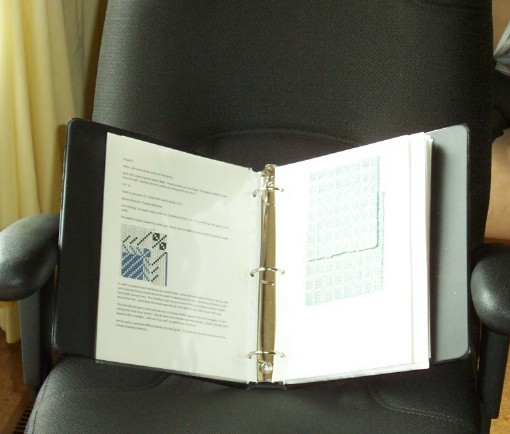
Stories from the Matrix is available from Blurb as are my two other 'books' - Magic in the Water and The Intentional Weaver.  They are printed in the US, but you can get them as a pdf as well.

I'm taking a wee break from writing for WEFT right now - I've fullfilled all my current contracts - and will look forward to Michelle Boyd's book ms.  I'm excited to learn more about yarn - how it is made, how it behaves - and apply what I learn to my own weaving.  

It seems I am not 'done' yet.  I have to keep moving forward.  If 'patience' won't get me there, 'stubborn' might?

Sunday, June 29, 2025

Writing A Book


Magic in the Water; wet finishing handwovens

As a kid, I loved words, stories.  I read voraciously and dreamt one day of writing, too.

But I soon realized that I didn't have stories to tell, as such.  It wasn't until I became a weaver that I realized that my stories were all weaving related.

Over the years I had done 'big' projects so when it came time to write my 'thesis' (or monograph as they called it) for the Guild of Canadian Weavers master weaver certificate, I knew what I wanted to do and generally how to go about doing it.

It was a work of years.  Literally.  Because I made the decision to weave samples.  Not just tiny postage stamp sized samples but samples large enough you could feel the drape/handle of the cloth and get a feel for how it would feel as an actual cloth. Five binders stuffed full of samples.

And once that was done, people started asking where they could get the 'book' and then urged me to write a 'proper' book.

That 'book' grew and grew.  I spent a lot of time (and I mean a *lot*) crunching the numbers.  How much would it cost to produce it?  How many samples?  How much would it cost to buy the yarn to produce the samples for that many copies?  The logistics were, shall we say, daunting?  (Any idea of how much space 1000 two inch ring binders take up?  A small bedroom.)

Never mind much of this happened before I ever started writing.  Having completed the thesis/monograph, I had a pretty good idea of what I wanted to include so I settled on 1000 copies and talked to a local printer who printed a fair number of local history books for local authors.

It was staggering.  Quite literally staggering.  And I was going to have to pay ALL the costs up front, on my own.  No hefty (ha!) advance to help finance it.  Because I knew that no traditional publisher would touch my 'vanity' project with all those tipped in samples.

One of the benefits of my going my own way, using local talent, financing it myself, doing ALL the promotion and marketing myself, is that this (and my subsequent) books were never 'stolen' by LLM to 'train' their AI. 

At the time I just stubbornly put one foot in front of the other, doing what I needed to do, financed the thing on my credit card and took out a hefty loan.  

The book sold fairly well, considering I asked a reasonable price, given all the samples.  I found some unexpected support within the weaving community.  And a fairly large number of people who wanted the book for 'free' because I was 'asking too much for it'.  

On the other hand, some people refer to it as a 'classic' in the craft.  Yes, it is still available, but no samples.  While dealing with chemo (and the fatigue that caused) I took close up photos of all the samples, before and after, and produced a 'digital' version of the book.  Then, when I decided to write a 2nd book, a friend oversaw the uploading of that .pdf to Blurb.com to test the site.

The site allowed the possibility of a print 'magazine' format as well as a .pdf and amazingly, there are still a few people who buy it.

And now, 22+ years later I still offer it for sale.  Just me, not a traditional publishing house.  And now we have to deal with LLM stealing our work and making money off it.  So now me is grateful that previous me was so stubbornly set on producing a book with samples, in the first place, then continuing to publish my books myself.

This year the US president decided to 'break' Canada economically so it would make it easier to 'annex' us.  I was concerned about that until I realized that the company that hosts my books is in US and the books are printed in the north east (I forget which state) so US weavers can still buy my books without paying Trump's Tariffs.  (The last book is only available digitally via my ko-fi shop but I knew very few people would be interested - however, again it is tariff free because it is a digital download.)

There are still a few copies of The Intentional Weaver at Sweet Georgia Yarns, signed ones, let me add.  Whether or not they will order more, I have no idea.  This tariff stuff is...making decisions difficult.  But you *can* still get both print and digital versions of Magic, Intentional Weaver and Stories from the Matrix at Blurb.  Canadians might want to buy the digital versions to avoid whatever shenanigans with tariffs a certain someone serves up.


Sunday, March 9, 2025

Thinking Things Through


Most people seem to assume that creativity bursts upon one in a sudden, perfect thought, no editing or changing allowed.  

We watch a program called Fake or Fortune.  In it an art dealer/expert and a journalist pair up to try and trace the provenance and/or originality of a painting.  Sometimes it gets quite convoluted, but one of the experts on the program will use technology to try to see what's under the surface.  When they use the technology, they can see below the surface paint and see the under drawings, and track the small (or sometimes large) changes the painter made as they were planning the painting.

Creatively isn't so much visual fireworks, but a fair bit of brain cramping, forehead scrunching, changing this, that, and something else, until being finally 'satisfied' enough to begin the actual creation of the item.

At no point am I ever assured of 'success' until I put the warp into the loom, weave it and then wet finish it.  Potters have a trial by fire; weavers a trial by water.

And why I am adamant that it isn't finished until it's wet finished.

In Stories from the Matrix, I tried to talk about the sorts of things that are rarely discussed.  The balancing act of taking the things that need to be done and explain why I used them in a specific way.

And other musings I tend to think about while throwing the shuttle.

I am weaving the next warp, and as of today I will hit the 1/3rd mark.  I'm still struggling with the new pain medication.  There are too many variables and it is time to let my body rest while I use the new medication and see if - as it was explained to me recently - that I do have to choose the pain I will be living with.  I have been on the new medication for 9 days and there have been some improvements, but still some pain.  It's like playing whack-a-mole - I address one thing, but 2 or 3 more pop their heads up and which I hope to keep them down.

Yesterday I finally did 'something' about some of the clutter in my office.  I was trying to write the text for the current article and realized that with so much chaos going on in the world, I needed to clear some of it out of my office.  I can *almost* see the top of the desk now.  But I need more work space, so I'm going to carry the tv trays up and give myself some flat space to work on that isn't cluttered.  

In so many ways I am 'done' with this project, in part because of the transition between meds.  My concentration is shot and my energy levels nearly non-existent.  My goal for the coming week is to keep weaving twice a day, and work on the data for the article.  

And, given the tariff and USPS situations, I am going to go ahead and mail the samples for the previous article and send them by courier.  I hear that the Seattle post office is overwhelmed and any mail that needs to be routed via Seattle are not getting delivered in a timely fashion.  And because I have no idea what will happen with a courier and the tariffs, well, a courier will at least get my parcel back to me if they can't deliver it.  I may have to consider not sending samples to the US but offer to take photos myself?

Still thinking...


Monday, April 1, 2024

Spring Has Sprung


Spring seems to have arrived.  We had a small 'flock' of American robins in our back yard this morning.

The woodpecker arrived last week, claiming his territory by rattling away at the metal vents in the roof.

With climate change advancing relentlessly, it is hard to know what the future holds.  We're old, we've been around a lot longer than younger generations, and we know what the seasons used to hold.  Someone in their 20s has no real idea of what was considered 'normal' - and now is not.  To them, what is happening has been happening for all of their lives and they have nothing in their experience to compare the 'now' to what used to be 'normal'.  As in, before climate change began to accelerate.

We continue to recycle, reuse, reduce.  Our wants are simple.  We have travelled (although not nearly as much as we had hoped) and we have experienced many things in our lives.

This morning a fellow weaver/teacher posted about the 'adventures' she had in her life, saying she should write a book.  I hope she does.

If anyone wants to know more about my life as a professional weaver/teacher/author, my book is still available as a pdf via my ko-fi shop.

Things are changing, rather rapidly, and will continue to do so.  What the future holds we cannot know.  

Decisions are being made that will forever impact our lives and most of us feel like we have no input into what those decisions will look like.  Billionaires are taking over more and more and making decisions that impact those of us who are not wealthy, investing gigantic amounts of money to take over things like writing and art.  Once again people who create things are being told that a) anyone can do it, b) your creativity, skill and talent is worthless because c) a machine can do it.  So they spend billions of dollars and suck up the equivalent of a small countries energy to feed AI machines while explaining that humans who do the same, but better, don't deserve to earn money.

Yes, I know AI is a 'tool'.  But as someone posted on Facebook the other day, I don't want AI to create art so I can do the dishes.  I want AI to do the dishes so that I can create art.

Writing is a skill.  Some people are a lot better at it than others.  Sometimes writers have spent years and years honing their skill in order to be able to tell a story well, or write a knitting pattern that actually makes sense, not gobbledygook.  

In a way, I'm glad I was a weaver/writer/teacher before AI came along to try to usurp my skill.  If nothing else, perhaps, just perhaps, my books will hang around long enough for people to learn how to weave from a human, not a machine who doesn't know how to weave.  Or all the 'it depends' conditions that affect how a weaver makes choices in order to create 'good' cloth.

I did not set out to write a book for the ages.  But maybe, just maybe, my books will outlive me and be useful long after I am gone.

Time will tell.

Sunday, March 31, 2024

Step by Step

 I'm coming down to the 'end' of the current series I've been working on for the last 18 or so months.  I've explored the weave structure and gotten comfortable with it, but I'm beginning to get that restless feeling that means...it is time to move on.  Not that I have anything grand I want to do.  In fact I will be revisiting 'fancy' twills.  

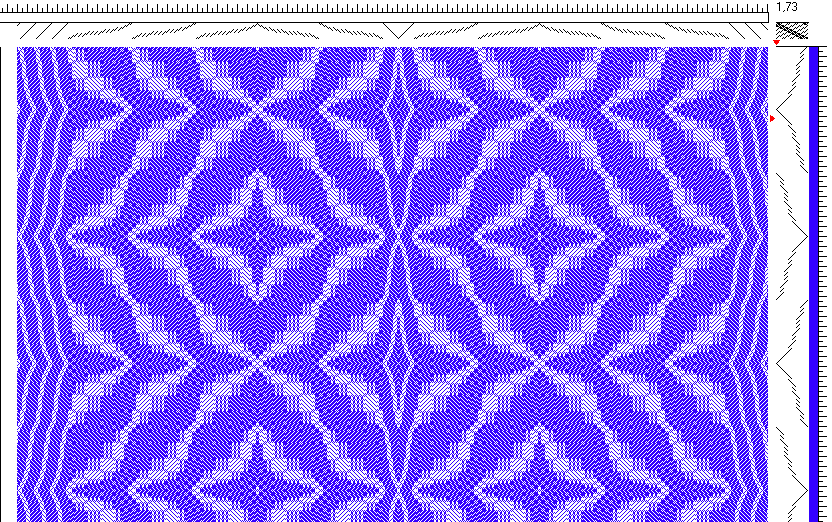
But I thought it might be interesting to some of you how the last few warps came about.  If you want to see more of the Matrix designs, my ko-fi shop is filled with some (not all) of the various designs I wove as I explored the weave structure.

At the end, I came up with a 'tile' design.


I was quite pleased with myself when this appeared on my screen.  I felt it showed off the weave structure, was complex (four different tile designs), and when woven in this 'counter change' format was symmetrical.

Once I had this one set up I wanted to see what else I could do with it.  Fiberworks offers a 'drop' option when copying the threading (and treadling) so I set up the first section, then requested that the software repeat the threading but to 'drop' it.  I had no idea what to expect.


Interesting but not all that attractive to me.  It was going to take some more messing around.

So instead of using the 'drop' function, I mirror imaged the first half of the threading, alternating the blocks in the treadling.


This one showed promise but I messed with it some more and wove this instead.


In this version, I used the mirror function for the threading, but in the treadling created a 4 x 4 block in the middle which then repeated along the length of the towel.  The repeat is too large to be seen in a thumbnail.  

And finally, after messing with the drop function more (a *lot* more) came up with this.


Now I'm preparing the 'last' warp of this series.  The warp will be the same blues (peacock and bleu moyen) and the weft will be what ever is left of the two blues in the warp and whatever warp is left - if there is any - will be natural white.

Colours are not close to 'true' but I wanted to see if I would get the effect I wanted so did an approximation.


When using the same colours in the weft as in the warp the effect will be more like a 'satin' weave - very subtle.

I'm now officially over the halfway point on the current warp so it feels good to have the next warp sorted out.  Sometimes it can take several hours before I find something I want to invest my time and effort into weaving.  Weaving is labour intensive and I don't want to 'waste' my time and effort so I prefer to have a plan I feel 90% confident in before I commit to threading, sleying and weaving the cloth.

If you are interested in more detail on the development of this series, I documented it up until about this time last year in Stories from the Matrix.

Tuesday, March 12, 2024

Thoughts on Creativity


As I worked through the iterations for the 'matrix' series, I was always cognizant of the fact that somewhere, some place, some other weaver had likely stumbled upon this technique.  So, no, I don't claim that I 'invented' it.  What I did was build upon my knowledge and skills and step by gradual step, I wound up with something I was pleased with.  

The above photo is from early in the series as I was exploring the potential for moving the twill 'line' direction, here, there, trying it out virtually, then, when I felt I had something that would be pleasing, getting it into the loom, then wet finishing it.

Because you never really know the quality of the cloth until you wet finish it.

There are people who don't want to 'follow the rules' of weaving, which is their prerogative.  They don't like to create artificial limitations because they feel that hinders their creativity.  And that is their journey, and a perfectly valid one for them.

But it is not mine.

My preference is to do some mental 'weaving', considering this, that and the other options involved in bringing threads together to make cloth.  I do this with bobbin lace as well.  I'm pretty adventurous with bobbin lace, but I *always* have a plan - a 'pricking' - that I work from.  I may adjust on the fly.  I may ignore some rules, and adapt some things, sometimes.  But I am well aware that I am deviating from the 'rules'.  I also know that my deviations are not likely to be noticed by anyone other than a more skilled lace maker than I am.

Does this make me less creative than someone who throws all the 'rules' out the window?  Perhaps.  Does it make me the 'better' weaver?  Not necessarily.  

There are many roads one can choose.  I chose the path that seemed to fit me the best, given my intention to produce textiles for sale.  (Yes, I've sold bobbin lace items, but everything I'm making right now will be donated to the guild.  If it sells great, if it doesn't, it's fine.)

But to say that in order to be creative you have to throw out *all* the rules?  Seems to be just as rigid as those who say you *must* follow all of their rules.

I made my own choices.  I don't follow all of the 'rules' that were taught to me as a beginning weaver.  When something seemed to be hindering my progress, I thought the processes through and adjusted what I was doing.

So, no, I don't chain my warps.  I don't tie 'choke' ties every yard.  (I tie a few gathering ties, but they are not 'choke' ties.)  I don't have a plain weave structure at the selvedge, and I even have floats of up to 5 (sometimes more if the thread is fine enough) at the selvedge.

And yes, I wove on a loom with a dobby and fly shuttle and *still* called my textiles hand woven - because according to the Canadian legal definition of 'hand' woven, the AVL qualified.  (Each and every action of the loom must be initiated by the weaver.)

So, if you belong to a group that has hard and fast 'rules' about things, you might want to consider if all of those rules are applicable to you.  If not, figure out what is best for you and do that.

Because change one thing, and everything can change.


If you want to know how the matrix series came to be, I shared drafts in Stories from the Matrix, available here.

Saturday, March 2, 2024

Making Things


While I was writing this book of essays, I was also working on a new-to-me approach to designing.  As part of that process, I worked in a series, with each new design building upon the previous designs and what I had learned in the process.

After about 18 months of pushing, pulling and tweaking the drafts, I think I'm ready to move on.  But I feel like my current design is pretty decent (although still not 'perfect'!)

There is much to be said for allowing the design process to take all the time it needs in order to get to the point where you feel you have pushed the boundaries as far as you want - or need - to do.  And then it is perfectly ok to go back to something simpler, easier.

I have enough yarn for two more warps of the current 'blue', and I think I will go back to a couple earlier iterations of the tile design currently on the loom, which was kind of the 'pinnacle' of my development of this line of exploration.


I have 10 of this design ready to sell, with another 5 or maybe 6, left on the loom to be woven.  I'm hoping to finish this warp off in the coming week, although the entire month of March somehow got very packed with appointments of one sort or another.

However, since this design seems to have stirred some interest, I have listed the first 10 towels in my ko-fi shop.  This one is listed as Matrix 19, and there are still *some* of the first 18 designs still available there as well.

There is also still one signed copy of Matrix left, and once that is gone, it will continue to be available in both pdf and print options.  I wrote about the development of this weave structure in Stories from the Matrix, including a 'skeleton' tie up.

If you have 16 (or more) shafts and a computer assisted dobby, weaving these designs is easy - once you understand the logic of how it works.  After 18 months, I still have to remind myself of how to make the weave structure behave the way I want it to.  I use Fiberworks as my weaving software, but any software will work.  Although I did have to dig my graph paper out and do it 'old school' to do the initial work of understanding how to make it all weave the way I wanted it to.

Speaking of appointments, I have a number of Zoom presentations this month.  If anyone is interested in booking me for a guild program  (1 hour - although fair warning I do tend to run over because there is SO much to share) or seminar (2 hours - but again, tend to run over especially if there are lots of questions).  My topics are listed on my website, and if you book now, I will honour the current pricing if I decide to increase my fees later this year (maybe in July? TBD).

Sunday, December 17, 2023

Shoulders of Giants


Continuing to explore the weave structure I went back to something simpler.  I call this one 'twinkle star' and it seems in keeping with the season.  

I still have no idea what to call this weave structure.  Maybe it isn't important that it has a 'name'?  We 'name' things as a kind of short hand.  Instead of saying 'twill blocks shifted a half block at a time', which is cumbersome, it needs a 'name' that conveys what it is.  After mulling it over for a year or so, I've kind of settled on shifted twill blocks.  Advancing twill blocks didn't seem quite...right.

Have I ever seen this particular weave structure before?  Can't say that I have.  That doesn't mean that it hasn't ever been done before, though, just that I've not seen it documented.

Is this weave structure 'mine'?  Nope.  No one 'owns' a threading sequence.

It may not have been recorded in a resource I've seen before, but that means nothing.  Humans have been weaving, in one form or another, for millennia.  I'm quite sure I'm not the first weaver to stumble across it.

How did it come to me?  When I look back and connect the dots, I had been exploring similar things for 20 or so years, dabbling a bit, then setting them aside as deadlines roared and I had no time to explore.

The first time I did something similar to this was with Summer and Winter, when I used double two tie unit weave to make more detailed designs in that weave structure.  The units were stepped in just the same way as the twill blocks - shifted by half a unit.  This allowed me to create designs that had curves that flowed, that were less 'block-y'.

How did I come up with doing that?  I'd been weaving Bronson Lace in pick up, based on a workshop I took with Mary Bentley doing pick up Summer and Winter, and realized I could do other unit weaves in the same pick up technique.  As part of my exploration of doing Bronson Lace in pick up, it occured to me that I could weave half units for details.

Prior to that, I'd taken a workshop with Peter Collingwood who explained his shaft switching technique and it was a revelation that just because a yarn was on a particular shaft, that didn't mean it was permanently controlled by that shaft.  By extension, I saw that unit weaves could be 'shifted' in their threading/treadling.  The options were more limited, but there was less 'fiddling'.

The challenge is to remember that in the treadling each block is controlled by four different treadles.  When I design the treadling, therefore, I can't just get the software to generate the treadling.  Or at least I don't see how I could do that.  I could try customizing block substitution treadles, but so far, I haven't bothered.  Because I am still learning how the lines 'work'. How they flow.  How far I can push them, here and there, and create a motif I'm happy to weave.

But none of this would be possible without the work done by other weavers before me.

I first heard "we stand on the shoulders of giants" from Judith MacKenzie.  Since then I've seen it elsewhere.  Every time I hear/read it, I think about my ancestors, the weavers who worked with threads, explored the possibilities, laid the groundwork for me, my generation, to carry on.

And I think about all the teachers I've had, some now sadly gone on to the great loom room in the sky, and I nod and send a thought of gratitude to them.

This weave structure is treadle hungry, so easiest done with a computer assisted loom.  But if anyone is interested in exploring it, I documented how it worked in Stories from the Matrix.  I even provided a skeleton tie up so that others don't have to work it out for themselves.  If you play around with it, I hope you'll share.  I'd love to see what others do with the idea.  

Friday, November 17, 2023

Stories from the Matrix


Yesterday, someone left a comment that started me thinking.

"It is not the tools the weaver uses, but how the weaver applies their knowledge and manages their tools." This principle needs to be stressed more. I see too many posts from new (and not-so-new) weavers that imply a belief that if one buys the correct product or tool, all weaving problems will be solved. Our brains are the ultimate tools."

Since I happen to agree with the comment, AND it's a message I have spent decades sharing, it is time to once again remind people of my latest book, Stories from the Matrix.

I also finished the last of the marking for Olds yesterday and I gotta say, I am going to miss bringing this message to the students who arrive anticipating - in some cases - that mastery of the craft will mean they don't make 'mistakes' anymore.  That when they achieve 'mastery' everything they make will be 'perfect'.

Um, ya, about that...

Just because you 'master' a task, doesn't mean you won't make mistakes.  Just because you buy the most expensive, most highly engineered tools, doesn't mean you won't make 'mistakes'.  Just because you've written a book (or three) doesn't mean you won't make 'mistakes'.

Mastering a craft is not about achieving 'perfection'.  It is an understanding of the capabilities and limitations of the tools and materials the craftsperson is working with.  It is being able to problem solve WHEN something goes wrong.  Is it the equipment failing?  Or a failure of the weaver to make good choices in their approach to designing their cloth?  It is understanding the relationship between all of those things that go into the making of a textile and what might need to change when the results are not what was desired.

Stories from the Matrix isn't a 'textbook' in the way The Intentional Weaver was meant to be.  It is a more philosophical, shall we say, look at weaving and (my) life.  It lays out much more clearly the things that I believe in.  As such, this collection of essays addresses many different things - part travelogue, part instruction, part problem solving, part speculation.  

If someone thinks this sort of 'message' needs to be amplified, well, there is something that can be done - share the fact this book exists.  Let new(er) weavers know it exists, so that they can chew some of the things presented therein over, and maybe, just maybe, develop a much broader view of what 'mastering' weaving entails?

And yes, I'm still looking for book reviews, so if you've read my blog and appreciate what I write here, you will find that many of the things I touch on in this format are further expanded in Stories, where I was not constrained by the limitations of a 'blog'.  Most are not terribly long - a few pages.  Easy reading if you have a few minutes here and there.  And if you like what I have to say, share a book review with your guild members or on social media.  Or write a letter to Handwoven.  Or book me for a zoom presentation.  Topics are listed on my website.


Wednesday, November 15, 2023

Hunkering Down


This photo is from a few years ago, but shows some of the accumulation that we can expect as 'normal'.

The weather forecast for the next few days is...snow.  I'm not particularly bothered by it because I don't really need to leave the house for the next few days.  After a flurry of activity (and stress) the past while, the coming week is supposed to be quiet.

I have one last box of Olds homework to mark, and I'm nearing the end of the current warp.  I will be using up one more colour on this warp and have the draft for the next ready to go.  

The next warp will be the 'last' dark blue at 36 epi and should see me able to use up the last of the mercerized cotton.  There are half a dozen or so partial tubes of navy and then some black.  Whatever the 'last' warp uses up will be the 'end' of that particular yarn.  Anything left will be too little to weave with so it will go into my bobbin lace stash.

When I'm done with that warp, there will be enough of the dark blues to do one warp at 32 epi and I have yet to decide which of the 2/16 colours will get used first.  I have some 2/16 navy, but also other colours that I 'found' when I did the deep clean of the clean storage area.

And then I will have a new warp colour to play with.  Brassard has already shipped the yarns for that.  No danger of me running out of yarn.  (HA!)

In the meantime the BOGO sale is going well on ko-fi, plus I'm hoping people are interested enough in the cotton/linen spa towels to buy - they are priced way below what they should be.

Someone complained about a can of paint costing 3/4's of their daily wage.  Well, it takes me several hours to weave a tea towel, and linen isn't cheap, so each towel warp represents several weeks of my labour, plus the materials, plus, plus, plus...  So I understand that some people can't stretch their budget to purchase something like one of my towels.  OTOH, I have bills to pay, too, and I have never ever managed to achieve even minimum wage by weaving.

So, why do I do it?  Because I must.  I worked 8-4 jobs and grew to hate them, every single one.  So I chose to do an 'antique' craft and earn way less money than I could have done, just to be able to keep my sanity.  And I always priced my things so that more people could afford them, which put me way down at the bottom of the pay pyramid.

But again - my choice.  

OTOH, someone else's pinched budget is not my problem to solve.  So I will continue to sell my textiles at a price that I feel is as fair as I can make it.  And from time to time I will offer 'special' pricing on certain items.  (i.e. the BOGO sale, the current spa towels)

The same with my books.  When I wrote Magic, it was because resources on wet finishing were sparse, and I felt I could contribute to the general knowledge in the weaving community by presenting that information in a way that was helpful.  Hence the before and after samples.  It was horrendously expensive to produce, so my labour (and that of Doug) was largely unpaid.  When I announced the price there was a hue and cry about my price gouging, especially on my shipping charge.  For a book that weighed about 5 pounds, and no book rate in Canada, I had to pay parcel rates and international shipping - because the vast majority of people wanting the book were not in Canada.  Not to mention all the tipped in samples - which were not postage stamp size.  But I held firm, and now?  People are not only getting their purchase price back when they sell it, the book (with actual samples) frequently sells for *more* than what I charged initially.  If I could have got that price when I published it, I would not have had to finance the publishing for nearly 10 years...

With The Intentional Weaver, I had to weigh the cost of the printing with what I felt people would be willing to pay for a 'textbook'.  Because that is what it is.  By self-publishing I actually get more per copy than if I'd gone the traditional publishing route.  BUT, I have to do all the marketing myself. 

Ditto Stories from the Matrix.

The *value* in my books is the information being conveyed, not in the cost of the paper and ink that holds that information.

If you want a copy of my books, they will remain available at blurb.com where you can purchase all three books (well, Magic is a 'magazine' format) or signed copies should be available at Sweet Georgia again.

But winter is definitely here, and it is time to hunker down...


Tuesday, October 24, 2023

Book Review: Stories from the Matrix


Book Review from Margaret Tayti:

(DISCLAIMER: Laura is a friend of mine, and I received a review copy of Stories from the Matrix - but I would have purchased a copy regardless!)

If you're fortunate, you may have a few 'Crossroads and Connections' friends. The friends who serve as mentor and sounding board, and fit so many other roles - and you find over time, that there's at least some trading of those roles.

Connections are really key to so many things. For example, there are a finite number of ways to interlace threads - they cross over or under, they skip, they twist, they loop - sounds simple, right? 

It Depends. (This is the Short Answer to nearly everything...)

How the threads get to the places where they meet, MATTERS - and the result is an enormous variety of textile traditions, spanning the globe, and human history.

I'm primarily a spinner, and a weaver of narrow goods. Anyone who knows about Laura might think we have very little in common - her career has been the production of VAST amounts of loom-controlled cloth, and teaching others to continue that craft. 

I... make tiny scraps of things, sporadically - often in ways that make some online discussions of 'Slow Cloth' seem ludicrously swift.

And yet, we connect. Our paths differ, each travelling its own way... but there are places where they merge, or where we find ourselves in parallel, each a  thread necessary to the final cloth. 

Many of the essays in Stories capture the essence of those spaces where we connect. They cover some of the important questions we need to ask ourselves, as well as Laura's observations from decades of lived experience as a production weaver.

I've heard many of these topics before, and was present in her studio for a few of them, a number of years ago. Having them collected in one place is like having her over for coffee and a private lesson (without having to wake her up at 3 am, when my muse strikes).

I can curl up with these essays, and be reminded in numerous ways that Laura doesn't think of my collection of sticks, string, and playing cards (or pile of spindles), as 'lesser' when compared to her tools. They're different, of course (I could never put a Megado in a backpack and take it camping) but they're no less suited to what I do than her equipment is to her workflow. The questions she poses to herself, and the observations she makes about her time at the loom, are often hauntingly familiar - in part because weavers still have bodies, in all shapes and sizes, and those bodies are prone to wear and tear if we aren't paying attention.

She has spent a lifetime refining her workflow to put efficiency foremost, and outlines what that can look like in a working studio, where 'waste' has to be balanced against remaining productive and profitable. We both have occasion to be frustrated with bodies that don't always let us do what we want, and she shares some of that journey here, as well. Her solutions may not suit everyone, but the process may be useful to anyone facing the realities of injury, aging, or physical changes.

The essays are as much about the life that surrounds the weaving time, as they are about technique, and I think many are relevant to a broader audience than just weavers. I suspect my Maker friends could benefit from the insights about workspace requirements and adapting to a changing world, and her observations about ergonomics are relevant to other physical skills.

I live close enough to have coffee with Laura, and I'm able to chat with her in person on occasion about refining my weaving technique, and exploring other shared and differing aspects of the craft we both love. It's amazing to be able to just catch up and share projects, or pick her brain when I'm at a decision-making Crossroads.

'Stories' might be the next best thing.

Margaret Tayti
Loomacy and Lace


Thursday, September 28, 2023

I Think Therefore...


Weaving is full of complexity.  I think about that.  A lot. 

Perhaps that is why weaving or other textile arts are so frequently found as metaphors in 'fairy tales'.

All the way back to ancient Greece where  our 'hero' was given a ball of string to help find his way through the maze - and back out again.

The Brothers Grimm and others collected folk tales from what we now call Europe and guess what?  They actually took out the more gruesome bits to make them more acceptable to 'polite' company.  Now even those versions are being 'cleaned up' because they are still too gruesome for our current sensibilities.  

Princess pricks finger on a spindle and falls asleep for a hundred years.  Princess has 7 brothers turned into swans, must make - from scratch - shirts from nettles to change them back again, with a very tight deadline.  Lowly peasant girl catches eye of the prince and brags of being an excellent spinner, then must turn a room full of flax into 'gold' and calls on the help of a nasty 'goblin', then must forfeit her first born son.  Etc.

These stories are not meant to be taken literally, but as object lessons for the listener to learn from.

So the question becomes - does 'artificial intelligence' actually *think*?

And if we allow such a thing to begin to dominate how we live our lives, are we going the way of the dodo bird?

It was Descartes who said "I think, therefore I am".

I think.  A lot.  About a lot of things.  One of the ways I think through a conundrum is to go to the loom, and if only surface attention is required the question I'm nibbling on wanders around in my brain trying to work out the knot.  Sometimes I can work out a solution to a weaving - or life - problem I'm having.  Sometimes I come to the computer and start musing.

Like this morning.

The concept of AI is on my mind, for obvious reasons.  

If we stand aside while a computer program who very obviously does not, can NOT think, just scrape words off the internet, then disgorge them pretending to some kind of expertise, then I suppose we will deserve what we get.

OTOH, there are multiple voices crying out warnings.  Too bad too many people cannot hear the truth over the noise of disinformation and outright lies being told by too many.

Why does it matter?  Because if we don't understand what we are doing, we cannot become proficient at any skill.  Not just textiles, but anything that requires skill - from cooking to medicine, teaching to repairing technology that breaks.  *Inventing new things*.

In my lifetime we have gone from records on vinyl (my mother had actual bakelight 78s, and yes we played them), to tape recordings, to CDs.  I still have a turntable, although it is so old the drivebelt is probably too old and would break if I were to try to play any of my LPs.  I still play cassette tapes.  And CDs.

I don't stream anything.  I do have music loaded onto my iPad, but I copied the music files from a CD to my desktop, then transferred them to the iPad. 

If we insist that we humans must make money, and if we can't make money being creative, or we go on strike for better wages for our creative work, and the capitalist response is to say 'we don't need you we have AI', then steals the work of creative people, what are we as a society, then?

I hear people 'defending' AI as just being another new sort of technology that we can use to our benefit.  They might be correct.  But I fear, as with so many other things, the lowest common denominator will become the new 'norm'.

So no, I won't be using Chat GPT or any other form of content scraping.  So far I doubt my personal production of words will be fodder for any LLM.  I did a quick look at the list of authors that were 'stolen' from, and I could not find any weaver whose content had been scraped, but I didn't check every weaver who publishes.  Mine were not included, which was a relief.

Sometimes being 'small' and addressing a slice of a niche market, NOT going the mainstream publishing route, but self-publishing, is a Good Thing.  Other times, it's not much fun, especially when the load to market my work falls on my shoulders, with no help from a marketing division to get the word out.

I'm still waiting for reviews of Matrix, by the way.

OTOH, I have been sitting on this email for several months, not sure I would - or should - share.  It's a response from Elaine Igoe, whose book broke open my thinking last year and set me on a new path for thinking about how threads interlace.

I've decided that she would most likely be ok with my sharing so here goes:


Hi Laura
Thanks so much for sharing this with me! It really makes me so happy and validated that you have connected with it. I really love the way that technical weave information, pedagogy and subjective creative journey are all there on the page. And I've only read the first few essays! The connection to Yunkaporta is really interesting too.

Would you mind if I shared your work with my colleagues and students? I would be happy to pay for a copy of your book or make a donation to somewhere of your choice?

At Chelsea, students are asked to undertake what they call 'critical practice' projects - aimed at integrating practice with theory, the outcome being both practical and written. I think your work would provide a great example to them. My colleague who coordinates 'critical practice' would be fascinated too, I'm sure. 

Your book's turn to become the teacher!

Very best wishes,
Elaine

Dr Elaine Igoe (she/her)
Senior Lecturer and Year 3 Leader, BA (Hons) Textile Design
Chelsea College of Arts, University of the Arts London

Monday, September 11, 2023

Stories from the Matrix - Book Review by V


"My textile book collection consists almost entirely of technical 'how-to' sort of volumes:  pattern books, books with weaving drafts or knitting charts in, and the odd bit of textile history.  Many of these are aspirational books; things that I really want to somehow find the time to explore, to learn.  Stories from the Matrix is unlike anything else I own, and is perhaps not something I'd ordinarily choose, as my shelf space is limited and I tend to try and get the best bang for my buck space-wise by only filling it with books that set out to show me how to do something.

After reading Stories from the Matrix though, I think that tactic was a mistake.  I decided to give this a try as I've seen Laura speak a couple of times, and read plenty of her writing, and find her stories and her perspective interesting, as well as being aware she is an excellent weaver and really applied herself to learning to weave quality pieces in an ergonomic and efficient way.  I expected this book to be heavy on the storytelling and the philosophy, and it certainly doesn't disappoint in those respects, but more than that, it's been surprisingly educational and enlightening about technical weaving topics too.

The essays are in no particular order, giving the book a companionable air, like you are hanging out with Laura in her studio while she weaves, discussing whatever comes to mind, from her travels when learning to weave, musings on how our ancient ancestors must have discovered string and yarn to fascinating technical details on weaving itself.  While the book didn't market itself as being one that would teach me about weaving and enable me to be a better and more efficient weaver, there are enough tips and tricks in there that I think it's going to be every bit as deserving of shelf space as my collection of how-to books.  There were several point during reading I found myself mimicking hand motions that Laura described to help myself understand what she was explaining, which likely earned me a few looks in the waiting room I was in at the time!

For those who don't weave, there will be a few essays which are slightly too technical or hard to follow, but the accompanying pictures help clarify the points being made, and many of the stories are widely applicable to all sorts of crafts and other skills, the weaving is just the medium of telling the story rather than the point of the story itself.  I'd highly recommend this book to anyone who is interested in the process of creating things with their hands and who would like to take a step back and examine the process from a wider perspective.  Laura's status as an excellent weaver and teacher as well as a perpetual student, always learning, as well as her innate storytelling ability make this book a wonderful read, either to dip into and read one essay at a time, or to read cover to cover if you can't wait to get more of her insights.

This book, while not fitting into one simple category on my shelves, happily straddles them all, covering technical points, historical and modern methods, and also nicely fits into my 'aspirational' category as a reminder to always be open to improving my methods, learning new things, and seeing old things from new perspectives.'

Friday, September 8, 2023

Because I Can


'four leaf clover'

This isn't really a four leaf clover, of course I know that.  But I need to name my weaving files with something that I will remember later, just in case I want to do the draft again - or modify it, use it as a stepping stone to another design.

I'm quite pleased with how this design turned out.  It took a while, requiring several iterations before I arrived at this one.  Using weaving software makes me a 'better' designer because I don't stop at one or two attempts but will keep going until I am finally satisfied I have something I want to weave.  

While I stopped exploring here and dressed the loom, as I have been weaving it I can see where I can further tweak it and create other variations.  And I probably will.  Because I'm not done with the mercerized cotton.  Yet. 

I will frequently design a different sequence for the hem area.  This can 'frame' the main body of design rather than have the motif run off the ends of the towels.  Sometimes I don't bother, but sometimes it pleases me to have such a border.

With this design the size of the motif is such that the hem 'border' will actually be hidden within the folds of the hem.  But I still chose to change the treadling for the hem.  I do that as a signal to me that I'm nearing the end of that towel.  It gives me a head's up I can stop weaving soon and I find a little spurt of energy to see me through to the end.

Not so much after the massive muscle spasm in my back.  Right now I'm only weaving for 30 minutes, which is half a towel.  But I still find that when I see the hem begin to appear in the cloth it gives me a frisson of satisfaction.  One more towel!

Does it matter I take the few minutes to add a special hem area?  Not really.  Especially when no one but me knows it exists.  But I do it because I can.  It gives me satisfaction and costs me just a few minutes of my time.  And every single time I come to the end of the towel with the signal of the end due to the changed treadling for the hem, I get another little sense of satisfaction.  Over a 20+ yard warp and 20 or so towels, that's a lot of satisfaction for little effort.

At this point in my life I am primarily weaving for me.  So the very first person I need to satisfy is me.  I hope that others will find what I do appealing, but first and foremost I am weaving, now, for myself.  To learn more.  To explore more.  To feel pleasure in the results.  But also for the physical benefits of doing some aerobic activity every day (if I can).  It is important as we age to keep physically active, within our personal health limitations.  So I weave.

We make choices every day.  I choose to focus on being creative.  Being physically active (as best I can be).  I am grateful for every day I can weave, and thankful for those who encourage me here and by purchasing my textiles on ko-fi.*  

I choose to focus on what I *can* rather than what I *can't*, although some days are easier than others to maintain that focus.  The past few years have been a whittling away of what I *can* do, which has been difficult.  So it has become ever more important to focus on the *can*.  

And keep going.  As Winston Churchill has reportedly said - when you are going through hell...keep going...

*still 3 signed copies of Stories from the Matrix on ko-fi - or purchase from blurb, print or pdf


Saturday, August 19, 2023

It's the Little Things


Yesterday I felt a bit 'better' and puttered in the studio for a bit doing small things that, I hoped, wouldn't aggravate my back.  One of the things I did was remove the ratty 4/8 cotton yarn I had been using as a 'sling' or 'cradle' for the brake handle on the Megado.

Over the winter the relative humidity drops such that a wooden machine like the Megado shrinks.  The loom is generally pretty good at dealing with this, but the one thing that did seem to be affected was the brake handle and the 'stop' the loom has to keep the handle up close and within reach.  The handle would slip by the 'stop' and next time I wanted to advance the fell, I would have to bend over, fish around and get the handle before I could do that.  

My patience, never very thick, meant I grabbed the first thing to hand, which was a bobbin of 4/8 cotton, and tied a loop around the loom side frame and handle which prevented it from dropping more than in inch below where it was supposed to be.

That worked well enough, but...it wasn't very attractive.  

Needing a band for a hat (see previous post), I asked a local guild member if she had some and I got some nice 'trims' from her.  The hat was dealt with immediately, but right after I got the trims, my back went into spasm and I haven't felt up to doing very much of anything.

Yesterday I felt improved enough after massage I thought I could at least deal with this little job and give the Megado some handwoven 'bling'.  I asked for several inches more than I needed because instead of sewing the band in place, I decided to tie it.  That way, should I ever need to remove the beam, or take the loom apart (I'm not immortal, and the loom will likely go to live somewhere else at some point), it can be easily untied and re-used.

While I had the ipad down in the studio I took a closeup of one of the 'new' tea towels I've been playing with.  The weave structure is documented in Stories from the Matrix, is generally 'best' woven with more than 8 shafts (12 and up) and a computer assisted dobby because of the number of treadles/lifts needed.

But the weave structure creates a very interesting texture that I am finding very satisfying, as I work through various iterations of what is possible.  The current design is really tickling my fancy, but I don't want to photograph it until I have wet finished the towels.  If I remember I will do a before and after comparison.

The weave structure is a 1:3-3:1 twill block and as the blocks change from one to the other they create a texture due to the weave structure.  Because they also 'shift' half a block, you get 'half-tones' which create a different kind of texture.  And I'm really quite enjoying trying various things in Fiberworks, then watching them as they develop in the weaving, then after wet finishing.

My back isn't happy today - certainly not enough to contemplate weaving - so I will try and work on the workshop drafts for a while, then perhaps finally dig out the Matrix towels and begin photographing them and uploading them to my ko-fi shop.

We'll see how far I get.

Here's one of the recent towels in close up:


Friday, August 11, 2023

Closed


are these the same yarns?

If you keep a closed mind, you can't take in new information.

There are many aspects of weaving (and no doubt other crafts) where the subtleties of the craft are such that it becomes a lifetime of learning.  Because change one thing and everything can change.

Let's say a weaver uses the same brand/range of yarns and rarely uses anything else.

They have a 'set' length and width they tend to stay within and as long as they do, the processes, tools and experience they have mean they generally have 'success'.

All is well, and they don't understand issues someone else may be having.  According to their reality bubble, everyone else just needs to do what they do and success will be assured.

That doesn't mean they necessarily understand the principles of the craft.  It means they have a skill set that serves them well, and they are happy.  As they should be.

The problem arises when they see someone having problems and try to help.  

Unfortunately the other person's circumstances may vary widely from their own and their advice is...not necessarily helpful.

Over the years I have seen this dynamic over and over again.  Especially when I try to explain *why* the correct answer will depend.

Sometimes I'm told I'm flat out wrong when I advise someone to try something or explain on a deeper than surface level, what *might* be happening.

The photo above is a prime example.

For years I have tried to explain to weavers that the US standard 8/2 (or 16/2) cotton is NOT the same *quality* as the Canadian standard 2/8 (2/16) cotton yarn.

The above photo is one of each.  Do they *look* the same?  No, they do not.

The thing is, the ONLY thing the numbers tell you is how many yards per pound each yarn will have, regardless of the order those numbers are written.

The numbers will not tell you anything at all about how the fibres have been prepared for, then spun.  The numbers will not tell you anything about the strength of the yarns.  Or, indeed, the thickness, as can be clearly seen in the photo I took, using a strand of 2/16 (on the left) and 16/2 (on the right).

What this means is that if someone is used to using a 2/8 cotton and then gets some 8/2, the experience of weaving with 8/2 as warp will be different than using 2/8 as warp.

(I use the two different number orders, not to specify anything other than that they are two different *qualities* - they both have the same number of yards per pound.)

Does the difference matter?  It can.

The 8/2 is generally spun from shorter fibres than the 2/8.  It has been open end spun, therefore more trapped air in the yarn, therefore thicker, more absorbent, weaker, with a different number of twists per single and ply, than the 2/8 Canadian standard yarn.

They are two very different yarns, having nothing in common, really, than the fact they come with the same number of yards per pound.  

There are many other cases in weaving where when the weaver does something different from their 'usual' they will run into problems.

Scaling up - or down - can mean their 'usual' skill set isn't appropriate.  They wind up with tangles and messes and huge disappointments.

So when I carefully explain *why* something is potentially going wrong, and a chorus of voices claim that *they* never have such problems, I walk away.

Because a closed mind will not absorb new information.  My hope is that, in the future, should they venture out of their comfort zone and start to discover problems, they might remember that if they change one thing, everything CAN change.   I'm not saying it will, just to be open to the possibility.  Be willing to change to meet the new challenge.  Try something different if the 'usual' suddenly isn't working.  Because it may not be 'bad' yarn, but the weaver making a 'poor' choice, given the change.  Or a poor choice of process.

When I say that weaving is a biofeedback activity/skill and people tell me their loom does everything for them, well, I'm glad for them.  Mine doesn't.  I am constantly monitoring what I am doing, adjusting, paying attention.  But that's me.  If someone is getting good results, I'm happy for them.

What I *try* to do is help those people who are NOT getting the results they desire by explaining why that might be happening and offering suggestions for how to adjust what they are doing.

It's up to the reader to decide.

If anyone is really interested in what I know/think - my books are available for sale.  I have You Tube video clips showing what I do.  I have this blog (subjects listed down the side if you are interested in a particular topic).  And I have my online classes.  I am always happy to help people who want to understand.  Who want to learn.

Happy weaving all y'all.