Friday, April 29, 2022

Procrastination


I have been so focused on getting my stash woven down I have been letting my other deadlines slide.  Of course I've always worked 'best' under the pressure of deadlines, so...

But April is nearly over, next week it will be May!  And I have things I need to take care of before June.  Weaving, being labour intensive, means that I have to get cracking and deal with getting ready for the Olds College class in mid-June.  Part of that is sampling the new-to-me yarn I got earlier this month while I was at Sweet Georgia Yarns.

One of the challenges with weaving is finding 'good' yarn.  Even better if that yarn comes in an array of colours.  

I don't weave much with wool these days, but level one of the master weaving course means weaving with wool and fulling it.  One of the class assignments is to create a value gamp, so you need at least 6 steps in the value of a hue and it has to be wool.

Since a percentage of the level one students are usually a bit less experienced, some of whom may have never woven with wool, I try to find 'friendly' yarn.  Many of the finer wool yarns that come in value gamp steps are extremely elastic/stretchy.  This makes them more challenging to weave with if you have never encountered a yarn with a lot of elasticity in it.

I've been using Harrisville yarns in part because it is meant to be fulled, in part because it doesn't have a lot of elasticity.  But it doesn't have a great value scale so I've fudged by reaching into the next hue for the darker values.  

Array (from GIST) is now being carried by Sweet Georgia, and the grey scale comes in a five step value package, plus you can buy natural white as an individual cone.  So I bought that for the class.  However, I also need to sample it so I did a two birds one stone thing and bought a set of their lime green value scale (plus white) which gives a five step value scale.  On this warp I will weave my samples in preparation for the Olds class and the grey scale, but I bought enough I can make a scarf for a friend who absolutely *adores* lime green.  

Yesterday was a pretty good day and after weaving two towels and taking a short break I wound the lime green warp.  I had re-designed this warp at least 6 times.  Array is not a cheap yarn and I wanted the scarf to turn out well but I don't have a lot of 'extra' yarn.  So I took my time combining the value scale concept and the stripe sequence in a way that was pleasing to me (I am not actually a fan of lime green, but I think this is going to look nice!) and stayed within the confines of the yarn I had available.

The changes in the value from one shade to the next are slight, so I will be needing to keep track of each step as I weave the gamp.  This should make a really nice gradient.  

The yarn is strong.  It's 'worsted', smooth, compact, and will full.  So it will be interesting to see how it is after a very light fulling and a good hard press.  It won't be merino soft, but it will be a lot friendlier to weave with than a sproingy (technical term) merino yarn.

And yes, it's a bit spendy, but worth it imho to have a less stressful weaving experience, plus the very lovely gradient of colours to work with.

Stay tuned.

Thursday, April 28, 2022

"Poor Man's Damask"


May be a little hard to see, but I've switched to white weft on white warp and while I'm sitting at the loom I can't really *see* what I'm doing.  It is only when I get up from the loom and look it from an angle that the pattern becomes visible.

Yes, I'm still weaving twill blocks (or turned twill) and this is sometimes called Poor Man's Damask, especially when woven white on white.

Damask is woven with satin weave and as such is very shaft hungry.  Usually it is woven on a drawloom or Jacquard in order to get those really fancy designs.  If you 'only' have a shaft loom, it's a lot harder to get very fancy with satin weave structures.  Satin also takes a *much* higher epi/ppi than twill blocks, so using turned twill to create motifs is a lot cheaper and quicker than satin.

Selvedges can be an issue with it (as mentioned in my previous post) but I don't fret too much so long as they are 'reasonable'.  

(Each weaver has to decide for themselves what level of 'not perfect' they are willing to live with.)

The next warp in this series will also be twill blocks but after than I think I will go back to 'fancy' twills.  Selvedges on a 16 shaft fancy twill can also be a problem, but again, usually not anything I'm too worried about.

My goal is to use up the 2/16 cotton this year.  (I *thought* it would be done by now, silly me!)  Once that's done, I have several boxes of 2/20 mercerized cotton.  More tea towels.

Am I bored with tea towels yet?  Nope.  Each warp is a different threading and I'm limiting how many of each motif I weave in each colour.  That is about to end as my dyed yarns are actually disappearing.  However, I have about 3 kilos of that turquoise I showed in my previous post, and a whole bunch of natural white.  Given all the other things I need to work on, weaving on the Megado will slow down for the next few months.  But I haven't forgotten my goal of reducing my stash.  It's just going to take a bit longer than I thought it would.

Wednesday, April 27, 2022

Not Up to the Challenge


When weaving 1:3 twill blocks, sometimes the selvedge doesn't want to weave in nicely.  For this warp, I doubled the four outside ends in the heddle (keeping them the same density as the rest of the cloth in the reed) but the pulling of the warp combined with the weave structure means that the selvedge ends tend to not want to pull in nicely to the body of the cloth and I'm left with 'loopy' selvedges.

This is NOT perfect.  Or ideal.  Or even acceptable if I were planning on entering them into a juried exhibit.  

But I'm not.  I'm just weaving up my yarn stash and trying to get it done as quickly as possible.  I don't have the spoons for fussing about it and frankly?  These loops really aren't going to much affect the function of a tea towel.  They might (might!) wear out more quickly, but should still give good service for several years.

I happen to like weaving twill blocks for the crisp motifs.  The 1:3 twill is easy to weave since fewer shafts rise than sink, therefore it takes less physical effort.  One down side is the selvedges tend to curl.  Where there is more weft than warp in the block the cloth will curl up.  Where there is more warp than weft in the block, the cloth will tend to curl down.  Much like the knitting.  If one side is all knit and the other all purl, the knitted cloth will curl to the purl side.

Wet finishing reduces that curling - in both knitting and weaving.  Unfortunately it doesn't always solve the 'problem' in it's entirety.

I do notice how much the wet finishing tends to camouflage minor inconsistencies, though, and so it is with these towels.  The high value contrast shows up my inconsistent beat, but after wet finishing and a good hard press, the minor 'streaks' are not jumping out at me.

So, here's to imperfection.  In spite of minor bobbles, these towels will still dry dishes.  I have another 3 or so kilos of this teal/turquoise yarn.  I may switch to a fancy twill for a while so that I'm not reminded so obviously that I'm *still* not perfect.

"Let go your perfect offering.  There is a crack in everything.  That's how the light gets in."

Leonard Cohen

Thanks for the reminder Leonard.   

Tuesday, April 26, 2022

Goat Trails


This morning Facebook showed me a memory from six years ago when I was preparing for a workshop with a guild.  It showed the Leclerc with a warp beamed but waiting for threading and baggies with weaving drafts and yarns to be used for the workshop warps all laid out all over the floor.  There was about 15" of walkway between those and the shelving unit on the other side.

I stopped letting students use their own yarns when I did a couple of workshop on wet finishing, specified that people needed to use wool that would full and have a couple show up with their looms all dressed with acrylic.  So much for experiencing fulling.  :(

It just became a whole lot easier for me to provide the yarns (for an additional materials fee) and make sure the students experienced the workshop in the way that *I* intended.

But it was an enormous amount of work.  

At the time I was also weaving for production, planning for upcoming shows to sell my work, writing articles to submit for publication.  My studio was crammed wall to wall with...stuff...and my studio had a couple of goat trails through it.  It was a constant shuffling of bins, boxes, and equipment as I juggled the deadlines and dealt with the logistics of it all.

Most of this type of work is completely invisible to others - unless you've done it (or something very similar).  

In addition there was the constant self-promotion and fielding questions, setting up teaching tours (always cheaper for two or three guilds to share my travel costs), and so on.

Over the years I designed and made weaving kits, self-published booklets with woven samples in addition to the two 'real' books I did, made a CD in a very early effort to produce digital 'workshops'.

And I did all this - and more - for 4 decades.

When I 'retired' I wanted less stress in my life.  Getting rid of travelling to teach was a no-brainer.  That sliced a big chunk of mental scrambling out of my life.  No more being a travel agent, a booking agent, ordering in yarns for teaching, being a photocopy centre, assembling 'kits' for workshops and then mailing them out to the workshop organizers.  Then making sure I collected the material fee when I got there if the guild hadn't done it for me.

Constantly promoting myself.  Which, given I'm essentially an introvert, wasn't an easy thing for me to do.  Still isn't, honestly

So now I'm 'retired' - for certain values of - and I have to say...I don't miss the goat trails.  I don't miss the constant scramble of looming (pun intended) deadlines.  The pressure to be 'on' all the time.  The dark o'clock flights.  The adjusting to different time zones.

But I'm not dead yet, and I do still have goals.  So while I AM 'retired' it's the craft fair circuit and travelling to teach that I've officially retired from.  I'm finding that I can manage - just - to develop online content, with the very talented team at SOS.  

So even though there are still challenges (buying a new laptop and trying to get it set up before the first lecture on May 4) I am managing.  Mostly.

I am officially a senior citizen, have been for a while.  I ride the health roller coaster, even if I don't want to, because I still feel the need to share my knowledge with anyone who wants to know what I know.  Or what I *think* I know.  Because I'm still learning.  The deeper I dig, the more I understand that I don't know, *can't* know, everything.

And that is just fine by me.  It's why I drag myself from my bed each morning.  Because I never know what the day will bring, and what I will learn.

And I really don't miss the goat trails.

Reading the latest book by Donna Leon, Give Unto Others

Saturday, April 23, 2022

Self Promotion


I forget to promote myself and the things I've done.  I get caught up in what I'm doing now and ignore what I've done in the past.  So here's a friendly reminder about the books I've been involved with.

The two books I wrote and self-published are available on blurb.ca (or com if you are outside of Canada).  There is a link on this page at the bottom if you are ever looking for either title.  Magic in the Water sometimes becomes available second hand, through guild/estate sales or someone downsizing.  I find it hard to believe that 20 years later it is still valued.  

The Intentional Weaver is also available through Sweet Georgia Yarns.  I signed 10 copies when I was in Vancouver earlier this month.  (Their website says 30 in stock but I'm pretty sure there are only 10.)

Weave a V was written by Kerstin Fröberg and I encouraged her to translate it into English, then had it printed in Canada.  And yes, I still have copies for sale.  Price including shipping to Canada/US is $25.  

Right now my focus is on the first SOS lecture, set to launch May 4.  People who join SOS have full access to all of their offerings.  They have a number of instructors for a variety of textile crafts and in addition to the classes, there are articles plus forums where members can ask questions.  

I am also taking bookings for guild programs (60 minutes) or lectures/seminar (120 minutes).  My fee for a guild program is $150 and the lectures are $250.  

There are two more topics in the works for classes with SOS.  I just can't seem to make myself sit down and do the thinking and number crunching.  However that will have to change very soon!  I have always worked 'better' under the pressure of a looming (pun intended) deadline.  Apparently I still haven't learned to start early and avoid the pressure!  

However, I am looking forward to these two topics.  I need to start by dragging out all my bins of teaching samples and sorting through them to see what else I need to weave.

Anyway, if people want to contact me, I just renewed my domain name and website so the easiest way to reach me is to email laura@laurafry.com

Friday, April 22, 2022

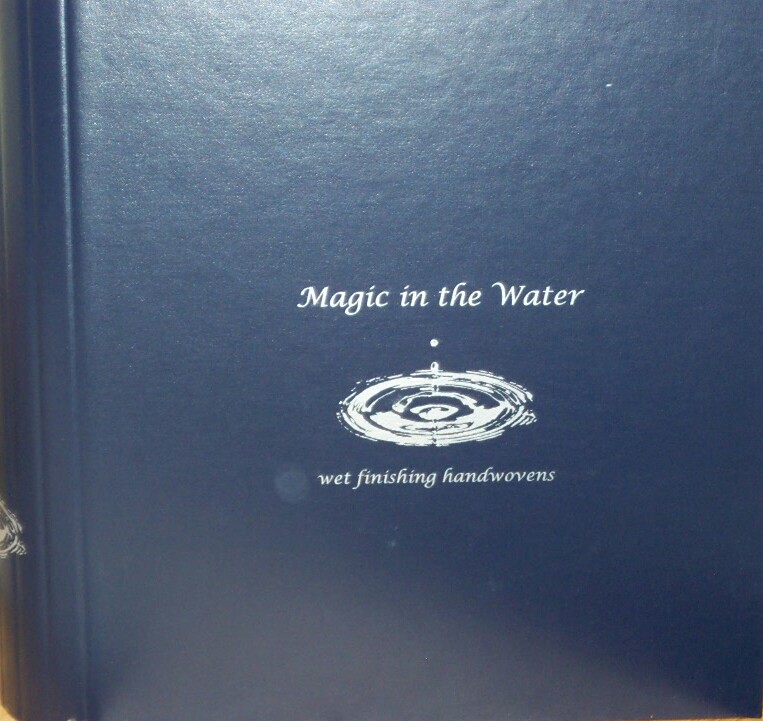
Magic in the Water


This morning I received a nice email from someone who had my book, but wondered if I had a DVD of the topic,  I pointed her in the direction of Handwoven, where they have the topic as a 'workshop' on line.  But of course, I also have the class on School of Sweet Georgia.

Because sometimes you need to *see* a process being done, not just read about it.

Given the time, energy and money it took to produce this book (with before and after samples) I am pleased that people still refer to it, still value it.  It is now 20 years old and the whole concept of wet finishing is still not very well understood.  Although I hope that my constant harping on it online has at least raised awareness that it is something weavers need to pay attention to.

As a brand new weaver I understood that what I was taking off the loom wasn't...good.  It was unstable, raw.  And in fact, industry still refers to the web fresh off the loom as 'grey or greige' goods, not cloth.

Once off the loom, the web is inspected and any repairs needed are done, and only then does it hit the water for that wondrous transformation, from web to actual cloth.

I'm pleased as punch that I am still being asked to do guild programs, and now to work with the School of Sweet Georgia.  I was very happy to do the DVDs for Handwoven but I continue to learn.  So for anyone who wants to see fulling in action, there are my video clips on You Tube, but if you want more extensive information, check out the workshops on the Handwoven website, or join me at SOS.


after wet finishing


before wet finishing


Thursday, April 21, 2022

Deeper Understanding


Harrisville and Gist yarns

Over the past year while I was developing my lecture series, I had to think about ways to inform people remotely.  I didn't have the capacity to do live video teaching, and besides there are others already doing that - and doing it very well - like Jane Stafford.  

I had no desire to 'compete' with those people in what is a rather small niche in a niche 'market', so I decided to focus on principles of the craft.

To say I am pleased that the School of Sweet Georgia picked up my lectures and are adding them to their course offerings would be an understatement.

As part of the school, they also publish articles by their various instructors and in our meeting at the beginning of the month we talked about the lectures and I showed them a blog post I'd written.  They asked if they could publish the blog post, but I wanted to do something more detailed, more...professional...in terms of the information I feel needs to be made more available to those who want to know more.  

Once I got home I looked at the blog post and dug through my resources, expanded the information in the post, added more photos, more examples and more information on the count numbering systems - imperial and metric.

People who have registered for SOS have access to the article along with all the other articles that have been published by the instructors and it's really a very good resource that might go unnoticed.

This morning I got an email from Handwoven and they also have an article on the numbering systems.  I am really pleased to see that other instructors are getting good information out.  I probably didn't cover the topic in complete detail so it's always a good idea for people looking for information to read what a variety of people have to say.  

Understanding our materials means we can make good choices when we plan our projects.

The first lecture, A Good Yarn, will look at yarn characteristics.  It's more of an overview, so if people want to know more detail, there are other resources.  My go-to resource is the book by Jackman and Dixon, A Guide to Textiles for Interior Designers.

If anyone is interested in following along with my classes for Sweet Georgia, you can register here.

Once a member, students have access to ALL of the school content - workshops in spinning, dyeing, weaving, felting, knitting, crochet.  Plus the articles as mentioned and beginning May 4 my lectures.