Monday, November 28, 2022

Proprioception

 Proprioception, or kinesthesia, is the sense that lets us perceive the location, movement, and action of parts of the body. It encompasses a complex of sensations, including perception of joint position and movement, muscle force, and effort.
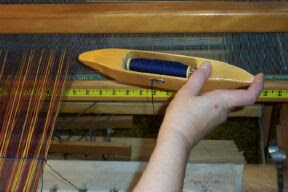


I didn't know what the word proprioception was until someone said I had it.  It's a 'fancy' word for body awareness, but not just being aware of one's body, but how it fits into the world, how it interacts with tools.

I came to weaving having been coached in various activities, and perhaps that stimulated my awareness.  Or perhaps I always had it and the coaching just enhanced it.  But regardless, I came to weaving with that awareness already fine tuned and when I began weaving with the express purpose of earning an income I realized very quickly that I needed to fine tune my movements.

So I analyzed what I was doing and constantly made tweaks in things.  I was fortunate in that I'd had a good introduction to ergonomic practices, so I didn't have to unlearn too many 'bad' habits.

Over the years I paid attention to how other people did things and when I saw techniques or tools that I felt would be 'better' than what I was doing, I took the time and effort to adopt the new information, tools, motions into my own practice.

At the same time I was trying to protect my body from repetitive stress injury because I also came to weaving with pre-existing conditions - injuries sustained before I began weaving, then another whiplash injury when I was in my 40s.

I've mentioned all this previously, but new readers don't necessarily have the time to go back in the archive, hence the quick recap now.

When I teach I try to convey to students how they must pay attention to their bodies.  But I also now know that not everyone has my level of proprioception.  So I explain, as best I can, how and why it is a good idea to work *with* one's body instead of against it.  

People also tell me I have a way with words, so I use my words to paint pictures while I do the motions, explaining what is going on in my body as I hold the shuttle cradled in my fingers, as opposed to holding it 'overhand'.    And so on.

Recently I saw someone comment, with photo showing what they were talking about, that when they weave they get blisters on the first knuckle of their finger.  I thought about that for a while wondering how on earth they could get a blister in that location, then realized they must be holding their shuttle overhand.  Because when I hold my shuttle underhand, by knuckles are rarely in contact with the reed.  Another argument for cradled in the hand, not held overhand?

Just this week, two people complained about how awkward and uncomfortable dressing the loom is.  Yes, it can be!  Especially if you are dealing with a 'broken' body.  

Try to find a loom that 'fits' you.  Not all looms are 'equal' - some are more accommodating than others.  Some are taller or shorter, with more room between the breast beam and shafts, harder or easier to treadle.  The 'best' thing to do is try before you buy, but that isn't always possible.  My next best advice is to buy second hand, and give it an honest trial, then sell it if it isn't working in a way that is going to be acceptable for you.

Take breaks.  I know people like me say this over and over again.  We say it because it is true.  It is much easier to prevent repetitive motion injury than recover from it.  Once inflammation has set into the soft tissue it can take weeks, months, even, to heal.  

Part of why I harp on this so much is that I hate to see people in pain.  I hate to hear that people cannot weave because of the pain.  

Check out the tag 'ergonomics' on this blog.  Check out my You Tube channel.  Check out the class on Long Thread Media, or my class at School of Sweet Georgia, or my book.  I harp on this all the time because I so frequently see people struggling.

The word 'efficiency' has a bad connotation when all it means is doing something with the least amount of effort or excess motion.  

In this day and age with personal time so scarce, it feels nice to go to the loom and walk away 45 minutes or an hour later, having made progress.  All I can say is, if you feel like weaving is just too complicated, too uncomfortable, too awkward, maybe it isn't weaving, but the particular processes you might be using.  There might be a better tool, a better process, a different way to do what you are trying to do.  

MY way may not be your way.  But maybe you can find a better way for YOU.  

Sunday, November 27, 2022

Red and White


latest tea towels cut off the loom, not wet finished

Cut these off the loom the other day, now begun the dark green.  The design is Snail's Trails and Cat's Paws, but woven star fashion rather than rose fashion.  

This is an example of the cross pollination between weavers.  Or maybe it is.  Because most weavers know this motif as an overshot pattern, where it was fairly commonly used in the weaving of coverlets.  As an overshot motif, all that is required is four shafts, while this twill block rendition needs 16.  Or 12 if you use a 1:2 twill instead of a 1:3 for the blocks.

The speculation is that overshot was developed as a way to get nice large designs with fewer shafts.  So far I've seen no actual documentation of this, but given this design appears to pre-date the overshot version, perhaps?

The design is found in a weaving manuscript that dates from around the early 1700s.  It isn't listed as being original to the author, and my best guess is that the designs in the manuscript pre-date the publication by quite some time.  The conclusion is that these designs were around for a while (100?  200? years) before the manuscript or pattern book was produced.  They may be much older.  I haven't done a deep dive into Keep Me Warm One Night by Harold and Dorothy Burnham, but they certainly have motifs of this type of design in their collection of coverlets.  One of these days I might sit down and see if I can find any evidence of how old the overshot versions are and see if the speculation is based on any kind of written documentation.

But that's the thing with textiles.  They are ephemeral.  They disintegrate (or did until synthetic fibres were produced) and not much of the textile record remains.

It was a great gift that Patricia Hilts gave the weaving record when she translated the books (there are two) and published the information in Ars Textrina.

With textiles such a scarce presence in archeological excavations, it has been hard to get much information.  And, dare I say it, respect from male practitioners since textiles are currently seen as 'women's work', therefore of little value?  Yes, even today among some.

There have been some books written about textiles throughout history.  Maybe one of these days I'll dig through the internet and see if I can find some of the ones I know about - and find some I don't.

In the meantime, I have Beverly Gordon's book that I really need/want to dig into, but just haven't have the mental wherewithal to sit down and begin.  What little energy I have gets spent on answering questions on the two websites I belong to, weaving, or thinking about weaving.  

Today we have a lovely sunny day (so far) but with warnings of colder temps to come.  We also have another crew coming on Friday to deal with the tub surround.  Another day I'll spend in the guild room with my hemming heap.  If I remember I may pull Elizabeth Wayland Barber's book Women's Work: the first 20,000 years and check her notes.  I seem to remember a rather long list of resources.  :)


Saturday, November 26, 2022

Unventing*


This is the beginning of me exploring a concept that I have been toying with lately.

It's not 'new' - I doubt much is actually new, as in no one has ever come up with this before, when it comes to textiles.  I have, in fact, played with the concept previously but set aside as other things took top of mind and energy.

At this point it's all very direct and not very complex, but I can see ways of playing with it to make it so.

One of the ways humans interact is to bounce ideas off each other.  I shared this with a friend who immediately started playing with it and came up with something far more complex, just by changing the tie up/treadling in a direction she had been exploring.  And came up with something much more dramatic than this simple proof of concept.

I have been mulling it over in the 'back of mind' way I do, and after thinking about it decided that I can continue with the current approach of 2/16 cotton at 36 epi and 2/20 merc cotton for weft.  There are fewer interlacements than the twill blocks I've been weaving, but that should not be a problem.  I'm only making tea towels, after all, and a little higher density (more ppi) won't be a problem.

I have nearly reached the half way point of the current warp.  This week kind of knocked me off my rails ending with the window guys coming on Friday to install the new window in the living room - a welcome notification, but one that left us scrambling to make room for them to come into the house and do the work.  Then putting things back to rights again.

It seemed better for me to simply leave the house, in case of covid, so I took my hemming to the guild room and managed to get the black rayon chenille scarves hemmed at long last - the log jam in my getting any hemming at all done as I was forcing myself to do the scarves first.  But they are done now, and who knows, may show up in my ko-fi shop on Monday, since there are still rayon chenille scarves in the inventory for the guild sale.

So the goal today is to get back on track after barely getting to the loom last week, finish off the current warp, then set up for the new design.  I still have to crunch the motif to fit into the width of a tea towel, and if I'm happy I will start tinkering with the threading/tie-up/treadling for the next warp.  I won't run out of yarn any time soon - I 'found' the other box of 2/20 merc cotton that had been shuffled once too many times and was hiding beneath boxes/bins of 2/10 merc. cotton.  A box of dark almost black navy blue.  On top of everything else I was beginning to worry I'd never get used up!  At 8400 yards per pound, each towel taking about 900 yards, I have enough yarn to last me all of next year - and perhaps beyond.

*unventing - a term coined by Elizabeth Zimmerman when she came up with a concept but didn't want to claim it had never been done before

Thursday, November 24, 2022

Sands of Time


photo of an ornate hourglass

As the climate changes, we see how things are no longer the way they were.  The thing that doesn't change is the slow march of the sun across the sky, north, then south, then back again and how that changes the length of daylight in our days.

We have had a string of dreary overcast days with temps higher than 'usual'.  Apparently that will change as the temps are set to plunge according to the Weather Network.  Will this bring clear skies?  Who knows, these days. 

It used to be that colder temps meant beautiful clear skies with brilliant sunshine.  Now?  Not so much.

As I get older, I find I have even less energy than ever and the sands of time seem to run through the clock ever more quickly.

As Bonnie Raitt put it, time becomes more precious the less of it you have.  (I paraphrase.)

I look at my stash and despair of ever getting it all woven.  OTOH, I still have fibre dreams.  Combinations I'd like to try.  Designs I would like to weave.

I've promised a project to go with the lace workshop on SOS and last night pieces I had been moving around seemed to fall into place.  Today I'll drag out the boxes of 2/10 yarn and see what colours I have and if I have enough to make something pleasing.  Until I see how much I have of the various colours in my stash, I can't make any final decisions.  So I'll work on that over the next few days.

In the meantime I'm making slow (but steady) progress on using up the 2/20.  I'm pleased - so far - with the quality of cloth that is resulting.

OTOH, we've just now been told that the window guys can come at 8 tomorrow so all my plans for today and tomorrow have gotten tossed.  Good thing I'm flexible????


Wednesday, November 23, 2022

Books!


Someone mused on line about books about Canadian textiles/by Canadian authors.  I started thinking about my learning curve, which began in 1975, and the history of handweaving in Canada.

This is not meant to be a comprehensive list, just what I can remember off the top of my head.  It will attempt to be somewhat chronological, but I don't know the actual publication dates of some of the books, so don't take the order as any kind of 'gospel'.

The first author I think more Canadians ought to be aware of is Oscar Beriau.  He is much better known in Quebec than the rest of Canada and I think he ought to be better known and his pivotal role in the development of Leclerc Looms should be recognized.  His grandson has created a lovely website which outlines M. Beriau's many accomplishments, including assisting weaving groups on the prairies.

Mary Black.  Ms. Black is very well known, but what may be less well known is that her roots are in Nova Scotia and her papers were archived online.  She, along with Mary Sandin and Ethel Henderson eventually set up the Guild of Canadian Weavers and the master weaver certificate program.  Last I heard, 29 people had successfully achieved the master level, with many more working on the other three levels.  This is a self-directed approach to learning - and testing - one's knowledge of weaving and it is not 'easy'.  Anyone who achieves the master level has invested a lot of time and energy into it.  

Ms. Black's book The (New) Key to Weaving is still around, and while dated in terms of graphics and approach, is still my go-to when I have a four to eight shaft weaving structure question.

Robert Leclerc.  M. Leclerc wrote a small book on how to weave as a support for people purchasing Leclerc Looms.  The booklet is now available as a free download from the Leclerc Looms website.  He also acquired the newsletters produced by T. Zielinski, sorted the information according to topic and then produced the Master Weaver Series of over 20 small booklets that are chock full of really good information.  Those books are still available for sale on the Leclerc website.

As people began completing their master level program, some of them began writing books, some of them as a direct result of their master level monograph.  

Nell Steedsman did several booklet type publications as did Grace McDowell.  Dini Moes (the only person I know of who achieved the GCW master, Boston Guild master AND the HGA COE certificate) published a book with swatches called Uncommon Threads.  All of these are now out of print but still reside in many guild libraries.

Linda Heinrich wrote The Magic of Linen, Jane Evans, A Joy Forever, Mary Andrews did a small run self-published book on fundamentals of weaving and of course I wrote Magic in the Water, then The Intentional Weaver.

Carol James has written about sprang and finger weaving.

Not weavers but historians, Harold and Dorothy Burnham became very well known for their book Keep Me Warm One Night, about coverlets, and Dorothy went on to write several other books including Unlike the Lilies about Doukhobor textiles in western Canada.

Paula Gustafson wrote about Salish Weaving (there is an older booklet but I can't pull the author's name up right now) and the Museum of Anthropology at UBC (Vancouver) has done some stunning exhibits around coastal First Nations textiles.  Cheryl Samuel has also written books about Chilkat weaving.

I'm not too familiar with knitting, but Sylvia Olson has written about the role of knitting in coastal First Nations culture and society.

Stephanie Pearl-McPhee is well known for her books on knitting.

As for magazines, there have been a number over the years.  Loom Music in the 1950s and into the 60s I believe.  Heddle, a short lived publication that I contributed articles to from time to time, until it faded away.  Now we have Digits and Threads by Kate Atherley and Kim Werker.

I am sure that there have been many more, smaller publications, regional publications, but these are just the ones I could pull out of my memory this morning.

We must keep our history alive and one way to do that is to remember those who have gone before.  Books are one way of keeping history at our fingertips.  

Monday, November 21, 2022

Coles Notes


Coles Notes

I honestly had no idea Coles Notes was a Canadian 'thing'.  They were just there, for most of my student life and I assumed everyone had them.  

So I was going to write a blog about my answers on social media forums as being like Coles Notes, but then realized younger folk might not know the reference, so I Googled it. 

Wow.  My how things have changed!

Anyway, back to my personal version of 'Coles Notes' - my answers on social media.

Social media isn't a great place for deep dives into subject matter.  Even here on my blog, I tend to write out quite specific information.  So when people ask questions online, what they tend to be looking for is an answer to a very specific circumstance that is causing them issues.  When I answer such questions I don't always share what I do, particularly, but try to just answer their question.  In Coles Notes form.

Even in my book, I wasn't able to write it ALL down.  If I'd tried I would never have finished writing the damn thing!  As it is, since the book was published I have continued to learn more, so the book is still just a 'snapshot' in time of what I knew - or thought I did - when it was written.

My lectures on SOS actually wind up more targeted and in depth, in part because I have a live audience who can ask questions at the time of recording, and I'm happy to expand when someone wants to know more.  The lectures are themed around specific principles of the craft and I am able to connect the dots between that theme and other aspects of weaving.

Generally the lectures last about two hours.  That's enough time for most people to feel saturated and unable to absorb more (which is where the recording comes in handy - they can go back and review the lecture as many times as they want) and myself wrung out from trying to stay on track and keep my language fresh.

The lectures tend to include lots of textiles as examples of what I'm talking about, too.

For guild I can pare down my lectures to around 60 or so minutes, but that usually means I tend to rush through.  If guilds want the full two hour experience, I can do those as a 'seminar'.

My relationship with SOS will continue for at least all of next year.  The woven lace workshop launches in July (at least that's the schedule right now), and in August I've agreed to do a Q&A with anyone interested.  I'm looking forward to more interaction with the students and hopefully guide them through anything that remains obscure.

I'd like to remind folk that my books are still available at blurb.com, and signed copies of The Intentional Weaver are at Sweet Georgia Yarns website.  Last I looked they still had lots of copies.  Might be a nice xmas present for a weaving friend?  


Saturday, November 19, 2022

Possibilities


The view from the back of the loom, poised to begin weaving the new warp, is quite satisfying.

I once did a seminar on weaving drafts, explaining how a threading draft can be manipulated, how I have made co-ordinating fabrics all on the same warp by changing the weave structure, changing the tie up, and the treadling sequence, AND the weft yarns and someone mused "so you're saying a threading is just a set of possibilities?"

YES!  Yes, that is exactly what I was saying.  But sometimes just *saying* that doesn't make any sense until people understand what a threading sequence is, and that you can change how you use the combinations within a particular sequence to create an effect.

People do not always realize that how we write drafts today is different from how people used to write them.  They also do not always grasp that for hundreds (thousands?) of years, weaving knowledge wasn't written down, but passed on through the transference of skills.  There are still cultures today that largely do the same thing because paper is scarce or difficult to store without it deteriorating.  So the knowledge is learned, then passed on to the next generation by showing how it is done, and a language that encodes the knowledge in a way that makes it easier to learn.

I get testy when I read books or watch a tv program that blithely dismisses the work of our ancestors as 'primitive' - or worse, ascribes what our ancestors have done to 'aliens'.  If someone takes the time to look back at history, accept that complex chemistry was being performed with little help in terms of *technology*, but great skill in the application of systemic knowledge, we would have nothing but the highest respect for our ancestors. 

Over the years I have tried to learn as much as possible about the history of textiles.  But that is a vast pool of knowledge, because every human around the globe was dependent, one way or another, on fibres for all of human history.  The current level of knowledge is pushing the start date of working with fibres back further and further, but if you, too, are interested, you could begin with Elizabeth Wayland Barber's book Women's Work; the first 20,000 years.  Her book was published in the 1990s, and new finds are pushing that date back to 30,000+ years.  

There are dozens of books about different cultures, many of whom are still making textiles in the traditional ways, but may be incorporating something of the present in their textiles.  I'm thinking of the tanks in the rugs made in Afghanistan, for instance.  There are other examples, but that one hit me hard, at the time.

But ultimately, when I go looking for books on cultures and history, I pay attention to the attitude of the author, in part because I was taught to watch the language being used, and to look for editorial bias.  When I read a book that talks about ancient dyers being 'only' craftspeople, not scientists?  I think about how many years indigo has been used as a dye stuff, and how for centuries dyers were able to develop colours, reliably adjusting the pH of the vat to achieve specific colours.  I think about the ancient dyers who extracted the 'royal purple' from mollusks through a complex process.  They may not have had the words for things like pH balance, but they knew what it took to make the colour and apply it to not just one type of fibre but both protein (silk) and cellulose (linen).  They may not have had 20th century science language, but they had the skills.  And to disrespect them by calling them *just* 'craftspeople' and raise up the 'scientists' - who were doing basically the same thing - trying things until they found something that actually worked, is to disrespect our ancestors.  

So I continue to look for books that celebrate our past and our ancestors and their knowledge.  I have not read all of the books there are, but I will focus my time and attention on those authors who also have a deep and abiding respect for the shoulders of giants we all stand on.

And if you want to know my approach to weaving, the latest lecture on weaving drafts has been posted to School of Sweet Georgia.  My two classes are also available, and I now have a release date for the next class, which will be in July.

And of course my books are still available on blurb.com or signed copies can be purchased from Sweet Georgia Yarns