Monday, November 25, 2024
Sampling
Sunday, November 24, 2024
Attitudes
For most of my life I have lived with inclusivity. I choose to help people, as much as I can. Sometimes I have the resources to help more, sometimes less.
If that makes me 'woke', then I will wear that label. But I don't declare that I am an ally because I feel the people who need support have to choose who they trust, who they consider a friend...an ally.
Because sometimes I come up against my reality bubble. And I forget that my reality is not another person's.
I'd like to think that - in the same way as I consider weaving is fraught with 'it depends' scenarios - life is, too.
It's one reason why, I think, that fairy tales have so many stories featuring textiles as part of the story - Sleeping Beauty pricking her finger on the spindle, Rumplestiltskin furiously spinning flax into gold, The Swan Princes - which is really about their sister, harvesting, processing, spinning and weaving magical shirts to turn her brothers back into humans after being magically turned into swans.
And so many more.
We can learn so many lessons via the craft of weaving. (Probably through other crafts, as well, but weaving is what I know.)
It depends. If you can't be perfect, be consistent. Embrace the transformations that are necessary to reach a 'finished' state.
Etc.
I'm living with all sorts of challenges right now, and it is very easy to lose sight of the benefits of living to this age. I have lived a life of 'heavy' work (If you have never woven like a production weaver, you don't really know how *much* labour is involved.) The problem of remembering what I used to be able to do, and adapting to how much less that is now, is a difficult transition. But I'm working on it.
Changing my attitude is the hardest thing! Letting go of what has already left. Embracing what I *can* do instead of kicking the baseboards over what I cannot.
This latest, um, challenge? - has been incredibly difficult to face. I'm glad I had the opportunity to talk to the surgeon, who gave me the attitude I need to hold onto - that most people have a much more challenging prognosis that I have been given.
I think the biggest benefit this 'fall' has been the attitude adjustment. Don't get me wrong, I'm not entirely there - yet! But I am working on it. And as I work on it, I become more 'woke' (if you will) about the challenges that people who are wheelchair users, or have difficulty walking. I am making progress, but I also have the damage to my spine/lower back.
So, I keep going, to the best of my ability, to not only see others with my type of physical challenges, but ultimately to realize that *everyone* has challenges of one kind or another.
Ultimately I hope that I will be aware of those beyond just me, to others in society dealing with things - things I may not understand, or have personal experience with. But challenges, nonetheless.
If that makes me 'woke', I will wear that label.
Saturday, November 23, 2024
Mastery Doesn't Mean Perfection
Like pretty much every other craft out there, just because you have been accepted as having a high level of mastery in said craft, doesn't mean you never make mistakes.
Shocking, I know!
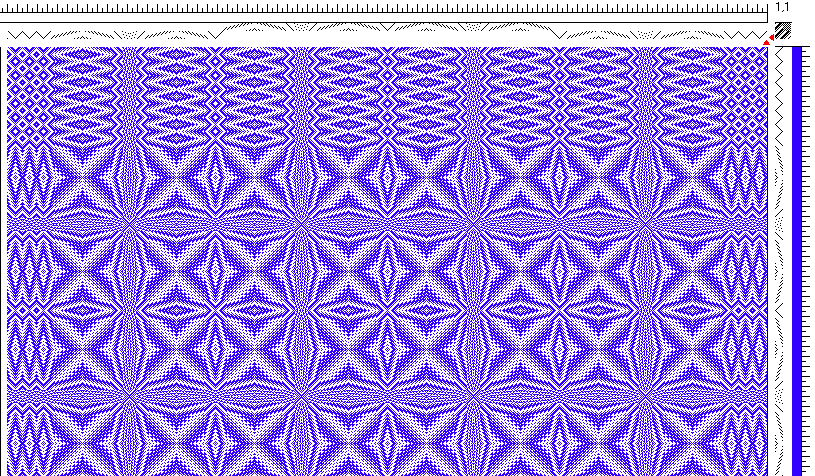
So I designed a warp for sampling for an article, then once the samples were woven I cut them off, wet finished them, decided I had enough information from that warp and switched to weaving the rest of the warp in tea towels.
Then set about weaving those tea towels. Until yesterday as I was just finishing towel #2 and I finally spotted the mistake. Turns out I'd made *two* mistakes in the treadling sequence, not just one. If it had been one, at the halfway point in the weaving, I would have called it a design feature, but nope. I had made a second one near the end.
I finished that towel and stopped weaving for the day, then checked my treadling,. Which, when I looked, very clearly showed the mistakes. I had been too tired, or too distracted to notice it while I was editing the treadling sequence, apparently.
Either that or one of the brain bleed 'holes' had opened and I totally missed it.
After thinking about it all evening, I decided to continue, despite the mistakes, but when I got up this morning I decided I needed to fix it.
I knew what I'd done, I pretty much knew how long it would take to edit again, and now aware of the 'hole' (and not tired from a day of errands and weaving) would pay particular attention to making sure I did it right this time.
I managed to weave 1.5 towels today. I was given permission to increase my weaving time to 45 minutes *if I felt up to it*. and I have been taking runs at getting closer. Today I did about 35 minutes the first session and 44 for the second.
Now I'm tired (again), and I'm thinking of laying down for 45 minutes before I start dinner. I used to sleep 9 hours a night but over the years my body has gotten to the point where it can only manage about 6 hours. It's not nearly enough and I have finally gotten comfortable with taking afternoon naps. Hopefully by spring I will recovered enough that the naps will be fewer, but que c'est sera, sera (however that's spelled).
Friday, November 22, 2024
It Depends!
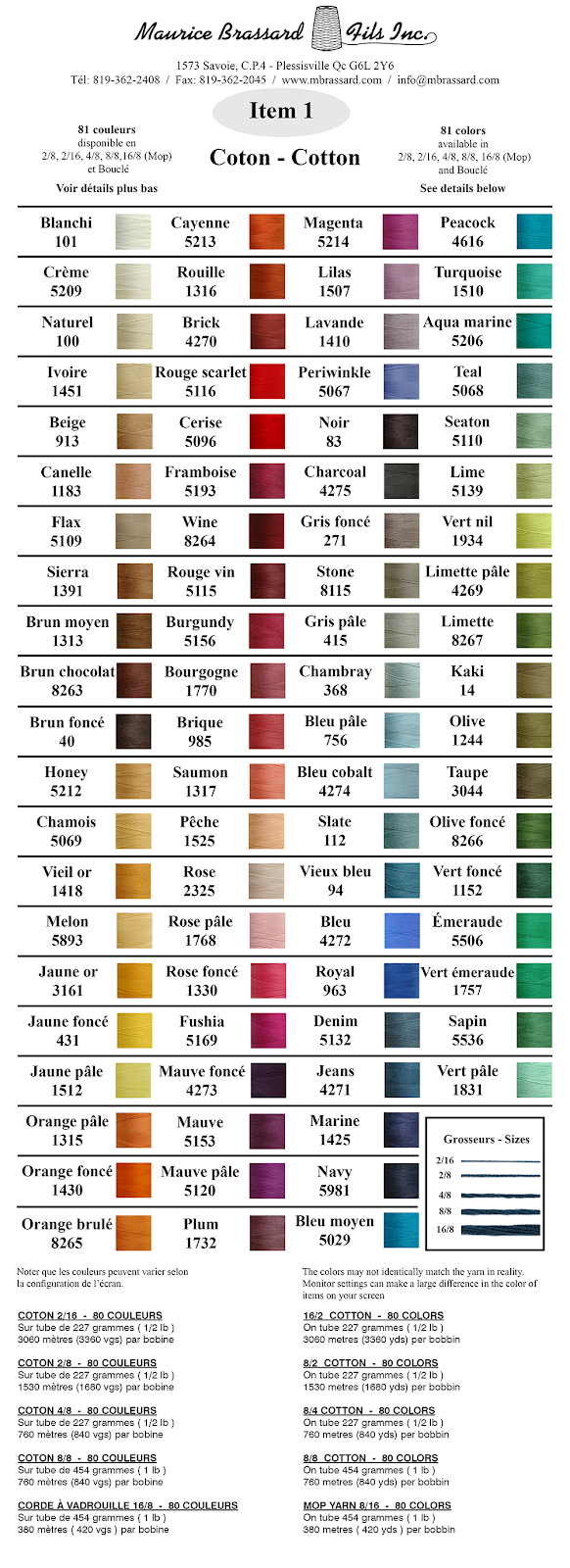
Yesterday I saw a conversation online about the 'proper' epi for a particular size of yarn woven in plain weave. As usual, some people strongly urged people to use 20 epi, others strongly advocated for 16-18 epi. Most people were calling it 8/2, so I could only assume that they were using and talking about US 8/2 cotton, not Brassard's 2/8. (In the photo above, the rust yarn is Brassard's 2/16; the teal is US 16/2 cotton.)
Why do I call Brassard's 2/8 instead of 8/2? Is it merely because I'm Canadian and 'contrary'?
Not entirely. (Although I freely admit to being 'contrary' at times!)
It is *because* I am Canadian and the first cotton yarns that I was introduced to were the 2/8 cottons from Brassard, South Landing and Curl Brothers, long before I was introduced to US 8/2 cotton. At the time I had been very confused at how many USians would turn their noses up at 2/8 (or as they said, 8/2) cotton.
Once I was able to see the yarns, side by side (in my own mind, if no where else), I came to understand why the USians preferred other yarns - all those lovely mercerized yarns which were spun ring spun, and then treated to have that sheen so typical of mercerized yarns.
Many USian weavers also referred to 'Perle' (or Purl) cottons as if they were a 'type' and all exactly the same. (For example, check out Astra mercerized cottons compared to other mercerized yarns - they are not the same, either.)
It is why, when I answer a question, I will inevitably begin by saying 'It depends.'
That US spun 8/2 cotton is NOT the same quality as the 2/8 cotton (usually called 8/2 now, but if you look at the Brassard website on the French page, they *still* call it 2/8.)
I know you probably can't see it on this tiny image of their colour card, put it's still there, 2/8, just like when I started weaving back in 1975.
The thing is, open end spun and ring spun yarn are not identical to each other. They have different natures/characteristics. (If you are a long time reader of this blog, this is a repeat for you - but I've had some new readers join since getting involved with BlueSky.)
I've written about this elsewhere and here, else when. As a weaver, one of the things that helps to know is the nature of your materials. If you don't understand their nature, it's a lot more difficult to chose the various things that have to be decided on as you go through the design processes. (More info on this in Stories From the Matrix and The Intentional Weaver.)
I am, right this time, sampling for an article I am going to be submitting to WEFT magazine. My first sample turned out for one weft, not so well for the second one. My decision to try again was set in concrete when I realized (belatedly) that I'd made a tie up mistake when I designed the 2nd option.
I anticipated that I would need a second warp to test a different epi based on the very different natures of the two wefts, so when I discovered that I did, indeed, need to set up a second warp to test the lower epi, I wasn't particularly upset. It was Plan B all along.
Given the hours it may take to design a new warp, there is a reason I want to set the loom up to weave quite a lot of it. The design hours get 'amortized' over a larger number of finished items.
As for the balance of this first, tentative warp, it is being woven off as tea towels, using the 2/16 cotton weft. They have great drape, which is desired in a tea towel. They will likely be listed in my ko-fi shop late December or early next year. I do still have to weave, wet finish, and hem them, after all.
Doesn't matter how 'efficient' you may be, you are still weaving 'slow' cloth...
Thursday, November 21, 2024
Oops.
I wove some full-sized samples, then wet finished them. Yesterday I pressed them, and was relatively pleased. Decided I needed to try one of the versions on a 30 epi density, and then carried the 'samples' upstairs to hem them.
While I was taking a closer look to determine exactly how much of the cloth was going to be used in the hems (in case I needed to cut any 'extra' off the sample - because I was sampling the entire process) I noticed something I had not, up to that point.
On the one set of samples, I had done the treadling incorrectly. It didn't actually show unless I was looking at the back side of the cloth, at the right angle.
Since I had been thinking of re-doing them anyway, I sighed, put the two that were 'wrong' aside and wrapped my head around the fact that I had done the treadling draft incorrectly.
Now, it's not very obvious, but once seen cannot be unseen.
I had already decided to weave off the rest of the warp in the first treadling, so dealing with re-creating the second treadling - this time sans mistake - can wait for a few days until I feel able to re-do the entire treadling, and this time make sure I don't have a treadling error. Oh well.
Truth to tell, I hadn't been entirely satisfied with that sample, anyway. I had a broken warp thread, and the centre field expanded in comparison to the pattern woven as a 'frame' around the edges. But the quality of the cloth is good, and I now have enough information to go ahead and set up the next warp at 30 epi and weave two more 'samples'. And this time, without the errors?
One hopes.
And that's the thing about weaving. It will always, always keep you humble!
Wednesday, November 20, 2024
Designing Textiles
Tuesday, November 19, 2024
It Isn't Finished Until...
Saw somewhere on line a knitter asking if you really *have* to block your knitting and one response saying no, not really.
Unfortunately wet finishing (blocking) a knitted structure will provide some changes as it reaches its finished state. With knitting it is less noticeable in some items. And some knitted items really need to be blocked as part of it's finishing - primarily lace knits, but also other items. For instance a knit that is primarily stockinette stitch will tend to curl on the edges. Wet finishing it should fix that. Other knit stitches may cause textures that are not desirable, as well.
Anyway, I'm weaving full sized 'samples' to check to make sure the cloth will turn out the way I want. If they are successful, I don't need to weave more as these 'samples' will be elevated to 'finished' and I can move on.
I'm trying to get through my inbox because several things had stacked up due to my not having the spoons to deal with them. As usual, they were less of a bugabear than I had expected, which will be teach me nothing - once more.
On the other hand, I was able to weave the two 'full-sized' samples yesterday - the longest I've woven since the brain bleed. Partly I just really wanted to get them both done, and partly I knew it was going to be slow weaving (technical reasons) and partly it just felt so good. So today I want to weave the second pair of full-sized samples, cut off, and wet finish and then see if they are going to be acceptable.
One thing about the face plant and all that followed is that I seem to be out of 'production' mode. Weaving to illustrate articles puts much less deadline strain on me (if I do things in a timely fashion!) and it is letting me do the kinds of things I had not been able to do because the production always had to come 'first'.
I have no idea if the guild sold much of my stuff at the first craft fair, or the second one, or if they will sell anything at the guild room sale. By slowing down my productivity I will have less stuff that needs to be sold. Given my lack of energy I don't much feel like steaming my way through a 20+ yard warp anymore. Perhaps that's not a bad thing...
Information on wet finishing available here as well as Long Thread Media and School of Sweet Georgia
PS - with Canada Post on strike, any orders placed via my ko-fi shop will be held and shipped when they settle their contract.