
There was an article online that was titled something about knitting being 'grannycore'. Assuming it was filled by pap about grannies being the 'only' knitters, I ignored it.
Personally I learned to knit at age 5 and I know I'm not the only one. Just because I am a knitter in my dotage, doesn't mean I started knitting recently. I've been doing the craft (as well as others) for a very long time. I've done complex cables, fancy ''Fair Isle", I have even learned how to turn a heel - in spite of the pattern having an error in it and my figuring out that it wasn't me, but the pattern.
And that was before I started weaving. Which again, I started practicing at 25, not waiting til my dotage for that, either.
The above towel was finished in October of last year. It was the warp I had on the loom when I fell and this warp was an integral part of my recovery/therapy. I kept on going for a number of reasons, no matter how many mistakes I made because my brain didn't brain very well. Eventually I pared back my expectations of being able to cope with complex threadings (I was making several errors per warp and was getting angry at myself for having made them).
I also continued to write, with enormous support and help from a friend, who continues to cheerlead and do my 'alpha' reading so that WEFT editors don't get my raw attempts to make sense. Since my friend is a good weaver as well as a good friend, she usually can spot what I *meant* to say and will provide me a 'sensitive' edit.
So when someone who (probably) knows zilch about knitting and other 'grannycore' crafts expresses shock and amazement, I keep scrolling.
Weaving is the most broadly based science that I do. It is a combination of understanding the diverse and extensive list of different kinds of science that weaving contains. Because I was intrigued about what was happening and I wanted to know why.
The physical skills are full of the science of movement and how the body works - or works 'better' if it is used in a way that incorporates ergonomics. The more efficient you become, the less you tend to harm your body by doing repetitive motions in a way that invites inflammation.
The science of textiles looks at the materials that are used - understanding the characteristics of the different fibres so that they can be used appropriately to create the quality of cloth desired. If you spin, or dye, there are even more sciences used in those.
Mathematics. Calculating dimensions, understanding the fibres being used and how they will react in the woven web, and in the water during wet finishing. Then calculating how much of the yarn(s) will be required. If you are running a business, scheduling is imperative so that you aren't 'down' while waiting for your yarn to arrive.
Setting up your studio to make multi-tasking possible - figuring out the best way to approach needing the work to 'flow', one task into the next, with the least amount of massive re-tooling your space every time you change a task.
And so on and so on. Weaving is considered a 'textile science' for good reason. I should pull all of my science books off my library shelves, just so you can see how many I actually have - *and use*.
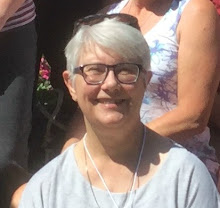
So, my hair might be grey, and my age would indicate that I am old enough to *be* a granny - I have been hard core weaving for 50 years now.
With luck, I will be weaving for a few more. With luck, I will still be writing about it, too.



1 comment:
You've inspired me since I first discovered weaving around 17 years ago. I learn so much from you and love reading all the words of wisdom contained in your blog. Used to stop in PG on the way to visit my sister in Terrace. She's not there anymore, otherwise I'd be knocking on your door while passing by, hoping to share a cup of tea with you. Thank you for all your contributions to the weaving community. Wishing you continued healing and good health.
Post a Comment